


Published : 25 Oct 2013, 02:10 AM
Updated : 09 Aug 2022, 11:14 AM


This aid has contributed to trade policy and regulations in the country and but not to infrastructure development and capacity building, according to the report.
However, the amount of trade aid Bangladesh received has not helped its development, as donors are withdrawing the aid given on many excuses, says the report: ‘Effectiveness and Impact of Aid for Trade Initiative in Bangladesh’.
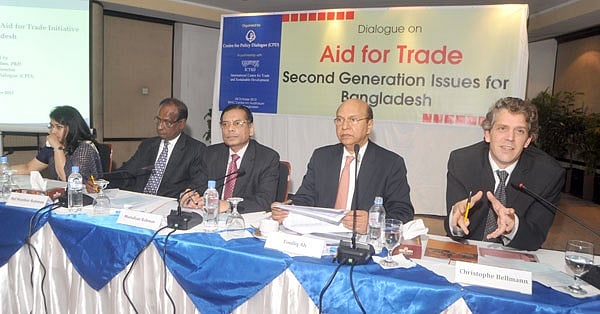
CPD Research Director Fahmida Khatun presented the report at a meet held by the think-tank, titled ‘Aid for Trade: Second Generation Issues for Bangladesh’, at BRAC Centre Inn Auditorium in Dhaka city on Thursday.
Though the Aid for Trade (AFT) was designed to support trade-related capacity building towards strengthening global integration of the LDCs, its effect has been mixed in Bangladesh, he said.
According to the report, the world saw an AFT growth of 77.2 per cent in infrastructure, while, for Bangladesh, it dropped by 20 per cent in 2006-11 fiscal.
In the same period, the world had an AFT growth of 56.03 per cent in capacity building, while it went down by 44.81 per cent in Bangladesh.
But the picture of trade policy and regulations was found to be good in the CPD report.
Bangladesh had an AFT growth of 686.03 per cent in trade policy and regulations while the world figure was 59.54 per cent.
The CPD director said Bangladesh had begun receiving an increasing amount of AFT since 2002 but it had decreased by 28.68 per cent on an average from 2006 to 2011.
In the same period, the AFT had grown by 67 per cent on average.
CPD Executive Director Mustafizur Rahman presided over the meet in which BFIT Executive Director Mozibur Rahman and and CPD Distinguished Fellow Debapriya Bhattacharya spoke.
Mozibur Rahman said Aid for Trade is not being effective in developing countries, like Bangladesh, as developed countries look at developing nations as consumer states only.
Officials from the developing countries get the scope for education tour and shopping at bigger malls only, through technical projects in the name of training abroad, he said.
Debapriya Bhattacharya said, “Donors attach many conditions while providing technical aid to developing countries.”
“They also made it compulsory to appoint a consultant and purchase all the things related to the project from the donor countries, which stand in the way of proper use of foreign aid locally.”
The CPD Distinguished Fellow demanded unconditional Aid for Trade to remove all that stands in the way of implementing a project locally.
World Bank South Asia Regional Integration Lead Economist Sanjay Kathuria said it would not do if Aid For Trade was confined only within the boundary of Trade Policy and Regulations.
Internal employment had to be created. Besides, boosting expertise in trade development was also important, he said.
Former Commerce Secretary Sohel Ahmed Chowdhury, who also spoke at the CPD dialogue, criticised the World Bank.
He said there were bad experiences in receiving donor money. For instance, most money of the World Bank had to be spent on appointing the World Bank consultants in Export Promotion Project.
These trade aids are used neither in infrastructural development nor in increasing productivity. Rather, most of the aid is used in the name of training and travelling abroad.
Dhaka Chamber of Commerce and Industry President Sabur Khan said, “The government frames policies at different times for increasing export, but private investors have little say at that."







