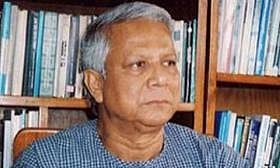
ড. মুহাম্মদ ইউনূস (ফাইল ছবি)
ড. মুহাম্মদ ইউনূস (ফাইল ছবি)
Addressing Yunus, Zafrullah Chowdhury, founder of nongovernmental organisation Gonoshasthaya Kendra, at a programme on Monday said, "The articles you are writing, the problems you are mentioning, there is no other way to solve those in a non-political way."
"So stop saying sweet words and join politics with courage," he told the former Grameen Bank Managing Director.
However, after the programme in Dhaka earlier, when journalists asked for his response to Chowdhury's call, Yunus simply avoided the issue by saying, "I don’t want to say anything outside my speech in this function."
But his brother, Muhammad Jahangir who was there ruled out the possibility of joining politics. "No chance," he said.
Independent research organisation Power and Participation Research Centre (PPRC) organised the discussion at a hotel at Gulshan in the capital. The discussion was on the recent building collapse at Savar which has left over 1,100 people dead.
Former caretaker government advisor Hossain Zillur Rahman is the founder of PPRC. He also moderated the discussion.
Several advisors to past caretaker governments also spoke at the programme. Yunus was also one of the advisors in the Justice Habibur Rahman-led 1996 caretaker government.
The two major political parties are at odds over the nature of government to oversee the next general elections. Rumours have it that the ruling and opposition parties are reaching a possible understanding.
The BNP wants the caretaker government system, annulled in 2011 through the 15th Amendment to the Constitution, be reinstated while the Awami League proposes an all-party interim government.
Some media have reported that leaders of both parties have been unofficially talking on the issue.
Yunus had also taken initiatives to form a political party named 'Nagorik Shokti' in 2007 after the military-backed caretaker government had come into office.
Many politicians including Awami League President Sheikh Hasina and BNP Chairperson Khaleda Zia were also arrested at that time during the anti-corruption drive of that government that allegedly attempted to send the both leaders to exile.
Yunus had reportedly broached the idea of ridding Bangladeshi politics of them.
According to a secret US embassy cable sent on April 16, 200 and exposed by the Wikileaks, Yunus had told Geeta Pasi, the deputy head of mission, on Apr 8 during the military-backed caretaker government, the "two ladies" had to be removed from politics.
He then jokingly, as the cable notes within parentheses, made a suggestion for the disposal of the two leading ladies: "maybe sent to work for the UN?"
The Awami League-led coalition government annulled the provision in June 2011 upholding the doings of the caretaker government and to prevent these from happening again.
The government says 'this will stop the unelected individuals from fulfilling their political ambitions'.
Yunus was also stripped of his position of MD of Grameen Bank during this government's tenure and he lost the legal battles before stepping down.
After that, western countries including the United States had ‘asked' the Bangladesh government to return his 'respect'.
A frustrated Yunus also dubbed the government move as 'political vengeance'.
On Monday at the dialogue on 'Savar Tragedy, Labour Welfare and Possible Economic Crisis: Things to do' , Yunus spoke about his recent article written over the worst ever building collapse in the world.
In that he said, "For Bangladeshis, the tragedy at the garment factory in Savar is a symbol of our failure as a nation. The crack that caused the collapse of the building has shown us that if we don't face up to the cracks in our own systems, we as a nation will get lost in the debris."
He also made
some suggestions
to avoid such accidents in the future.
British daily The Guardian published the article on Sunday headilined, ‘After the Savar tragedy, time for an international minimum wage'.
Yunus on Monday started his speech following his article.
He said, "The garment industry can be called the base of the modern Bangladesh. But it will be a mistake if we see it only as a business structure. This sector is the centre of national economy."
"But this sector must be considered from social purview too, not just economic. Because at least four million of women work in this sector."
"The matter must be seen from a doctor's point of view. The problem is treatment is needed. Not blaming. And if the garment industry is the base of modern Bangladesh, then the workers must be given the chance to become modernised. They must be paid fairly," Yunus stressed.
He continued, "According to the Pope, there are four million slaves. We must not turn them to slaves for real. Their wages must be at least that much to lead a happy life as humans. So that we can tell the international arena that, 'we don’t want to live like slaves, but like humans. And we don’t want to build our economy by selling the labour of slaves'."
"We are discussing this at a time when dead bodies of workers are still being pulled out from the wreckage at Savar. And this is one of a kind incident which we won't be able to forget. If we don’t come to our senses and change even after this huge incident, then shame on us."
Of the other former caretaker government advisors, Prof Rehman Sobhan, Jamilur Reza Chowdhury and Golam Quader also spoke at the discussion. US Ambassador Dan Mozena also addressed the dialogue.