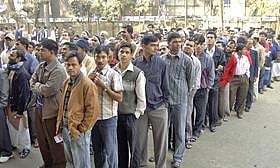
'Youth against polls under present govt'
A survey says the country's youth perceives police and judiciary as the most corrupt institutions
bdnews24.com News Service
bdnews24.com
Published :
09 Aug 2012, 04:55 PM
Updated :
09 Aug 2022, 04:06 PM
Dhaka, Aug 9 (bdnews24.com) – Bangladeshi youths, who are believed to have played a decisive role in the last elections, have objections to staging the upcoming national elections under the ruling party, according to a survey.
Released at a seminar on Thursday, the survey that comes amid ongoing debate as to who will oversee the next elections, has some startling revelations to make.
It says youths aged between 15 and 30 want to see political parties respect each other and a 'strong' Election Commission in Bangladesh, as the word democracy means 'free and fair election' to them.
The BRAC University's Institute of Governance Studies conducted the nationwide Bangladesh Youth Survey in December 2011 among 6,575 youths, with almost equal number of male and female, to get 'an in-depth understanding of youth and their demands'.
Analysts present at the primary dissemination at BRAC Centre termed the findings 'significant' for Bangladesh.
"It's a significant signal," Secretary of Shujan –- Shushashoner Jannoy Nagorik -- Badiul Alam Majumder, told bdnews24.com.
He said young voters comprised one-third of the total voters in the last election and 'they brought the mega alliance to power'.
The government must consider their views, he felt.
The ruling Awami League-led Grand Alliance came to power following December 2008 elections riding its charter for change, which was dedicated to woo young voters, who were believed to bring the landslide margin for the present government.
The election was held under a non-party caretaker government, a constitutional provision that the present government scrapped after assuming power.
As the main opposition BNP repeatedly demanded for revival of the caretaker government system, Prime Minister Sheikh Hasina had said that the opposition could join an interim cabinet to be constituted ahead of the next parliamentary polls.
Majumder, a keen observer of elections himself, said: "They (young voters) are not loyal to any party. They are swing voters. If they don't like activities of a government, they will not vote again."
The survey, however, shows only 2 percent have reported their affiliation with political parties.
"But we think it's under-reported because people are reluctant to speak of their political affiliation publicly," said Syeda Salina Aziz, a senior research associate closely involved with the survey.
She said over 80 percent responded that students should not be involved in politics, but 45 percent felt youths could take part.
Salina Aziz, however, could not specify immediately what percentage of youths in the survey were objected to staging of elections under the present government, as it was primary dissemination of the findings and political aspects were not the only focus of the survey.
"A major percentage had objections," she said.
With regard to corruption perception, the survey says youths perceive police and judiciary as the most corrupt institutions.
They feel crimes like murder, drug and alcohol abuse, dowry and personal property rivalties plague Bangladesh, and trust much-in-news Rapid Action Battalion (RAB) more than the police force.
To them, health, finding employment, and getting quality education are the major challenges before the nation, the survey finds out.
Of the total respondents, 45 percent were married with mixed occupations – students, employees, housewives and self-employed.
Getting better qualified teachers in their classes was the top priority to them while they gave less importance to revising curriculum and introducing school meals.
Only 34 percent of the sample youth had work experience -– paid or unpaid, while their skills on computer and internet were found 'low' despite high connectivity with mobile phones.
Barrister Manzoor Hasan, an adviser of the Institute of Governance Studies, termed the survey findings 'thought-provoking'. "Policymaker and politicians must wake up and take the issue very seriously," he said.
Citing youths' contribution to the formation of Bangladesh, United Nations Development Programme's Country Director Stefan Priesner said they were the 'significant' source of societal changes.
"They are the biggest assets," he said, "Steps should be taken to unleash the potentials of youths between 15 and 30."
Rasheda K Chowdhury, a former adviser in the caretaker government, stressed on policies and activities based on the wisdom of aged people and energies of the youth.
bdnews24.com/nih/nir/2239h