'You helped save our lives, now help us start anew'
Sixty year-old Shahar Banu is worried that as the distribution of post-Sidr emergency relief comes to an end sometime soon, there will no further provisions for rehabilitation. As she tried to convey her worries Tuesday to a visiting US dignitary, her voice became feeble, almost imperceptible. bdnews24.com's Sumon Kaiser writes from Morrelganj, Bagherhat.
bdnews24.com News Service
bdnews24.com
Published :
01 Apr 2008, 02:39 PM
Updated :
24 Apr 2022, 08:22 PM
Sumon Kaiser
Assistant News Editor
Bagerhat, April 1 (bdnews24.com)--Sixty year-old Shahar Banu is worried that as the distribution of post-Sidr emergency relief comes to an end sometime soon, there will be no further provisions for rehabilitation.
As she tried to convey her worries Tuesday to a visiting US dignitary, her voice became feeble, almost imperceptible.
"How will I survive if the food relief come to an end?" she asked, her voice choking with a degree of helplessness that moved everyone to listen intently.
Shahar has no son – a curse for many a widow – and she has to rely on her married daughters who, she says, aren't even able to feed themselves properly.
Gathering at a public village forum in Nishanbaria union, poor landless women and teenage girls were unanimous in saying that the help they received from donors such as USAID, after Cyclone Sidr struck in November last year, had saved their lives.
But they all know it cannot continue forever, and now they want to find work and get back to normal life.
There has been a severe lack of income generating activites in this area. Day labourers or domestic workers who used to work for the relatively better-off families have no work now.
"Rich and poor are in the same condition," as 20 year-old Fatema from the village of Gulshikhali put it.
Spiralling prices have hurt the people most, as many have been forced to cut down on the number of meals. Most can only afford two meals a day instead of the usual three, while some claim to get no more than one substantial meal a day.
The United State's ambassador to the UN Agencies in Rome Gaddi Vasquez was central to Tuesday's exchange of views.
On a whirlwind tour of Bangladesh, visiting Sidr-hit areas in Bagherhat district, he appreciated the gravity of the situation after listening to first hand accounts and seeing the still-evident trail of devastation left by the Nov 15 Tropical Cyclone.
"The challenge of the task at hand is something I fully appreciate," said Vasquez to Shahar Banu, adding that he understood the widow's fears.
He assured all the villagers that he would take their issues to his colleagues in Rome.
When asked to identify four things they think should be given priority for post-cyclone rehabilitation, the villagers named continued food distribution until their livelihoods were substantially restored, creation of jobs, shelter before the monsoon sets in full swing, and not least more cyclone shelters.
"There was a storm the other night and we got very very scared. There are no cyclone shelters or even some elevated land close by where we can take refuge," Fatema said.
Having a roof after over their heads remains one of the biggest concerns more than four months after the devasting cyclone. The government grant of Tk 5,000 is just not enough to rebuild a totally destroyed house, many said.
"In this time of financial crisis, this amount is insignificant," said villager Lokman Hossain Gazi.
Md Farook Akhand claimed that building a proper house would cost at least Tk 25,000 as a single large roll of corrugated tin costs as much as Tk 3,500.
Some used the government's Tk 5,000 to buy a few corrugated sheets and build themselves some sort of makeshift shelter, while others have simply spent the money on food and other urgent needs.
The World Food Programme and Care International are providing food relief to 69,000 households across 9 upazillas in Bagerhat district, with funds from USAID. Of these, 17,000 households are in Morrelganj.
Care has been working on two fronts: the Livelihood Programme, which includes cash for work, home gardening, boat building and buying fishing nets, and the Shelter Programme.
Under the Shelter Programme, Care is building 1,200 semi-permanent units for individual households at a cost of $1,200 each. "This is not enough; in fact it's just a fraction of what we really need. But we have limited resources," says local Care officer Mustafizur Rahman.
The organisation is now working on compilation of a list of beneficiaries who would be eligible for receiving a new home. "Care has strict criteria for selecting the eligible beneficiaries and the list will be finalised only after house to house visits," said WFP official John McHarris who is overseeing the distribution work of Care and other local executing partners.
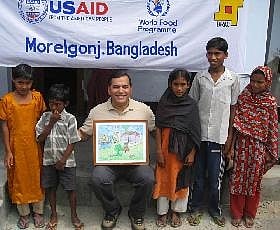
Meanwhile, Gaddi Vasquez spent some lighter moments with schoolchildren in Bagerhat, enquiring about their studies and interests, on a visit to a School Feeding Programme at a local public school.
He distributed high-energy biscuits, which the kids receive under the programme as a dietary supplement, and was happy to smile and pose for photographs with them after a day of sombre reckoning.
Vasques was accompanied by USAID mission chief Denise Rollins, WFP deputy country director Edward Kallon, director of the American Centre Amy Hart Vrampas, public affairs officer for the US mission to FAO Lilian deValcourt-Ayala, and members of a visiting media team among others.
bdnews24.com/sk/rah/2027hours