


Published : 08 Mar 2013, 12:43 PM
Updated : 09 Aug 2022, 10:21 AM


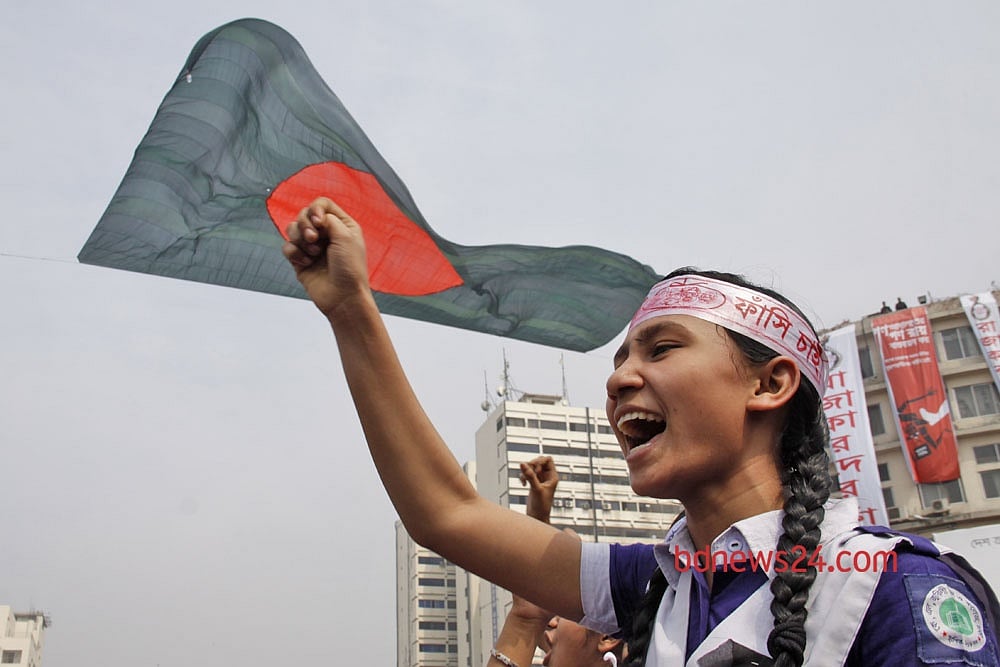
It would be rare to find a better locale for observing the International Women’s Day than Shahbagh 2013, where thousands gather to demand death penalty to the ‘war criminals’ of 1971 and where women of all age groups have flocked in large numbers from Day One.
And so it was. Shahbagh reverberated to slogans to honour the tortured and dishonoured women of 1971 who paid the ultimate price for the country’s Liberation from a brutal military junta supported by local auxiliaries, some of whom are now facing trials at the war crimes tribunals.
Those raised the slogans were the women of today, who opposed male domination and want an equitable society and who hate fundemantalists for what they did to the country's womenfolk in 1971.
The Nari Jagaran rally started at 4:30pm in the afternoon with the national anthem, Kaniz Aklima Chinu moderated the proceedings.
Thousands of people from all walks of life arrived in small processions to join the rally after midday, with women and children in much larger numbers than on other days.
bdnews24.com Correspondent Shahidul Islam said the women of all age-groups appeared enthusiastic, as they waved the national flag or held up banners and festoons.
The Shahbagh movement entered its 32nd day on Friday. The protestors now demand not only death penalty for all convicted war criminals but also a ban on the religion-driven politics of Jamaat-e-Islami and nationalisation of its considerable assets. The movement started on Feb 5 with protests over the life sentence of Jamaat leader Abul Quader Molla.
A photography exhibition on women was also held behind the portrait of Jahanara Imam at the intersection.
Foreign Minister Dipu Moni and Ferdousi Priobhashini, among others, were present at the rally from 3pm.
While leaving after her 40-minute stay there, Dipu Moni told reporters, “The Liberation War was aimed at building a discrimination-free society. But attempt to destroy that spirit started with the assassination of Bangabandhu [Sheikh Mujibur Rahman] in 1975.”
“Anti-liberation forces were in power for a long time in the last 42 years after independence. That’s why the spirit of the Liberation War did not bear fruit.”
“But the youth have brought that spirit back. The spirit of this mass uprising is the spirit of 1971,” she added.
Ferdousi Priobhashini said, “This generation has made us braver. We are more hopeful than ever. Those women who were tortured and repressed in 1971 will find some comfort if capital punishment for the war criminals can be ensured.”







