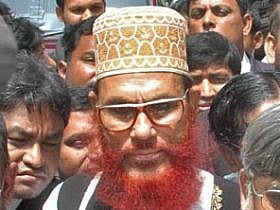
Witness puts Sayedee at '71 scene
A carpenter's son puts Sayedee at the scene of arson and looting, and says the Jamaat leader had a role behind killing of one Ibrahim Updates 1
bdnews24.com News Service
bdnews24.com
Published :
08 Jan 2012, 07:22 AM
Updated :
09 Aug 2022, 03:16 PM
Dhaka, Jan 8 (bdnews24.com) — A carpenter's son and assistant during the Liberation War, Basudeb Mistri, on Sunday put Jamaat-e-Islami leader Delwar Hossain Sayedee at the scene of an arson and loot in 1971.
The 10th prosecution witness against Jamaat executive council member gave his deposition at the war crimes tribunal in the morning. Prosecutor Muklesur Rahman Badal deposed the witness.
Defence counsellors Mizanul Islam, Mohammed Kafil Uddin Chowdhury and Manjur Ahmed Ansari finished cross-examining Mistri, in his mid-fifties, later in the day.
The International Crimes Tribunal, set up to try crimes against humanity during the Liberation War of 1971, has indicted Sayedee on 20 counts of war crimes including murder, rape, loot and arson.
Basudeb also put Sayedee at a murder scene of one Ibrahim Kutti, whom the Razakars — an organisation that collaborated with the Pakistani Army during the war— had apprehended.
Basudeb told the court that he had been to work at the house of one Manik Poshari with his father, who was a carpenter, in May 1971 when he was 13 or 14 years.
He said that on May 8, inmates of Manik Poshari's house fled upon seeing a group of Razakars and Pakistani soldiers advancing towards the house.
According to the witness, this group looted the house and Delu Shikdar took away the valuable while he gave some of the loot to members of the party. The prosecution holds that Delwar Hossain Sayedee went by Delwar Hossain Shikdar before and during the war, and furthermore that he was also known as Delu Shikdar or Deilla Razakar.
The party also caught two persons, one Mafiz and Ibrahim Kutti and tied them up. The party left with these two persons after burning down the house, but on the way Ibrahim Kutti was shot after Sayedee had a word with one of Ibrahim's captors.
Mafiz was taken to the Razakar camp but managed to flee. Basudeb and Mafiz met only after the war.
In his bid to show inconsistencies in the deposition, Mizanul Islam asked the witness about dates. He first asked Mistri whether he knew when the Liberation War had begun. The witness said he did not know that.
Basudeb still could not tell if it was right when Mizanul Islam suggested that the war had begun on Mar 26, 1971. Mizanul Islam then went on to ask the witness if he knew which month followed May. Basudeb answered, "June."
However, when asked which month preceded May, the witness said August, which was struck from the records and the tribunal chairman Justice Nizamul Huq said that the records should state that witness could not answer. Mizanul Islam was content with the change.
When one of the prosecutors said that the witness would probably know the months in sequence, Mizanul Islam muttered, "Of course he can, he has been trained to learn the sequence."
He then asked the witness, "Who told you that it was May 8 when the Razakars had come to torch Poshari's house?"
Justice Huq said, "You cannot ask that question. You may ask how it was that he came to know the date."
When the question was put to him, the witness said he simply remembered. The defence counsellor muttered under his breath, 'more is the pity since he could not remember when his own house was torched'.
Prosecutor Zead-Al-Malum objected to the defence's questioning saying that it was not fair on witness who was merely an adolescent at the time of Liberation War when he had witnessed the offences.
Tribunal chief Huq told him that the tribunal will see to it.
The prosecutor objected again to the cross-examination soon afterwards when Mizanul Islam had asked whether the witness had worked at Manik Poshari's house. Malum told the court that the defence could not ask questions that went beyond the time frame of Mar 26 and Dec 16 of 1971.
Huq told him, "You could say that questions beyond that timeframe were not of any concern but you certainly cannot say that cross-examination cannot stretch beyond that time."
At this Malum became agitated and told the tribunal, "I would like to learn, my lord, how it is of any relevance to the case." He reiterated his position that the question did not have any relevance to the case.
Malum only sat down after the Justice Huq reassured him that the tribunal would surely look into the relevance of such questions.
Mizanul Islam, who had been looking on during the entire exchange, then said, "If the prosecution is suggesting that we cannot ask any questions beyond those dates then I must say it is very unfortunate."
Huq intervened saying, "You should perhaps say embarrassing."
Mizanul Islam replied, "Indeed my lord, it is rather embarrassing."
Sayedee's is the first case to proceed to the trial at the tribunal. The prosecution on Sept 4 proposed the framing of charges against Sayedee on 31 counts for crimes against humanity and genocide in ICT Case-1/2011. The tribunal indicted Sayedee on 20 counts on Oct 3.
Apart from Sayedee, Jamaat chief Matiur Rahman Nizami, secretary general Ali Ahsan Mohammad Mojaheed and assistant secretaries general Mohammad Kamaruzzaman and Abdul Quader Molla, and Bangladesh Nationalist Party's standing committee member Salauddin Quader Chowdhury, also a lawmaker, have been detained, along with others, on charges of committing war crimes.
The tribunal is also expected to rule on whether it will take charges against Jamaat guru, a former chief of the party, Ghulam Azam into cognisance on Jan 9.
The tribunal, however, on March 31 granted conditional bail to former BNP MP and minister Abdul Alim.
bdnews24.com/ta/jr/bd/1632h