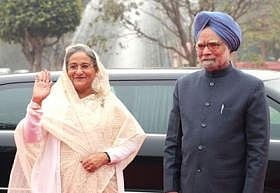
WIKILEAKS EXPOSÉ: BangladeshAdvisor finalised PM's India visit
Preparations of Hasina's Jan 2010 India visit was finalised by an adviser, reflecting on inertia within Bangladesh's bureaucracy, reveals Wikileaks. UPDATES
bdnews24.com News Service
bdnews24.com
Published :
18 Mar 2011, 09:47 AM
Updated :
10 Aug 2022, 04:30 PM
Dhaka, Mar 18 (bdnews24.com) — The prime minister had entrusted her advisors with the ground work ahead of her India visit in 2010.
A leaked cable from the US embassy in Bangladesh suggests that Sheikh Hasina's foreign affairs advisor was leading the process because of their lack of confidence in a lethargic bureaucracy.
"Recognizing the inertia within Bangladesh's bureaucracy, the Prime Minister entrusted her own office with preparations for the visit, and her advisors tell us they expect the results to 'transform' Indo-Bangladesh relations," states the cable from James F Moriarty, the US ambassador in Bangladesh.
The 'confidential' cable, leaked by Wikileaks, dated Jan 10, 2010, reveals details of a briefing from prime minister Hasina's foreign affairs advisor Gowher Rizvi, only hours before the envoy set off. The cable read, "[Rizvi] reported that preparations had been completed for the PM's visit to New Delhi later in the day."
The cable also shed light on the rift within the bureaucratic mechanism of the incumbent government including the ministry and the prime minister's advisors.
The cable also claims Hasina's foreign affairs advisor said the details of the tour and its preceding negotiations were kept under the wraps until the very end of the preparations.
"The foreign minister [was] only being brought into the loop within the past week [the first week of Jan 2010]," the cable reads, "Rizvi was dismissive of the foreign ministry bureaucracy, which he said lacked creativity and vision."
The advisor also told the ambassador about the government move to bring in the prime minister's administrative affairs advisor H T Imam and financial affairs advisor Mashiur Rahman, at the final stage "to help push through" the implementation of agreements that were stalled in red tapes.
'SABOTAGE'
When contacted over phone by bdnews24.com on Friday, Rizvi said, "No matter where and what is published, please verify the authenticity of the source and information."
He allegedly told the ambassador that he had thought that Hasina's decision to delay her return until Jan 13, and paying a one-day pilgrimage to Ajmer was a mistake. The advisor had also confided that he had "sabotaged" the PM's plan to prolong her stay in India and cancelled her stopover in Kolkata, the cable reveals.
It added that the advisor was worried that a 24-hour delay would give scope to the media and the opposition to make their stand about the visit before Hasina could address the nation on it.
He pressed the prime minister to outline the results of the visit in an address in parliament on her return.
Moriarty said in the cable, "According to Rizvi, the PM believed that the agreements would sell themselves. We discussed with Rizvi the possible benefits if the government were to offer to take the opposition into confidence and provide a separate briefing on the results of the visit."
RIZVI BRIEFS US ENVOY
The cable also claimed that the foreign affairs advisor had also divulged in the meeting the results of his fourth sitting with Indian interlocutors, from which he returned on Jan 8, to prepare the ground for the prime minister's visit.
"Rizvi confessed that the Indian officials had initially been skeptical about what the visit could achieve … he told the ambassador that the stage had been set for agreements to 'transform' Indo-Bangladesh relations."
"Improved India-Bangladesh ties would serve US interests," Moriarty said in the cable.
Rizvi also gave the ambassador an insight about the main priority of the pre-tour discussions, "[the advisor] and his Indian interlocutors had instead focused primarily on the need to implement long dormant agreements on transit and interconnectivity".
Moriarty pointed out that at that time the Bangladesh media were more focused on "new, relatively minor, agreements (extradition, prisoner transfer, electricity sharing, etc.) that would likely be signed during the visit."
"According to Rizvi, there would be agreement on enhancing interconnectivity between India and Bangladesh focused on both expanding rail networks as well as water transport. The two sides would agree to allow access to Chittagong, Mongla, and Ashuganj ports in Bangladesh to India," the cable added.
In a separate note in the cable, the ambassador pointed out that the advisor also revealed that controversy rose over Mongla Port in the discussions because it would lead to diversion of trade from Kolkata's port, a touchy issue in West Bengal.
MARITIME BOUNDARY ISSUE
In the cable, Moriarty said he was informed by Rizvi beforehand that discussion on the demarcation of the Indo-Bangladesh maritime boundary did not go smoothly as "the Indians had been disappointed when Bangladesh unilaterally referred the maritime boundary dispute to international arbitration."
COMMENTS
The US ambassador also forwarded a comment that stipulates that one of the Awami League's priorities since taking office had been to improve the Indo-Bangla relations, says the leaked cable.
The Feb 25-26, 2009 BDR mutiny caused a temporary setback to these efforts, it added.
"In recent months, however, preparations for the PM's visit to India have been her office's primary focus. The decision to hand over several high-profile Indian insurgents in late 2009 helped create a favourable atmosphere for the visit," it said.
In a recent poll, 80 percent of Bangladesh's population expressed support for improved Indo-Bangladesh ties, it observed.
At the same time, the political opposition can be expected to criticise the government for failing to protect Bangladesh's interests, the ambassador commented.
He continued: Poor strategic communications weakened the 2007- 2008 caretaker government's hands as it tried to implement reforms. It appears that Hasina's government has not learned this lesson from its predecessor.
The cable also said a positive transformation of the Indo-Bangladesh relationship could help bring greater stability and prosperity to a region that could use more of both.
bdnews24.com/rn/sht/ta/1745h