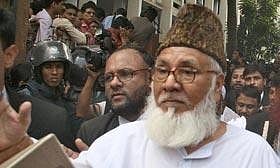
'Why Nizami not charged for intellectuals killing?'
War crimes tribunal wonders, even though there are 'volumes of references to his widely alleged role'.Full Story
bdnews24.com News Service
bdnews24.com
Published :
15 Mar 2012, 07:48 AM
Updated :
09 Aug 2022, 03:33 PM
Dhaka, Mar 15 (bdnews24.com)— The war crimes tribunal has wondered why the prosecution had not charged Jamaat-e-Islami chief Matiur Rahman Nizami with killing intellectuals, even though there are volumes of references to his widely alleged role.
After the prosecution finished presenting its formal charge on Thursday, proposing to indict Nizami on 15 counts at the war crimes tribunal, chairman Justice Nizamul Huq wondered why the prosecution had not brought that charge against the Jamaat chief.
Justice Huq agreed that the formal charge had "touched" upon the matter when prosecutor Syed Haider Ali said it was there and would be shown convincingly in the evidences. But the chairman still wondered the killing of intellectuals was not included in the formal charge.
The prosecution will begin its arguments on Mar 21 in support of the formal charges.
The International Crimes Tribunal, set up to deal with crimes against humanity during the Liberation War, also saw the prosecution submit formal charges against Abdul Alim, a former MP and minister in late president Ziaur Rahman's cabinet, on Thursday.
The tribunal said it would give cognisance order on Mar 22 and extended Alim's bail until then. Alim was also ordered to be present at the court on that date.
Nizami, headed Jamaat's student wing, that used to be called Islami Chhatra Sangha, in 1971.
Later that year, Nizami was replaced by his current number two, Jamaat secretary general Ali Ahsan Mohammad Mujaheed, who is also behind bars on war crimes charges.
Nizami is also said to have headed the Al Badr which had a lead role in many of the atrocities during 1971.
The right wing party's student cadres are said to have been instrumental in mobilising several fronts like the Razakars, Al Badr and Al Shams that actively engaged against the freedom fighters to thwart the liberation forces.
These fronts were notorious for ruthlessly trying to subdue resistance against Pakistani occupation forces and full-fledged collaboration with the Pakistan Army.
It is through these militia fronts that Nizami is said to have masterminded the murder of pro-liberation intellectuals of Bangladesh days before the Pakistani occupation army surrendered on Dec 16, 1971.
The tribunal took charges into cognisance against Nizami on Jan 9.
bdnews24.com/ta/jr/bd/1332h