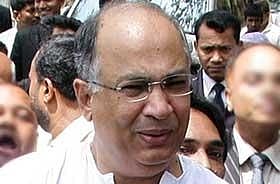
SUST VC was 'tortured severely'
Prof Mohammad Saleh Uddin recounts his 'torture' at S Q Chowdhury's ancestral home in Chittagong in 1971
bdnews24.com News Service
bdnews24.com
Published :
23 Jul 2012, 04:48 PM
Updated :
09 Aug 2022, 04:02 PM
Dhaka, Jul 23 (bdnews24.com) — The Vice Chancellor of the Shahjalal University of Science and Technology has told the first war crimes tribunal that he was tortured severely during the Liberation War at BNP MP Salauddin Quader Chowdhury's ancestral home in Chittagong.
Prof Mohammad Saleh Uddin, a young economics undergraduate at Chittagong University in 1971, was picked up from a village and taken to Goods Hill where he saw the BNP leader.
The vice chancellor described how he was tortured through one day around the third week of July — to the best of his recollection — and said how Salauddin Quader had himself assaulted him.
Set up to deal with crimes against humanity during the 1971 Liberation War, the three-judge International Crimes Tribunal – 1 has indicted the six-time Chittagong MP for 23 war crimes charges.
Saleh Uddin said the local union council Chairman, one Shamsu — a Muslim Leaguer — had him picked up from Mohora village where he had grown up at Rajjak Chowdhury's house through his school days.
The young university student had left the campus in the middle of March 1971 when classes suddenly got suspended and had come back to Mohora. It was an early morning towards the end of July. "Must have been around 5:30 or 6am when they came."
"Shamsu Chairman came to my door along with two aides and knocked. I became very scared as his right hand was inside a pocket where he was clearly holding a weapon."
The local union Chairman was a follower of Fazlul Quader Chowdhury, leader of one Muslim League faction, said Saleh Uddin appearing as the prosecution's eighth witness against Fazlul Quader's eldest son Salauddin, who was in his early 20s during the war.
The local union leader told Saleh Uddin to follow him and said it would only be for a short while, when the witness wondered if he should change into something more suitable.
"After advancing about 200-300 yards, I saw there was an army jeep. Two Pakistani soldiers grabbed me and hauled me up to the jeep."
Shamsu sat out in the front as the jeep travelled towards Goods Hill first on the Kaptai Road and then on the Arakan Road. "They dropped Shamsu Chairman at his house. But we continued."
The jeep took Saleh Uddin to Goods Hill and presented him to Fazlul Quader Chowdhury. The Muslim League leader confirmed whether he was Saleh Uddin and having done so, he said, "Give him a good rubbing."
The witness said he was then confined to a second storey room of a longish structure which housed the garage. It was here that Saleh Uddin was beaten up by one Hamidul Kabir and another Sekendar, who was said to be the local chief of the Al Shams vigilante militia, which along with the Al Badr and Razakar, are widely held to have been responsible for atrocities during the Liberation War.
After severely beating him for some time, Saleh Uddin was asked who else was with him and what their names were. The witness said he was not involved with anything or anyone.
At one point, when the witness had almost fainted, one of the Pakistani soldiers came into the room and beat him up again with one of the bed-posts that were piled in a corner of that room.
"I remember him breaking four such posts on me. And after that I almost fainted. But he kept asking where the weapons and who my associates were." Saleh Uddin had the same answer.
"They left me there and went downstairs as I lay on the floor semi-conscious."
After some time, the two soldiers reappeared and pushed him down the wooden stairs since the young student could hardly walk. It was the foot of these stairs that Saleh Uddin said he saw Salauddin who said, "And you say you beat him up? There is not even a sign of tear in his eyes."
Salauddin then came up to Saleh Uddin and slapped him on the left cheek. The witness was then taken to the garage and beaten up with hose pipes. They then hauled him up the stairs again and left on the floor. "I don't know how long I lay there."
But Saleh Uddin remembers an acquaintance from his university, a member of the National Student's Federation -- a student wing of the Muslim League -- Nurul Islam, coming to see him.
Nurul Islam asked whether he had admitted to anything. "But I am not involved with anything anyway! I could not possibly admit to anything."
Nurul Islam then advised, "Alright, let me see what I can do. But whatever you do, don't admit to anything."
"He returned after a while and asked who in Mohora Village would vouch for me. He said if the local member spoke in my favour then there might be a way out."
Saleh Uddin thought his ordeal might indeed come to an end. "I was very popular in my village. I gave names of two Muslim Leaguers who liked me very much."
He also told Nurul Islam that all the teachers of his school would vouch for him and swear that he was not involved in anything.
Towards late afternoon, Saleh Uddin was not sure what time exactly the two Muslim Leaguers, Nurul Huda Quaderi and Badshah Miah Shawdagar came to see him along with Harun-ar Rashid Chowdhury, who Saleh Uddin used to teach in return for his room and board at the Chowdhury's in Mohora.
"I don't know what went on between Salauddin Quader and these three, but they claimed to have said that I had been living in the village for a long time and was rather good chap."
Salauddin Quader, surrounded by his supposed accomplices, had then told the witness to return to the village and stay there. "We will collect further information about you."
"I remember they gave me an over-size shirt to wear as the one I was wearing had become all bloody," said Saleh Uddin who remained at the village until he recovered and then fled.
Salauddin Quader in ICT
The prosecution submitted formal charges against Salauddin Quader on Nov 14, 2011 and the tribunal took them into cognisance three days later.
A former prime ministerial adviser on parliamentary affairs when BNP chief Khaleda Zia was in the office, the Chittagong MP was shown arrested for war crimes charges on Dec 20, 2010, five days after his arrest.
The investigating agency submitted a 119-page report with around 8,000-page data to the chief prosecutor on Oct 3 in a bid to prove allegations of war crimes during the 1971 Liberation War.
The BNP leader was indicted on Apr 4 on 23 charges of war crimes.
bdnews24.com/ta/nir/2240h