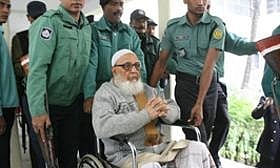
Make it fast, Azam counsel told
The ICT-1 chief tells the defence counsel to wind up cross-examination of first prosecution witness 'as soon as possible' on Thursday
bdnews24.com News Service
bdnews24.com
Published :
04 Jul 2012, 05:05 PM
Updated :
09 Aug 2022, 03:58 PM
Dhaka, Jul 4 (bdnews24.com) – The first war crimes tribunal on Wednesday continued with the cross-examination of the first prosecution witness against Jamaat-e-Islami guru Ghulam Azam.
Dhaka University's History teacher Prof Moontassir Mamun answered defence counsel Mizanul Islam's questions. The cross examination is set to resume on Thursday.
Tribunal Chairman Justice Mohammad Nizamul Huq told the defence counsel that the tribunal wanted the cross-examination to conclude "as soon as possible" on Thursday.
The International Crimes Tribunal – 1, set up to try crimes against humanity during the 1971 Liberation War, indicted the former Jamaat chief on May 13. Deposition of the prosecution's first witness began on Sunday and has been continuing off and on.
The tribunal chief told the defence counsel that the signal going out was that it was going too slow. Further, the tribunal chair said, the court would fix the amount of time for witness examination and cross-examination.
Justice Huq said the time for cross-examination would typically be double that of the duration of the deposition. The defence counsel, Mizanul Islam, said, "I believe this requires a little more discussion before you given an order."
He pointed that out even one sentence of deposition could take hours of cross-examination. The judge agreed and said there would of course be exceptions.
But the defence counsel requested that the judge refrain from passing such an order before further discussion.
Justice Huq said that the court wanted to send across a message so that potential witnesses did not consider testifying at the tribunal a hassle which would cause wastage of their time and harassment at the hand of the counsels. "And this is for both the prosecution and defence witnesses."
The defence counsel said he would rather request the tribunal to pass such an order after sufficient discussion and pleaded that the time bar, for the moment, remain as the court's observation.
"No, we believe we will go further," said Justice Huq.
Tribunal piqued
The tribunal on Wednesday showed a clear disapproval at a story of one internet news portal banglanews24.com. The story covered the tribunal's decision on delivery of home-cooked food for Jamaat leader Delwar Hossain Sayedee, who is also behind bars for alleged war crimes, currently recovering from an angioplasty.
Without even hearing the prosecution, the tribunal on Monday (Jul 2) had almost readily agreed to pass a similar order that it did in Ghulam Azam's case, when the defence approached the court with a plea that hospital food was not suiting Sayedee and would like home-cooked food.
The only reservation that the tribunal chairman spoke of was that this order did not suffer the same fate as that of the previous order which remains unavailed as Azam's family was not ready to accept the court's conditions.
Justice Huq indicated that the court would pass a similar order with the same conditions – saying that the family would be responsible if Sayedee's health deteriorated after taking the home-cooked food which would be inspected by the prison authorities before being delivered.
The judge asked whether Saydee's sons would be ready to sign a bond to that effect accepting the conditions and abiding by the order. The defence counsels had agreed after speaking with Sayedee's family.
However, on Tuesday morning the tribunal found that the defence had not approached the prison authorities before approaching the court with the petition. Justice Huq said on Wednesday, "We cannot allow everyone to come straight to the tribunal."
The tribunal then asked the defence counsel to first approach the jail authorities. They could approach the tribunal only if they are turned down by them.
The internet news portal had published Tajul Islam's reactions for the court's having recalled its order. The defence counsel was quoted as saying that Sayedee was becoming very weak and the court's decision would mean further delay for the patient to get his desired and he could then even die. "Who will the tribunal try then?" the story had quoted Tajul as saying, which he denied in court and said, "I had said something like 'Who will bear the responsibility if he dies?' but not this."
The tribunal gave all the indications that it would order all parties concerned, news outlets that had reported erroneously and the defence counsel to explain their position in this regard. However, after the lunch recess, Mizanul Islam managed to persuade the court against any such proceedings.
Having indicated his acquiescence, Justice Huq said that the court expected cooperation from all parties. "And we are indeed getting."
The tribunal chair reiterated his previous position saying that no matter what, the dignity of the court could not be undermined. "Furthermore there is a difference when senior counsels say something or when a junior lawyer says something. It is only when the senior lawyers say things that strike us more and sometime we express that disappointment in the court."
Jamaat Guru in ICT-1
On Dec 12, 2011, the prosecution brought a 52-point charter of charges against Azam and appealed for his arrest. Later, following the tribunal order, charges were re-arranged and presented to the tribunal on Jan 5.
He was produced before the tribunal on Jan 11 and sent to jail the same day. Since that evening, Ghulam Azam has been kept at the prison cell of the Bangabandhu Sheikh Mujib Medical University for better treatment considering his delicate health.
A former chief of Jamaat-e-Islami, arguably the largest Islamist organisation in the subcontinent, Azam is allegedly among the key people who pioneered anti-liberation efforts in 1971 colluding with the Pakistani military junta of that time.
He is widely perceived to have been among core group of right-wing supporters of the Pakistani Army, who came out strongly in support of a united Pakistan.
Ghulam Azam, then chief of Jamaat, was instrumental in setting up the infamous Peace Committee at the national level. The Razakars, an auxiliary force set up mainly to actively thwart the liberation forces, are said to have been mobilised through the Peace Committees across Bangladesh.
Among the most notorious vigilante militia are the Al Badr, whose membership is said to have been mainly dominated by the Jamaat's student wing called the Islami Chhatra Sangha at that time.
The Al Badr is alleged to have spearheaded execution of the intellectual elites of Bangladesh just days before the victory on Dec 16, 1971.
Azam also spoke in favour of Pakistan to the Middle Eastern countries during the war, according to the prosecution.
He stayed in London for seven years after 1971 and returned to Bangladesh in 1978 during BNP founder Ziaur Rahman's rule. Having led Jamaat for long, Azam retired from active politics in 1999.
His party remains a key ally of the main opposition BNP. Two Jamaat leaders, also behind bars for war crimes charges, have even served as ministers during the BNP's last tenure in government between 2001 and 2006, when Azam's party was part of the ruling coalition.
Azam was indicted on five charges including incitement, conspiracy and abetment.
bdnews24.com/ta/nir/2254h