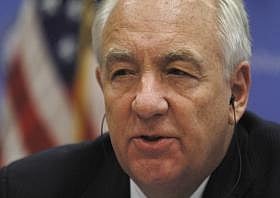
Define 'crimes against humanity': Rapp
A former prosecutor for courts trying crimes against humanity, Stephen J Rapp said the war crimes tribunal should define "crimes against humanity" as soon as possible.
bdnews24.com News Service
bdnews24.com
Published :
28 Nov 2011, 12:31 PM
Updated :
10 Aug 2022, 05:52 PM
Dhaka, Nov 28 (bdnews24.com)—A former prosecutor for courts trying crimes against humanity, Stephen J Rapp said the war crimes tribunal should define "crimes against humanity" as soon as possible.
Reading out a statement on Monday, he also said the war crimes trial being held in Bangladesh under the International Crimes Tribunal should be transparent and accessible to all.
The former prosecutor for the Special Court for Sierra Leone, and the International Crimes Tribunal of Rwanda, said that while the term crimes against humanity had been defined in the statutes and cases of international courts, it had not in Bangladesh.
"In their charge framing order in the first case, the judges said that they would interpret the statute according to Bangladesh law but look for additional guidance in the decisions of international tribunals."
Also a US ambassador-at-large for war crimes issues, invited here by the government, Rapp pointed out at his press briefing that it was not, however, clear whether murders and rapes were stipulated to be "part of a widespread and systematic attack. Or whether they were committed on a racial, religious, or political basis; or whether the alleged perpetrators would need to have knowledge of the larger attack.
Before rushing off to a meeting with the prime minister, Rapp made a few more observations but stressed on broadcasting the trial proceedings on television since it was not easy for the people to attend court session.
"Ideally, the trial sessions should be broadcast on television or radio, or weekly reports be aired that would show key testimony, arguments, and rulings."
Rapp also suggested 'neutral observers' to follow the trials and produce daily and weekly reports available through the internet and other media.
The US special envoy said in his written speech that he had made a few recommendations in March on amending the rules for these trials to ensure fair and transparent proceedings. "Some of these suggestions were incorporated in amendments adopted in June. I regret to say that many were not."
To a question regarding the removal of Justice Nizamul Huq, the former war crimes prosecutor said he was not here to take sides and would not comment on how he would have judged it. But Rapp did mention that he had recommended a system that would allow parties to challenge the proceedings at a different court.
To another question about foreign attorneys arguing cases before the tribunal, Rapp said it would actually be beneficial for all parties. "I myself have benefited from the experience of attorneys from different backgrounds and cultures."
However, he did acknowledge that the Bangladeshi laws did not allow anyone but local citizens to act as barristers. "But foreign attorneys could sit in as advisers at the trial."
To another question of transparency and accessibility, he said that the ongoing trials were significant and historic for Bangladesh. "I want people around the world to see how these trials are going."
Rapp suggested that there should be interpretations so that when people testified, or spoke in English it is instantly translated to Bengali and vice versa.
Rapp has had a round of meetings with relevant officials. He met the war crimes tribunal on Sunday. The defence lawyers of those currently facing war crimes charges had a lunch with him at the Ruposhi Bangla Hotel in the afternoon.
That was followed by a meeting with law minister Shafique Ahmed from where he reached the Dhaka Reporter's Unity for the press briefing.
bdnews24.com/ta/bd/1820h