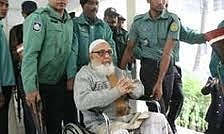
Defence ends quizzing IO
Sunday was the eighth time that Ghulam Azam's war crimes investigator Matiur Rahman took the stand to face the defence.
bdnews24.com News Service
bdnews24.com
Published :
04 Nov 2012, 03:42 PM
Updated :
09 Aug 2022, 04:28 PM
Dhaka, Nov 4 (bdnews24.com) — The first war crimes tribunal of Bangladesh on Sunday saw Jamaat-e-Islami guru Ghulam Azam's defence conclude cross-examination of the investigation officer.
Sunday was the eighth time that Azam's war crimes investigator Matiur Rahman took the stand to face the defence. Although the court had ordered on Thursday that the defence would get one more session, it extended the time by another session and saw the cross-examination come to an end almost 45 minutes after the regular time for closing the day's proceedings around 5:15pm.
The International Crimes Tribunal-1, set up to try crimes against humanity during the 1971 War of Independence, directed the defence to start deposition of its witnesses on Nov 11 (Sunday) giving it one week's time.
The investigator, to a number of questions from senior defence counsel Mizanul Islam, replied he could not find out from his records.
The counsel asked him whether there was any such document that showed an individual had committed a crime incited by Ghulam Azam's speech or statement published in the papers.
Mizanul Islam also asked whether the investigator had any document that showed Ghulam Azam had the authority to control or punish anyone of the Peace Committee — which was more of a social front of the vigilante groups — or of the Razakar, Al Badr or Al Shams, the vigilante militia groups responsible for widespread atrocities across Bangladesh in 1971.
The investigator was asked whether he collected any reports of the 12-member Hamoodur Rahman Commission set up by the Pakistani Government after the war to look into war crimes by either Pakistan Army or their collaborators. The investigator faced question whether he had collected any reports of the committee headed by Mazharul Islam for the History of Liberation War.
Matiur Rahman had a similar answer for many of such questions answering either that he could not find the answer from his records or that he could not go through his exhibits and answer in a short time.
The investigator was also asked about his 523 exhibits and 31 hours of CD and DVDs. The defence suggested that he had not investigated the veracity of those materials or ascertained their nature before submitting them to the tribunal.
When suggested or asked whether Matiur Rahman's exhibits gave out contradictory information compared to the prosecution's case, the investigator said he could not remember.
The defence asked whether any of the exhibits said one Ashraf Hossain had led the formation of Al Badr, or whether any such information among them that said Al Badr was centred around Dhaka University.
Although the tribunal had previously ordered the defence to wrap up cross-examination within one session, there was a long discussion at the end of the first session with the tribunal eventually granting one more session before going into lunch recess a half hour late.
The tribunal chairman, Justice Mohammad Nizamul Huq asked Mizanul Islam, "How much time do you need for contradictions?"
The counsel replied, "The contradictions and suggestions for the defence case, we would need another hour and a half. I might finish earlier though."
Prosecutor Zead-Al-Malum stood up to protest but the tribunal did not allow him to conclude his submissions right after he agreed the tribunal had ample authority to give time.
Throughout the day, the prosecutor kept having slight brushes with the defence and twice pleaded with the tribunal to ask defence counsel Tajul Islam to behave professionally.
The tribunal chose to ignore the prosecutor's pleas and asked the prosecutors to be seated repeatedly. The court has already issued a notice to Tajul Islam to explain why legal action would not be taken against him for professional misconduct. The defence counsel is expected to give a reply to the notice.
Jamaat guru in ICT-1
On Dec 12, 2011, the prosecution brought a 52-point charter of charges against Azam and appealed for his arrest. Later, following the tribunal order, charges were re-arranged and presented to the tribunal on Jan 5.
He was produced before the tribunal on Jan 11 and sent to jail the same day. Since that evening, the 89-year old former Carmichael College professor has been kept at the prison cell of the Bangabandhu Sheikh Mujib Medical University for better treatment considering his delicate health.
A former chief of Jamaat-e-Islami, arguably the largest Islamist organisation in the subcontinent, Azam is allegedly among the key people who pioneered anti-liberation efforts in 1971 colluding with the Pakistani military junta of that time.
He is widely perceived to have been among core group of right-wing supporters of the Pakistani Army, who came out strongly in support of a united Pakistan.
Ghulam Azam, then chief of Jamaat, was instrumental in setting up the infamous Peace Committee at the national level. The Razakars, an auxiliary force set up mainly to actively thwart the liberation forces, are said to have been mobilised through the Peace Committees across Bangladesh.
Among the most notorious vigilante militia are the Al Badr, whose membership is said to have been mainly dominated by the Jamaat's student wing called the Islami Chhatra Sangha at that time.
The Al Badr is alleged to have spearheaded execution of the intellectual elites of Bangladesh just days before the victory on Dec 16, 1971.
Azam also spoke in favour of Pakistan to the Middle Eastern countries during the war, according to the prosecution.
He stayed in London for seven years after 1971 and returned to Bangladesh in 1978 during BNP founder Ziaur Rahman's rule. Having led Jamaat for long, Azam retired from active politics in 1999.
His party remains a key ally of the main opposition BNP. Two Jamaat leaders, also behind bars for war crimes charges, have even served as ministers during the BNP's last tenure in government between 2001 and 2006, when Azam's party was part of the ruling coalition.
Azam was indicted on five charges including incitement, conspiracy and abetment.
bdnews24.com/ta/bd/2103h