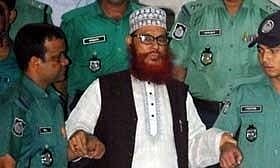
Defence asked to close arguments by Wed
Just before the lunch recess on Monday, the Tribunal Chairman tells Sayedee's senior defence lawyer to try to finish his arguments by Wednesday.
bdnews24.com News Service
bdnews24.com
Published :
26 Nov 2012, 03:26 PM
Updated :
09 Aug 2022, 04:33 PM
Dhaka, Nov 26 (bdnews24.com) — Monday was the first time that the war crimes tribunal hinted at a timeline for finishing closing arguments of Jamaat-e-Islami leader Delwar Hossain Sayedee's defence.
Just before the lunch recess, International Crimes Tribunal-1 Chairman told Sayedee's senior defence lawyer to try to finish his arguments by Wednesday.
Defence counsel Mizanul Islam has been going through his closing arguments in the war crimes case against Sayedee since Nov 18. The lawyer ended his seventh session on Monday.
The three-judge tribunal, set up to try crimes against humanity during the 1971 Liberation War, indicted the Jamaat executive council member for 20 war crimes charges on Oct 3, 2011.
Justice Mohammad Nizamul Huq explicitly said it was a "request" a second time when the defence lawyer indicated that he was taking this request as an order, which, he suggested would be rather daunting to comply with.
Justice Huq said, "No no. This is just a request, not an order."
He had told the lawyer to finish up by Wednesday. "If needed we will give you both the sessions on Wednesday. That means you still have five more sessions to go."
The counsel said that it would be very difficult and he still had not gotten to the broader points. Mizanul Islam is still dwelling on the war crimes charges one by one, which continued on Monday too.
The lawyer is still to get to the debate whether Sayedee was at all a Razakar — a group of vigilante collaborators said to have been mobilised by Jamaat who along with other notorious militia like Al Badr and Al Shams committed widespread atrocities in Bangladesh to thwart the liberation efforts that amount to war crimes.
Mizanul Islam said that he was doing his best to which Justice Huq said, "We feel that you are going a little slow."
The tribunal indicated that it had the fullest confidence that the senior lawyer could pick up the pace of his deliberations if he wanted.
The counsel continued to counter the charges against Sayedee and dwelt upon three on Monday. The most sensational among them was the murder of one Faizur Rahman, the sub-divisional police chief of Pirojpur in 1971, father to the most famous contemporary Bengali writer Humayun Ahmed. Humayun passed away earlier this year.
His younger brother Mohammad Zafar Iqbal, a university professor, is also a noted writer in his own right.
The defence counsel said that the only connection his client had with the murder of three senior Bengali government officials of the sub-division was that Sayedee was seen sitting in the car when Faizur Rahman was being picked up.
But there have been no further witnesses from other places connecting Sayedee with the execution.
The defence also presented its points against two other charges — abduction and rape of Gouranga Chandra Saha's three sisters and rape of Madhusudan Gharami's wife.
Both Saha and Gharami appeared as prosecution witnesses. Both said Sayedee was involved with the incident.
Saha said the Jamaat leader had led abduction of his sisters and deposited them to the nearby Pakistani Army camp where they were raped repeatedly.
Forcibly converted into a Muslim by Sayedee, Gharami said his house had been attacked and he only came back to hear his wife say that she had been visited by the man who had converted Gharami. "That man," Gharami cited his wife to have said, "raped me."
The woman later moved to India to spare herself the obvious embarrassment in a society where she would forever be stigmatised.
The defence said that according to documents, Gouranga was only eight years of age during the war which would make his younger sisters mere children, substantially lessening their likelihood of abducted to serve as sex slaves.
The defence also pointed to a prosecution document which had its first witness, Mahbubul Alam Howladar — whose complaint had triggered the investigation against Sayedee — certify a report on behalf of the local freedom fighters' council that said there were no killing grounds or mass graves in Pirojpur. Instead it referred the matter to the local government ministry officials for providing that information.
Regarding Gharami, the defence counsel pointed out a number of inconsistencies of the witness account. He also pointed to the witness' admission that this Delwar Shikdar was son of Rasul Shikdar.
But the tribunal chief intervened saying that he remembered that day well. "The man was ill and lying here on the bed when you had him answer the question asking that if it was 'Delwar Shikdar son of Rasul Shikdar' and the poor man most likely did not even take note of the detail and admitted the veiled suggestion by way of his answer."
The defence counsel said, "It appears that the tribunal is saying that my question was meant to puzzle the witness."
"If that were indeed the case, the court had all its powers to stop me at that time," he said. But Mizanul Islam also pointed out that he was well within his rights to have asked that question.
Justice Huq said that for that single instance he would not accept the witness' admission that this Delwar was the son of one Rasul Shikdar. "Mind you, it is only for this case. For all other cases we will accept it."
It has been the prosecution's case the Delwar Hossain had the surname of Shikdar and only changed his surname after the war to become Sayedee. On the other hand, the defence case has been that this is a case of mistaken identity and the more notorious Delwar Hossains — one Shikdar and another Mallik — were executed by freedom fighters soon after liberation.
The counsel will resume his argument with Gharami's case on Tuesday.
First case to trial
Sayedee's is the first case to proceed to the trial stage in the war crimes tribunals. The prosecution on Sep 4, 2011 proposed framing of charges against him on 31 counts of crimes against humanity.
The tribunal also sent Jamaat's former chief Ghulam Azam to jail on Jan 11. His indictment hearing began on Feb 15 and the court charged him on May 13.
Jamaat chief Matiur Rahman Nizami, Secretary General Ali Ahsan Mohammad Mujaheed and assistant secretaries general Mohammad Kamaruzzaman and Abdul Quader Molla are also behind bars on war crimes charges. Jamaat financier Mir Quasem Ali was also arrested recently on similar charges as investigation continues into allegations against him.
BNP MP and Standing Committee member, Salauddin Quader Chowdhury, also behind bars, was indicted for 23 charges on Apr 4.
Former BNP lawmaker and minister Abdul Alim is the only one out on bail. All cases have already entered the trial phase.
bdnews24.com/ta/bd/2110h