Published :
01 May 2013, 02:29 PM
Updated :
20 Oct 2022, 03:36 PM
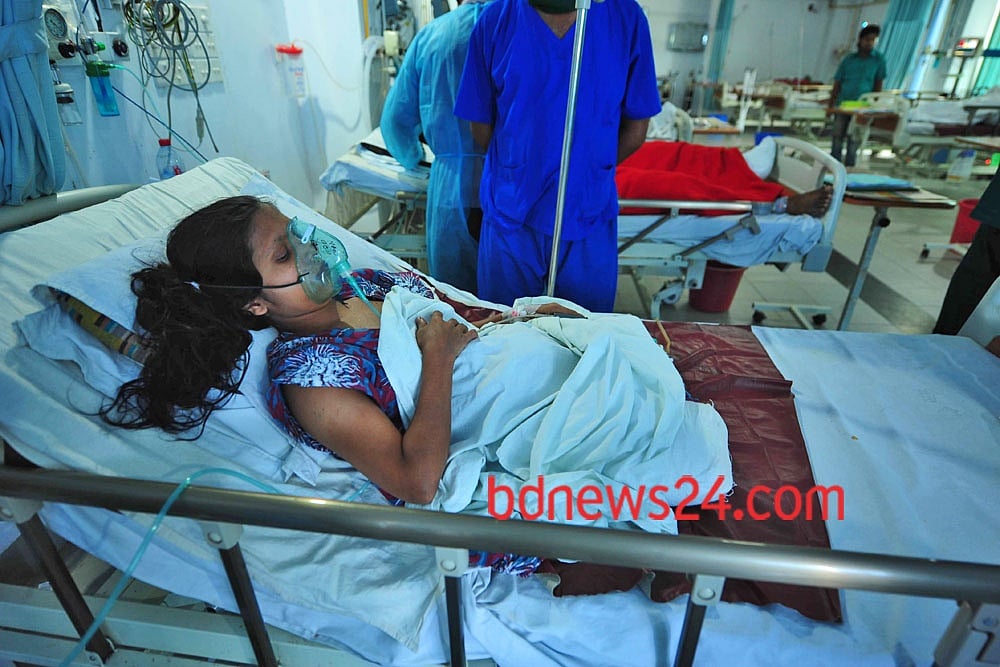
এনাম মেডিকেল কলেজ হাসপাতালে চিকিৎসাধীন অবস্থায় একজন আহত শ্রমিক।
But what worries the people hit with disability most is the uncertain future staring in their face.
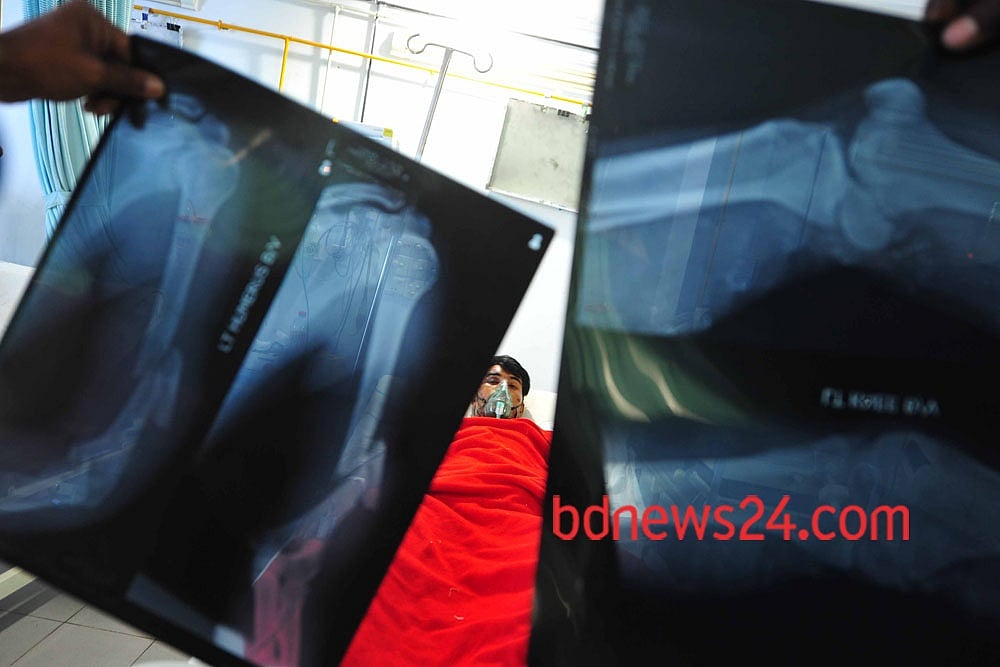
The hundreds of workers, who were admitted to the Enam Medical College and Hospital in Savar, now speak of their worries for their families amidst their own unbearable physical pain.
More and more tales of horrific times spent buried under the rubbles also surfaced with their accounts.
Khulna’s Pakhi Begum had both her legs amputated. But she decided to forget all her pain, at least for now, as she got reunited with her two daughters.
Pakhi began to sob as she was approached in the ICU.
“I will see my daughters again because I am alive. I feel so happy,” she said with tears flowing from the corner of her eyes.
But her words of joy vanished soon in the agonising pain of her amputations and the fear to walk the future without her legs.
“My legs are gone. Allah knows what the future holds for me. How will I survive with my daughters …” is all Pakhi could say.
She had spent two days under the debris of Rana Plaza after the nine-storey building collapsed on Apr 24.
Habibur Rahman, a second-year student of Haldhora Degree College, discovered himself at the Enam Hospital with a broken arm and a leg as he regained consciousness.
He is terrified at the very thought of having to support his family of eight younger siblings.
Habib, besides doing his studies, used to work for a potato farm in Nilphamari.
After finishing his first-year exams, he joined one of the factories of Rana Plaza in the hopes of a better compensation.
On the fateful day, he tried to move to the next building after the building began to fall apart. But his efforts went in vain, and he was soon buried under concrete piles.
Habib dosen’t remember anything after that. He woke up to find himself in the hospital with two severely ruptured limbs.
“I will never be able to do heavy work again. What will I do then? How will I feed my family?”
Rangpur’s Parveen Akhter also does not feel safe about her future despite a government’s announcement which promised to rehabilitate the victims.
The garment worker, whose leg was broken below the knee, said, “No one will remember us once the situation cools down.”
Clouds of fear have started taking over the mind of Manikganj’s Dulal Miah or Dhamrai’s Anwarul Islam even before their wounds were fully healed.
Rikta Begum spent three days buried under the rubble before rescuers found her. They had to chop her right hand off to bring her out of the debris.
She used to work in the factory on the third floor.
“There was a wall one foot above my head. There were corpses next to me. Some people arrived on the third day and took out the bodies. My hand was stuck so they were leaving without me.”
“I told them to cut it off. They were reluctant and wanted to leave. I grabbed their legs. I again begged them to cut my arm. They said ‘we are afraid’. Then they cut off my arm off with a saw and brought me out of that hell.”
Monwar Hossain was on life support for days and did not have the luxury of thought. He laid there a sole witness to his traumatic experience.
Humayun Kabir, an official responsible for admitting patients at the Enam Medical College Hospital, told bdnews24.com, at least 652 workers who used to work in the various factories of Rana Plaza were currently admitted in the hospital. 296 were released from the hospital until Wednesday noon.
A total of 355 workers are still receiving treatment at the Enam Medical College Hospital and five passed away succumbing to their injuries.
Most of the injured workers said they were the sole bread-earning member of their families.
‘Raju’, another garment worker receiving treatment in the hospital, has wounds all over his body.
The rescue operation continued on the eighth day of the collapse on Wednesday. Thousands of people are still gathered at the site in the hope finding their loved ones.
The walls lining the road to Savar are now covered with thousands of small posters of the missing – the silent reminders of the fate of so many workers.