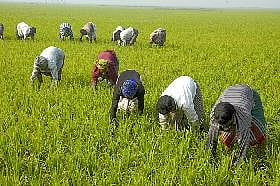
'Very good' Aman crop expected this year
Bangladesh is likely to see "very good" Aman production this year, barring natural calamities, during harvest period starting at the end of November, officials have said. Kamran Reza Chowdhury reports
bdnews24.com News Service
bdnews24.com
Published :
17 Oct 2009, 11:11 AM
Updated :
12 Aug 2022, 01:56 PM
Kamran Reza Chowdhury
bdnews24.com Senior Correspondent
Dhaka, Oct 17 (bdnews24.com)—Bangladesh is likely to see "very good" Aman production this year, barring natural calamities, during harvest period starting at the end of November, officials have said.
The optimism came from the officials of Department of Agricultural Extension (DAE) though the government earlier feared that lower than usual rainfall during this rainy season would cut Aman (transplanted) production.
Water Development Board's Md Selim Bhuiyan, a superintendent engineer, told bdnews24.com said on an average 441mm of rainfall was recorded in September and this downpour saved the whole country from drought-like situation.
Until Aug 31, the board officials said this monsoon could have be worse than the one in 1994, considered the driest in Bangladesh's history. In 1994, poor rainfall resulted in flooding of less than one percent of total land, Bhuiyan added.
He is currently in-charge of the WDB's Flood Forecasting and Warning Centre.
According to WDB officials, Bangladesh needs to see normal flooding—inundation of 20 to 30 percent of its total land—for ground water recharge and good agricultural output.
"Thanks to favourable rainfall in September and October, farmers have been able to transplant Aman well at last.
"Again, rainfall in October is also favourable for good yield," Fazlul Huq, DAE's director (field service), told bdnews24.com on Thursday.
"If no natural calamities take place, we will have a very good harvest of transplanted Aman this season," said the director.
Huq's predecessor Shahidul Islam agreed with him and said in addition to cyclones and hailstorm, pest attack poses another threat to good production.
"Many feared that poor rainfall even in the rainy season would spell disaster in Aman production this season.
"But nature rescued the farmers from a possible disaster, thanks to downpour in September and favourable rainfall October," Islam, now a consultant to UN's Food and Agriculture Organisation in Dhaka, told bdnews24.com on Thursday.
The DAE sources say the department has set a target of cultivating transplanted Aman on 54.41 lakh hectares of land across the country this season. This year's production target is 1.22 crore metric tons.
"We have achieved our target of cultivating Aman," said Huq.
The department managed to achieve the target of cultivating Aman on 54.41 lakh hectrates of land. 1 crore 22 lakh metric tonnes of Aman was produced as per the production target.
A mid-ranking official of the DAE told bdnews24.com Wednesday that due to poor rain, the farmers in the low-lying areas transplanted Aman, which required lower level of water, on the bed of water bodies.
"Poor rainfall meant hundreds of water bodies, which remains full to the brim during the Aman period (rainy season), almost dried up.
"The resilient farmers transplanted Aman seedlings on muddy bed of the water bodies," said the official, who refused to be named.
Food minister Abdur Razzaque on Sep 12 feared that the farmers may not be able to irrigate their land as poor rainfall would not let the ground water level to recharge.
Farmers transplant Aman seedlings from end-June to Sep 15.
Agro-based Bangladesh is very much dependent on Aman production for its food security. The country imports a significant portion of its food grains mainly from food-surplus India every year to feed its 160 million people.
The government put its best efforts to achieve Aman target as food production in India, as per media reports, is likely to hit by a drought-like situation there.
bdnews24.com/krc/bd/1556h.