Published :
21 Jul 2011, 07:58 PM
Updated :
10 Aug 2022, 05:09 PM
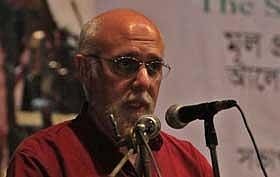
Dhaka, July 21 (bdnews24.com) — Lawrence Lifschultz thinks the government should find the number of military officers who 'went missing' during a certain period in Zia rule.
"The government should conduct a survey among the families of the missing military officers of 1977–78, so that we could know how and where they died, and where their mortal remains were laid to rest," the veteran American journalist and author said at a discussion on Thursday.
Lifschultz came to Dhaka during the military regime of Ziaur Rahman and became an annoyance for the government at the important turn of the country's political history.
He urged the incumbent government—in whose regime the High Court declared Col Taher's trial illegal and said his execution was a cold-blooded murder—to form a commission to discover the details of the mysterious incidents occurring during that period.
The discussion was arranged by Col Taher Sangsad, on the 35th anniversary of his death.
A number of military officers who fought the Liberation War were allegedly hanged by military tribunals during the regime of Zia, who became the centre of the country's politics after the assassination of father of the nation Sheikh Mujibur Rahman on Aug 15, 1975.
Taher orchestrated a socialist uprising amongst the soldiers and freed then chief of army staff Ziaur Rahman from house-arrest on Nov 7, 1975. He also fuelled Zia's consolidation of power as deputy chief martial law administrator.
However, only 17 days after the takeover by Zia, Taher was arrested. A total of 33 people, including him, were tried in a secret court martial inside Dhaka Central Jail on June 17, 1976.
Of them 16 were released, while 17 were handed down various sentences. Three of them, including Taher, were sentenced to death. However, the death verdicts of the other two were later reduced to life imprisonment.
Taher, a Liberation War sector commander, was executed on July 21, 1976, four days after the military court order.
During the trial, Lifschultz came to Dhaka as the South Asia correspondent for the Far Eastern Economic Review and tried to gain access to the secret trial being held at Dhaka Jail.
But, the government of Zia, who founded the BNP, expelled him from the country.
On Mar 22 this year, the High Court declared Col Taher's execution illegal, calling it a cold-blooded murder given the shape of a trial as per Ziaur Rahman's plan. It asked the government to consider him a martyr and file a case against the judge of the military tribunal.
Lifschultz, who wrote the book
Bangladesh: The Unfinished Revolution
comprised his own views on the political incidents taking place during the murder of Taher, hailed the High Court verdict as historic.
"The incident of Taher murder is a part of the missing history of Bangladesh and the High Court verdict established justice through its historic verdict this year," he said.
'I HOPE FAKHRUL WILL SPEAK'
The US journalist, who had testified in court on the Taher trial, said BNP leader M K Anwar after his testimony had said 'the government has hired a foreign journalist'.
"I had called Anwar and requested a talk. He refused me."
He added that acting secretary-general Mirza Fakhrul Islam Alamgir had later said the same thing.
"I called Mirza Fakhrul Islam Alamgir when I came to Bangladesh this time. I hope he will talk," Lifschultz said.
In July, 1971, Taher along with several other Bengali officers defected from the Pakistan Army Staff College and crossed over the border near Abbottabad, West Pakistan, into India.
He was the commander of Sector 11 in the Liberation War.
On November 14, (his birthday) Taher was injured and lost a leg during a battle at Kamalpur near Dhaka.
A Bengali novel titled
Crutch er Kornel
(The Colonel of Crutch) on the battle at Kamalpur has recently been published.
For his valour he was awarded Bir Uttam.
"Taher was an inspirational character. His life story should be told to the present generations so they can be inspired by him," Lifschultz said.
bdnews24.com/sn/pd/sh/ost/nir/2100h