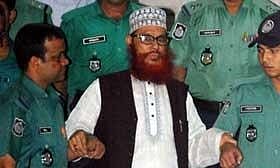
'Upon Sayedee's signal, a Pak soldier shot him'
Another prosecution witness puts the Jamaat leader at the scene of arson, loot and murder on May 8, 1971 Full story
bdnews24.com News Service
bdnews24.com
Published :
09 Jan 2012, 08:45 AM
Updated :
09 Aug 2022, 03:17 PM
Dhaka, Jan 9 (bdnews24.com) — Another prosecution witness on Monday put Jamaat -e-Islami leader Delwar Hossain Sayedee at the scene of an arson, loot and murder on May 8, 1971.
The 11th prosecution witness against Jamaat-e-Islami executive council member gave his deposition at the war crimes tribunal on Monday morning. His cross-examination had been concluded by the close of the day's proceedings.
The International Crimes Tribunal, set up to try crimes against humanity during the Liberation War of 1971, has indicted Sayedee on 20 counts of crimes against humanity including murder, rape, loot and arson.
Abdul Jalil Sheikh, son of a fisherman, said he had witnessed Sayedee, a few other Razakars — a group notorious for collaborating with the Pakistan Army — and Pakistani soldiers loot his neighbour Manik Poshari's house and set it on fire on May 8, 1971.
He then went on to describe the murder of Ibrahim Kutti more elaborately than the previous witness Basudeb Mistri, a carpenter's assistant at that time, who had been working at the Poshari's house on May 8, 1971.
Jalil Sheikh said that that the perpetrators took Ibrahim Kutti and Mafizuddin Poshari in captivity and tied them up. They took them back from the house once it had burnt down. Jalil said he followed them secretly.
"Once they had crossed the bridge, Ibrahim was untied. Then upon Sayedee's signal, a Pakistani soldier shot him."
Jalil Sheikh, just about 60, was being cross-examined by the defence counsellor Mizanul Islam when the court went to lunch recess.
Although one of the three tribunal judges, Justice AKM Zaheer Ahmed, had told the defence that they would control the defence's cross-examination on Monday, there was no such indication except a few instances of muttered disapproval from the tribunal when Islam appeared to be deviating far away from the point.
Justice Ahmed had said that the deposition was rather brief and concise. He insisted that for senior lawyers like those seated among the defence it was nothing but a trifle. "Fifteen minutes for veracity, 15 minutes for denial and 15 minutes for contradiction should be enough," he said.
Mizanul Islam's cross-examination alone was almost as long as the stipulated 45 minutes when the court broke for lunch.
Islam's generally monotonous cross-examination became lively after lunch on Monday as he began to ask Jalil Sheikh regarding his three marriages.
It transpired from the cross-examination that his second wife had filed a suit for torturing her and demanding dowry.
Jalil Sheikh said he had been framed in a false case but admitted that he had given an affidavit to the court saying that he would not beat his wife or demand dowry any further.
He, however, claimed that he wanted to marry again since he was childless and his in-laws only wanted to prevent that by framing him.
Jalil Sheikh had apparently then filed a murder case against his wife, her parents, her brother and other in-laws, which was later dismissed after a police report suggested that it was also a false case.
His second wife Golinur's mother, Motijan Bibi, had apparently filed a case against him alleging that he had swiped a knife on his wife's throat. While Jalil Sheikh admitted that he also had been in jail for seven months in the case, he told the court that the case was later dismissed when the complainant withdrew the charge.
Mohammed Kafil Uddin Chowdhury then came in and first established that being a fisherman's assistant Jalil Sheikh and his father would naturally refer to the Bengali calendar to determine the fishing season and tides and so forth.
Chowdhury then asked if the witness remembered what date May 8 — the day when Kutti was shot dead and when Manik Poshari's house was torched — was in the Bengali calendar. Jalil said he could not say without calculating.
"You have married three times. Do you remember any of those dates?"
The witness said he could not.
"Can you tell me your birth date?"
Jalil said, "No, I can't."
Chowdhury then asked to everyone's surprise, "Do you know your name?"
"Yes, Abdul Jalil Sheikh."
"But according to your marriage documents you have entered your name as Abdul Jalil Howladar, son of Majed Ali Howladar."
The witness said he could not remember.
Tribunal head Justice Nizamul Huq intervened to clarify that sometime the familial surname was used interchangeably with the awarded title like Talukdar and Howladar. "People could refer to the same person has Howladar or Talukdar or by their surname Sheikh and so on."
Chowdhury was followed by Manjur Ahmed Ansari. This defence counsel suggested that the witness had applied to be included in the freedom fighters' list and the government's 'One house, one farm' programme and was testifying against Sayedee only to secure those privileges through the local MP's endorsement, which would be confirmed upon his agreement to be a witness in the case.
Jalil Sheikh denied the suggestion.
The witness also denied the suggestion by Ansari that Delwar Hossain Sayedee, Delwar Hossain Shikdar and Delwar Hossain Mallik are three different people. While Shikdar and Mallik were notorious Razakars (one had apparently been shot while the other had been jailed according to the defence), the witness was knowingly blaming Sayedee with the crimes of the other two Delwars.
Jalil Sheikh said the suggestion was not true either.
Sayedee's is the first case to proceed to the trial at the tribunal. The prosecution on September 4 proposed the framing of charges against Sayedee on 31 counts for crimes against humanity and genocide in ICT Case-1/2011. The tribunal indicted Sayedee on 20 counts on Oct 3.
The tribunal also ordered Jamaat guru, and a former party chief Ghulam Azam, on Monday to appear before it on Wednesday. However, there have no dates for further proceedings in the case against Azam.
Apart from Sayedee, Jamaat chief Matiur Rahman Nizami, secretary-general Ali Ahsan Mohammad Mojaheed and assistant secretaries-general Mohammad Kamaruzzaman and Abdul Quader Molla, and Bangladesh Nationalist Party's standing committee member Salauddin Quader Chowdhury, also a lawmaker, have been detained, along with others, on charges of committing war crimes.
The tribunal, however, on March 31 granted conditional bail to former BNP MP and minister Abdul Alim.
bdnews24.com/ta/bd/1732h