Published :
19 May 2011, 05:11 PM
Updated :
10 Aug 2022, 04:49 PM
Syed Nahas Pasa
London, May 19 (bdnews24.com) – Britain has expressed its concern over the future of Grameen Bank after the ouster of its managing director Mohammad Yunus ,an adviser to opposition leader Khaleda Zia has said.
"The UK government will also observe whether the crisis centring the bank have any negative impact on the micro-credit beneficiaries," Shamser Mobin Chowdhury told bdnews24.com after a meeting between Khaleda and UK state minister for international development affairs minister Allan Duncan in London on Thursday.
He said their discussion covered many other issues including Bangladesh's share market and the UK's development assistance.
Quoting Duncan, Chowdhury said the British government would continue its development assistance to Bangladesh, but would not finance any large infrastructure project.
"Assistance to education and small projects would continue through NGOs]" the British minister was quoted as telling Khaleda, the chief of BNP.
Bangladesh Bank removed Noble Peace laureate Yunus from Grameen Bank on the ground that he crossed the age-limit determined by law for serving a banking institution as its chief executive.
His removal triggered speculation that it would affect the country's relation with donors.
Meeting sources said the UK itself would monitor the works implemented with its assistance to the private sector since "they do not have the confidence in Bangladesh government".
They said the UK government is also concerned over the share market, which saw a debacle recently.
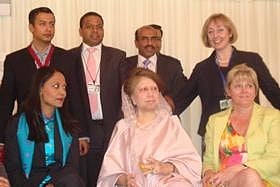
Meanwhile, Khaleda attended a reception accorded to her by the all-party parliamentary group at the House of Commons on Thursday.
Addressing the function, the former prime minister said democracy is being interrupted and human rights violated in Bangladesh.
She came down heavily on the army-installed 2007-08 caretaker government and said former army chief Moeen U Ahmed, who virtually ran the country for two years, pushed the country back 10 years.
Khaleda said though Bangladesh set its journey with Westminster-style democracy after independence in 1971, later it was gagged and one-party rule established.
"Late president Ziaur Rahman re-established democracy after 1975," she claimed.
Journalist Shafiq Rehman, former minister Osman Farruk and former secretary Sabihuddin Ahmed accompanied Khaleda during the reception.
bdnews24.com/corr/ssr/bd/2315h.