Published :
25 May 2012, 07:40 PM
Updated :
09 Aug 2022, 03:49 PM
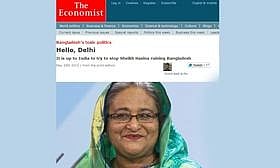
Dhaka, May 26 (bdnews24.com)—The Economist magazine has taken an increasingly hostile snipe at Bangladesh and its government in two more articles where it sees Prime Minister Sheikh Hasina planning to twist election results and cracking down on NGOs.
The disparaging articles appeared on the London-based magazine's May 26 edition, also uploaded on its website on Friday, and also took sideswipes at the opposition led by BNP Chairperson Khaleda Zia.
In one of the stories titled 'Bangladesh's toxic politics: Hello, Delhi', the magazine suggested India try to stop Hasina from 'ruining Bangladesh'.
The other report, titled 'Politics in Bangladesh: Banged about', was no less derisive as it said the Prime Minister was setting the country "on a dangerous path'.
Hasina was at the centre of a fusillade of criticism, with the first story attempting to justify the call for Indian intervention. "Since Bangladesh's political leaders show no interest in their fate, outsiders need to do so."
It then goes on to accuse Hasina of using her party's sweeping mandate in the 2008 polls "to consolidate power and hound her enemies, real and imagined".
"There has been a spate of mysterious disappearances. This month 33 senior members of the opposition were arrested on charges of vandalism and arson.
"A war-crimes tribunal to investigate the atrocities in Bangladesh's war of independence...now looks like an attempt to discredit the BNP and its Islamist allies."
It urges for a shift in India's attitude saying it has the "most telling" influence in Dhaka.
The Economist leader charged the government with pursuing Mohammad Yunus, which is "seen as payback for his temerity in 2007 in trying to launch a "third force" in politics". The Hasina administration "announced a review into ownership of Grameen, a move to take over (and probably destroy) the bank".
The publication was unrelenting in its attack on the Awami League-led government.
The second article continues: "One of the country's best known figures, Muhammad Yunus of Grameen Bank, has been harassed for some time. An increasingly paranoid Mrs Hasina sees him as a political threat."
And it quotes the man himself as saying: "We are very worried that the commission has been formed and terms of reference include ownership."
Then the piece again urges India to intervene, saying it could change things since it has "much influence in Dhaka".
"Until recently the regional superpower tolerated Sheikh Hasina's excesses... India now seems to be hedging its bets between the two parties. But if it still wants to have a functioning democracy next door, it needs to speak out far louder in favour of it," the first piece concludes.
Interestingly, the second one tries to feel the pulse of the Indian ruling class.
"India's ruling Congress party may now, sensibly, be hedging its bets. Pranab Mukherjee, India's finance minister, called on Mrs Zia recently, inviting her back to Delhi. Mrs Zia chuckles that she will go after Delhi's summer heat is past."
The write-up enlarges on the political volatility in Bangladesh and draws an analogy between Prime Minister Hasina and the drivers on crowded Dhaka streets.
"Drivers skilled at furious honking are also masters of compromise and smiles."
Make of that what you will.
Hasina came in for more scathing criticism for tinkering with the constitution with the next general election in sight.
It goes: "Although she did mess with the constitution, scrapping arrangements she had previously insisted on in opposition for a neutral caretaker to run the government for three months before election day, she now appears to want to keep her options open, possibly in order to be better able to skew the outcome of the next election."
The government was also castigated for a spate of mysterious killings and disappearance of M Ilias Ali, murder of a Saudi diplomat, "a trade-union activist tortured and murdered; a pair of journalists butchered after investigating corruption".
"This correspondent was trailed in Dhaka by a pair of secret-service men on a motorbike. A rumour of a bizarre coup attempt, in January, was used by the government to get closer political control over the army."
The magazine then announced that it will be none other than Hasina who will have to take the blame for what apparently looks like a violent political storm on the horizon.
"Uncertainty leading up to the next election, and growing anxiety among diplomats and foreign observers of Bangladesh, suggest a hard, tense time ahead. More than anyone, blame the driver."
Smear campaign
The Bangladesh government had accused the magazine of running a "smear campaign" against the country after it ran an article which said India had helped and funded the ruling party's election victory in 2008.
In a story titled Embraceable You on July 30 last year, The Economist wrote that relations between India and Bangladesh had "blossomed" ever since "2008, when the Awami League, helped by bags of Indian cash and advice, triumphed in general elections in Bangladesh".
It sparked incandescent outburst even from many independent political observers and brought a swathe of reaction from the ruling think-tank.
Foreign Minister Dipu Moni had told bdnews24 that the report was "disgraceful".
Moni said the magazine had earlier opposed the International Crimes Tribunal to try those Bangladeshis accused of collaborating with the Pakistani forces and committing atrocities during the nation's independence in 1971.
bdnews24.com/trb/bd/0115h