


Published : 22 Aug 2013, 12:11 AM
Updated : 09 Aug 2022, 11:02 AM


Of these, two trials concerning a grenade attack on an Awami League rally in Dhaka on Aug 21, 2004, has made some headway, but the other four have remained stuck.
The four that have seen minimal progress include two related to hurling of bombs on Hasina’s residence at Dhanmondi on Aug 10, 1989, allegedly by Freedom Party activists, one for planting 76 kg of explosives on Jul 20, 2000, near Kotalipara, venue of a rally she was supposed to address, and another for an attack on her motorcade at Kalaroa, in Satkhira, on Aug 30, 2002.
All cases, barring the one on the Satkhira incident, are pending in different Dhaka courts, showing no indication yet of when they would end.
Freedom Party bomb attack
Trials in the cases filed over a bomb attack on Hasina in Dhanmondi 24 years ago are in limbo, as the magistrate recording the statements of the accused remains untraced.
Dhaka’s Fourth Additional Session’s Judge’s court, where the cases are now pending, summoned the then Metropolitan Magistrate of Dhaka, Afzalur Rahman, who had recorded the statements of three accused, several times.
But the magistrate did not turn up, prompting the judge to defer the recording of deposition.
Non-bailable arrest warrant issued for the magistrate was sent to his permanent address in Bilwali village, under Tangail, to no effect.
According to the case documents, a group of 10-12 people, led by Freedom Party activists ‘Kajal’ and ‘Kabir’, attacked Hasina’s Dhanmondi house, hurling bombs and firing several rounds.
Three accused in the case – Rezaul Islam Khan, Md Liakat and Humayun Kabir – confessed to having carried out the attack to kill Hasina at the behest of Freedom Party leaders Abdur Rashid and Bazlul Huda.
Both men were later hanged for their involvement in the murder of Bangabandhu Sheikh Mujibur Rahman and most of the members of his family.
Kotalipara bomb case
Trial in the case over the planting of bombs at Kotalipara, pending at Dhaka’s Speedy Tribunal-2, is making no headway, as the public prosecutors is unable to present witnesses before the court.
According to the case documents, police on Jul 20, 2000, recovered 76 kg of explosives planted near Sheikh Lutfor Raman College at Kotalipara, where Hasina was to address a rally two days later.
Kotalipara Police Station Sub-Inspector Noor Hossain filed a case under the Explosives Act, framing charges against 16 people on Apr 8, 2001.
A supplementary charge-sheet was filed on Jun 29 in 2009, when the Awami League-led government came to power, accusing another nine people.
A Gopalganj court recorded the depositions of 41 witnesses out of total of 89, but the case was transferred to Dhaka’s fast-track tribunal in Sept, 2010.
State counsel in the tribunal Syed Samsul Haq Badal told bdnews24.com that they were having problems bringing the witnesses to Dhaka. “To tell the truth, we’ve landed in trouble following the order recalling the witnesses from the Gopalganj court.”
Aug 21 grenade attack
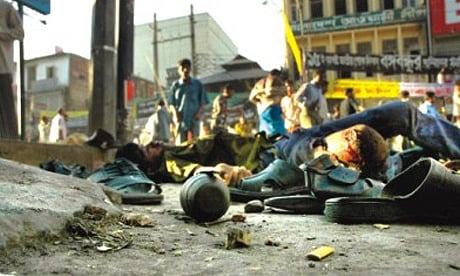
The court is still recording the testimonies of witnesses in the Aug 21 grenade attack case, five years after trial began.
The attack was launched moments before Hasina began her speech at a rally on Bangabandhu Avenue in 2004.
Though the Awami League President escaped the attempt on her life, 23 people, including Mohila Awami League chief Ivy Rahman, were killed and many injured.
Statements of 71 witnesses out of a total 491 have so far been recorded.
Awami League, an opposition party at the time, alleged that the BNP-led government diverted the course of investigation. The Criminal Investigation Department (CID) had directed the investigation against a vagabond, Joj Mia. Three investigating officers (IO) were later sued for trying to scuttle the probe.
The sixth Investigating Officer, CID's Fazlul Kabir, filed the charge-sheet in June, 2008, accusing 22 people, including Harkat-ul-Jihad-al-Islami, Bangladesh (HuJI), leader Mufti Abdul Hannan.
Special Superintendent of Police Abdul Kahhar Akand carried out further investigations under the current Awami League government, adding another 30 people to the list of accused, including then the Prime Minister Khaleda Zia's son Tarique Rahman.
The case of the gruesome attack was shifted to the Speedy Trial Tribunal and again sent back to the Sessions Judge’s court, as the fast-track tribunal failed to complete the trial with the stipulated 135 days.
After a new set of accused were named in the supplementary charge-sheet, the case was again transferred to the Speedy Trial Tribunal.
Shahed Noor Uddin of the tribunal, set up at Nazimuddin Road in Old Dhaka, recently recorded the deposition of the 72nd witness, former Deputy Director of RAB Mohammad Atiqur Rahman, and fixed Aug 26 for the next hearing.
Before Rahman, the tribunal recorded the deposition of police constable Ahsan Habib, bodyguard of Abdus Salam Pintu, Deputy Minister in the previous BNP government. Pintu is behind bars at present.
Witness Mizanur Rahman, a Navy Lieutenant Commander working for the Directorate General of Forces Intelligence (DGFI), said the grenade attack plan was finalised at meetings held on Aug 18 and 19 at Pintu’s residence, where Pintu’s brother, Maulana Tajuddin, and Harkat-ul-Jihad-al-Islami, Bangladesh (HuJI) leader Mufti Abdul Hannan and Abu Taher were present.
He said Mufti Hannan divulged during questioning that the then State Minister for Home, Lutfozzaman Babar, also attended the meetings.
Apart from Tarique, the 30 new accused in the supplementary charge-sheet include Khaleda's former Political Secretary Harris Chowdhury, Jamaat-e-Islami Secretary General Ali Ahsan Mohammad Mujaheed, former BNP MP Shah Mofazzal Hossain Kaikobad, former State Minister for Home Lutfozzaman Babar, Khaeda's nephew Saiful Islam Duke, former NSI Directors General Rezzakul Haider and Abdur Rahim, former Inspectors General of Police Mohammad Ashraful Huda, Shahidul Haque and Khoda Bakhsh Chowdhury.
Nineteen accused, including Tajuddin, have remained at large.













