


Published : 10 Aug 2021, 12:46 PM
Updated : 14 Oct 2022, 06:56 PM


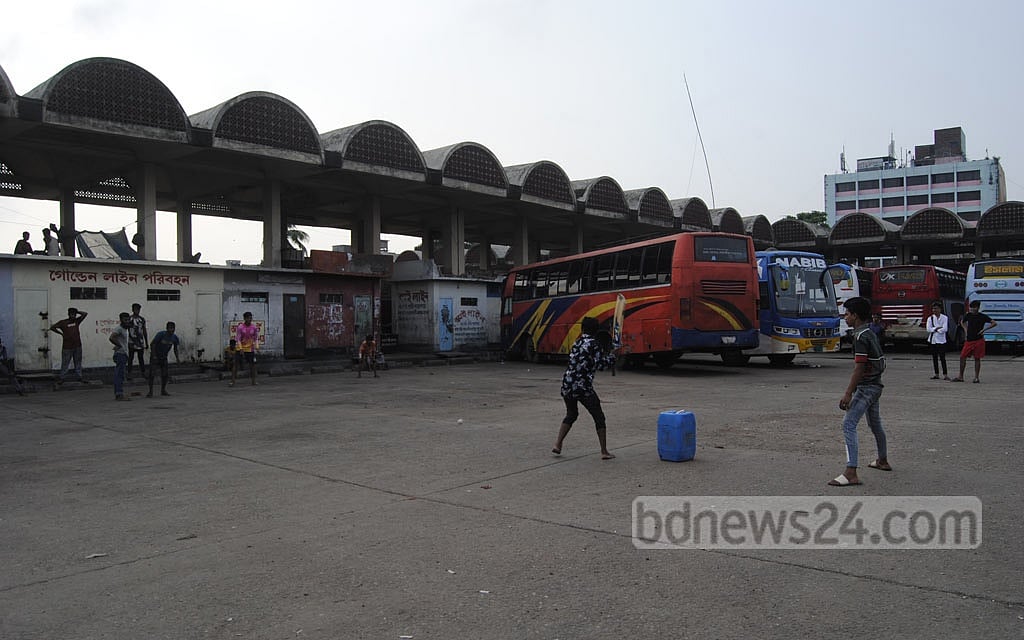


The buses, which will start their trip from Dhaka to Kushtia’s Kumarkhali on Tuesday night, were getting repainted as well.
Abdur Razzak, manager of Zaman Paribahan, was busy supervising. Each of the buses has one or two staff who stay in the terminal and sleep inside the buses at night. A few of these workers were playing board games, while others played cricket in the open space inside the terminal.
“As the buses are not running now, they are going out of order quite frequently. It wasn’t the case when we were operating the buses regularly,” said Manager Abdur Razzak.
Two buses of the Zaman Paribahan fleet had their air-conditioning systems break down as they were not running during the lockdown. It took more than Tk 60,000 to repair the compressor, condenser and other parts, Razzak said.
“On top of that, we need to feed the staff, change engine oil, fix the brakes, and grease the machinery parts. Altogether, the amount of financial damage for two AC buses will surpass Tk 100,000,” he said.
“Apart from these issues, all buses had to go through servicing work. Their hydraulic brakes and the cylinder bucket for the clutches got inflated and broken due to non-operation.”
Batteries in some buses went out of order. Each battery costs Tk 30,000, he said, adding that he made sure each of the bus’s engines is started every day to prevent this battery failure.
“But we needed to pay two staff members Tk 600 each per day to do this job. Then you calculate the petrol price and other repair work like fixing clutch buckets or putting grease. It’s only expenses.”
Kamal, who runs a vehicle mechanic shop, has been busy at the Gabtali terminal for the past few days. He has contracts with several transport companies operating buses on the Satkhira-Khulna route to mend their vehicles.
“Bus owners are compelled to spend a huge amount to maintain their buses and keep them fit to hit the road again, after days of lockdown when they were not operated,” he said.
“Some owners have requested me to do the repair work and they’ll pay me later. But I have to feed my family too.”
Kamal needs at least Tk 20,000 per month to pay the rent for his shop and pay his staff, he said. He has a daughter and another child on the way. After a slump in his income due to the lockdown, he has started to earn again but that too, on a limited scale, he said.
Abdul Baten, a driver of Diganta Paribahan, was having a cup of tea inside the bus terminal.
“Bus owners are definitely facing financial trouble - but think of our situation. We don’t go home as we can’t pay the rent or feed our families. Who is embezzling the money we paid for workers’ welfare? You should look into the matter,” Baten said.
No labour leader gave them any aid, not even a kilogram of rice, during the lockdown, said bus driver Ashraful. The Dhaka North City Corporation mayor had sent aid packages for 1,000 transport workers on Monday.
Many labour leaders sent their own associates to the terminal to collect the relief goods, complained bus workers. Therefore, regular transport workers did not receive the relief packages, despite having identification cards.
Many workers complained about their leaders for not helping them. Some of them even used abusive language.
“They claim to be workers’ leaders but never pay any heed to us,” said one worker. “They extort money from us across the country when the buses run, but no one comes forward to help the workers who are starving.”
WHO WILL ENFORCE BUS ROTATION?
The Cabinet Division, in a notice on Sunday, lifted almost all lockdown restrictions starting on Wednesday, Aug 11. The order, however, asked the transport owners to use half of their fleets at a time and rotate them once the lockdown was lifted.
Transport owners have demanded that they are allowed to run all buses, but only take half their capacity of passengers instead of going to the trouble of making a rotation.
Road Transport Minister Obaidul Quader also questioned the new rules.
Transport workers said they are waiting to see how the government can implement this new rule.
“I myself don’t know how many buses there are in my company’s fleet. How’ll they count the buses to see who is operating half of their fleet?” said bus driver Abdul Baten.
“Do you think the police will count buses on the streets? Many owners have only one bus. What will they do?”







