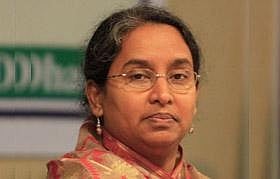
Transit fee must: FM
Apart from bearing part of the infrastructure costs, the countries that will avail of transit facility must pay fees for the services, the foreign minister has said.
bdnews24.com News Service
bdnews24.com
Published :
23 May 2011, 04:46 PM
Updated :
10 Aug 2022, 04:51 PM
Dhaka, May 23 (bdnews24.com)—Apart from bearing part of the infrastructure costs, the countries that will avail of transit facility must pay fees for the services, the foreign minister has said.
"It doesn't make any sense if Bangladesh only focuses on recovering the costs of building transit infrastructure. It'll also ask for its share of profits for service to other countries," Dipu Moni told a press briefing at her ministry on Monday.
"We make profits from goods trading and now we're selling a service, and it should be a win-win situation for all the countries," she added.
Earlier, prime minister's economic affairs advisor Mashiur Rahman had rejected the idea of transit fees, saying it was against World Trade Organisation rules (WTO).
According to WTO rules, transit facility should not be used to enhance revenue but to pass the benefits on to the customers, he had said.
"Had Bangladesh been an uncivilised country or its leaders illiterate, they could have asked for transit fees, but that's not the case," he said.
"The shipment cost of India will reduce significantly due to transit facility as it is expensive to send goods through 'chicken neck' in Assam," Mashiur added.
The foreign minister said it was difficult to determine transit fee as many factors or components were involved here.
"Transit fee is a big issue and we are yet to determine the cost and its component, but it's certain we'll ask for service charge and it is included in the WTO provision," she said.
"Before fixing any fee, Bangladesh will consult the user countries," she said.
Necessary infrastructures will have to be built for providing transit and if the fee is too high, other countries may not like to use it, she added.
KHALEDA ZIA
Dipu Moni said it was quite normal that the prime minister or the leader of the opposition would meet political leaders and government officials during their visits abroad.
When her attention was drawn whether the government is embarrassed as Khaleda discussed internal affairs of the country with foreign officials, she said, "I'll leave it to people whether they feel embarrassed when she lodges complaints with the foreign persons."
Khaldea Zia is now in New York following a tour of the UK.
The minister said she could discuss and resolve internal issues in parliament but it was not a good practice to lodge complaints with foreign people.
JOINT COMMUNIQUÉ
The minister said a good progress had been made to implement the joint communiqué declared during the visit of prime minister Sheikh Hasina to India last year.
"Foreign ministries and other implementing-agencies of both the countries are monitoring the development," she said.
"There has been substantial progress in sharing Teesta River water and reduce the trade gap between the countries," she added.
Asked about the visit of the Indian prime minister to Bangladesh, she said the date was yet to be fixed.
RELATIONS WITH US-FRANCE
Bangladesh has maintained a very good relation with the US and France, and the recent developments (Grameen Bank and Prof Yunus issue) do not have any impact on the relations, she said.
"We accepted a Libyan offer to send its delegation considering the interest of Bangladeshis still living there but the US government did not welcome it," she said.
"They (US government) have their perception about the issue and differences of opinion were normal in diplomacy," she added.
"We have about 30,000 Bangladeshis still living in Libya and we must consider it," Moni said.
About the relationship with France, she said no recent development had any impact on Bangladesh and France relationship. "I don't see any reason for that."
"A special envoy of the French president visited Bangladesh last month and wanted to know the government view on Grameen Bank and Prof Yunus issue and I told him that it is a legal issue."
Grameen Bank is a statutory body and Prof Yunus went to court and received the verdict from the highest court of the country, she said.
About G-20 summit meeting, she said Bangladesh had been trying to include itself as a member of the prestigious body.
"Be it an observer state or a regular member."
"The decisions taken in the G-20 meeting have impact on the whole world, but there's no representation of any least developed country in the powerful body," she said.
Bangladesh is an eligible candidate to discuss the plights, including climate change, to women empowerment in the forum, she said.
"If it is not possible in this meeting, we'll try in the next meeting," she added.
HUMAN RIGHTS SITUATION
The government is trying to improve the human rights situation in the country.
About human rights 'violation by elite force RAB', she said the state was not patronising them.
"The basic difference between the Awami League and BNP governments is that RAB was engaged in state-sponsored extrajudicial killings, but the present government was not doing that," she said.
RAB was created by the BNP government and one should not expect that the character of an organisation would change overnight after the change of government, she said.
"No force is above the government and they are also brought to book for their misconduct," she added.
bdnews24.com/ssz/mr/1900h