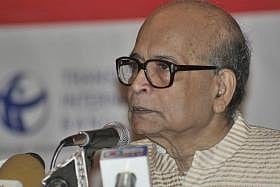
Top civil society leaders react
Grameen Bank's deal with a family business comes into question as prominent personalities term it illegal and unethical. UPDATES
bdnews24.com News Service
bdnews24.com
Published :
04 Jan 2011, 07:40 AM
Updated :
10 Aug 2022, 04:09 PM
Dhaka, Jan 4 (bdnews24.com)—Prof Muzaffer Ahmed, a top economist and former chairman of the trustee board of Transparency International, Bangladesh, has sharply reacted over the Grameen Bank controversy in selecting beneficiaries.
"I do not consider it an act of any moral standards," said Prof Ahmad who has spearheaded the national anti-corruption campaign for years as head of Transparency International Bangladesh.
"Nor was it legal," he said.
"Grameen Bank was mandated to dispense micro loans for poor people. Getting into such a contract with a family business was not morally right," said Ahmad.
Muzaffer, also chief of Sujan, a citizens' platform for justice, asked, "Why didn't Bangladesh Bank take any action then? Why didn't those who run the government at the time take any steps?"
A former head of chief of the state-run Bangladesh Sangbad Sangstha, Foyez Ahmed, was fiercely critical.
"The deal must have something to do with personal interest," he told bdnews24.com.
"The fact that the firm is family owned obviously has certain undertones," he said.
"A lot about him is just myth," said the octogenarian journalist and added that the Nobel laureate "had never been selfless in any of his initiatives".
Citing Yunus' activities beside Grameen Bank, he said, "His [Yunus] other activities should also be questioned."
Though there were several opinions against microcredit, Grameen Bank managing director Yunus was recently subjected to widespread debate on siphoning foreign funds of the bank to another organisation.
The criticisms did not end as the latest report on controversy over selecting beneficiaries was published on bdnews24.com.
According to the report, a Chittagong-based packaging company appointed Grameen Bank as its managing agent in a deal, struck 20 years ago, giving the bank a job having nothing to do with its core business.
Yunus signed the deal for Grameen Bank, granting the micro-lending entity all rights—just ownership aside—to run and manage the packaging business.
His father, Muhammad Dula Meah Saodagor, represented Packages Corporation as its managing director, in an apparent case of conflict of interest. He along with his sons owned the company incorporated in 1961 as Pakistan Packages Corporation.
The family owns the company, and Yunus still sits on its board as a shareholder director, according to documents obtained by bdnews24.com.
Signed on June 17, 1990, the contract was initially valid for 15 years. Three of Yunus' brothers—Muhammad Ibrahim, Muhammad Azam and Muhammad Jahangir—signed as witnesses to the contract between the father and the son who would secure a Nobel peace prize 16 years later.
The Grameen Bank managing director has evaded bdnews24.com requests for a face-to-face interview.
Under the 1990 deal, Packages Corporation was allowed to deploy Grameen Bank employees and managers, to be sent on "deputation" from the Yunus-run non-profit, to boost dividends for the family business.
Grameen Bank told bdnews24.com that six managers or executives had gone on "deputation" so far.
The deal also created room for Grameen Bank to invest in Packages Corporation. According to the contract, such investments would be considered as loans given by Grameen Bank to the business.
The Bank said on Monday it did not lend any money to Packages but that Social Venture Capital Fund (SVCF) of the Bank gave the loans.
The SVCF fund channelled to Packages until 1993 amounted to Tk 30 million, the Bank told bdnews24.com.
For the last 17 years, Grameen Fund has been lending Packages Corporation. The Grameen Bank responses to bdnews24.com queries did not include the loan figures after 1993.
The contract further says that any profits generated from any printing work done for Grameen Bank would be diverted to Grameen Trust. Such profits would be calculated in consultation with the Trust.
Grameen Bank said on Monday that no money had been donated in the last 20 years to Grameen Trust.
bdnews24.com/mhc/pc/mi/ost/ec/bd/1640h