Sticky foods 'raise dental disease risks'
Changing food habit is raising the risk of dental diseases in Bangladesh as most of the people do not brush properly, dentists say.
bdnews24.com News Service
bdnews24.com
Published :
19 Sep 2011, 04:07 PM
Updated :
10 Aug 2022, 05:28 PM
Dhaka, Sep 19 (bdnews24.com)—Changing food habit is raising the risk of dental diseases in Bangladesh as most of the people do not brush properly, dentists say.
"People across the country are now taking snacks and sticky foods like chocolates and biscuits, but most of them do not brush teeth properly," Dr Khurshid uz Zaman, a gum disease expert, told bdnews24.com on Monday on the sidelines of a seminar in the capital.
"Such behaviour can cause dental caries and gum diseases. It increases the risk of heart diseases and premature delivery," he said and advised people to use 'soft and small' brush.
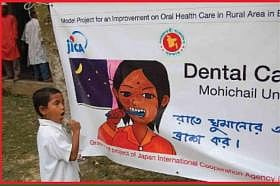
Directorate General of Health Services (DGHS) and Japanese International Cooperation Agency co-organised the seminar to evaluate the JICA's 'oral healthcare in rural Bangladesh' project.
The three-year project at different schools of Chandina Upazila in Comilla district showed the number of students who brush their teeth at least twice a day increased from 15 percent to 50 percent after counselling.
DGHS director general Prof Khondhaker Mohammed Shefyet Ullah said the project experience would help 'to enhance dental service delivery in future.'
"We kept oral healthcare in the draft operational plans of the next five-year health sector programme (HPNSDP)," Shefyet Ullah said.
JICA senior representative Shigeki Furuta pointed out that oral health should be 'more highlighted' as there would be 'more people with more bad teeth' ahead due to changing food habit.
He said in near future Bangladesh might experience the same problem Japan faced in 1960s and 70s when dental caries increased 'rapidly'.
Changing people's behaviour towards brushing teeth, according to Furuta, is 'not easy but an important step toward maintaining long-term oral health.'
Under the school-based project, 4,000 students were motivated to maintain oral health through pictorial stories and demonstrations from dentists.
"Teachers were also trained up with proper tooth brush instructions," Dr Zaman, also a team leader of the project, said and added that buying tooth brush and paste have increased from 40 percent to 80 percent after motivation.
He said poor oral hygiene allows a number of bacteria that live in the mouth to flourish and bleeding gums gives them direct access to the bloodstream.
"It increases the risk of heart attack and premature births."
bdnews24.com/nih/bd/2152h