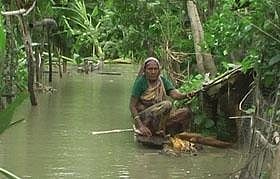
SPECIALShort sight hits UN project for Sidr victims
Hundreds of women were seen standing in line for hours to get a sheep from the US official Ertharine Cousin on Sep 28.
bdnews24.com News Service
bdnews24.com
Published :
08 Oct 2010, 09:23 AM
Updated :
24 Apr 2022, 05:42 PM
Kamran Reza Chowdhury
bdnews24.com senior correspondent
Dhaka, Oct 08 (bdnews24.com)--Hundreds of women were seen standing in line for hours to get a sheep from the US official Ertharine Cousin on Sep 28.
Over 200 affected people of the 2007 cyclone (Sidr) in Sharonkhola and surrounding areas were brought in front of the Parisha Union Parishad building by the local NGOs to get the cattle head from Cousin, who was present at Sharonkhola upzilla in Bagerhat, on Sept 28, to distribute sheep among the cyclone Sidr victims.
Cousin, the US ambassador to the UN agencies in Rome, had come to Bangladesh to see some of the donor-funded development projects implemented by the UN agencies.
The officials of the government and the Food and Agriculture Organisation in Dhaka briefed Cousin about a rehabilitation project on agriculture and she praised the UN efforts in Bangladesh.
The recipients, standing hardly 15 metres away from the herd of sheep being distributed free of cost, however, thought differently and pointed out a basic flaw in the project design.
Rahima Begum, who hails from Kadomtola village under Rayenda upazila of Bagerhat district, was one of the hundreds of women in line for hours on the day.
"We come to know from the officials that we will get an ewe only. No ram will be distributed," Begum, in her 30s, told bdnews24.com.
"How will the ewe give birth without a ram? Where will we get a ram?" Begum said, with a bashful smile, before taking her ewe.
Other waiting women supported her and said the project would "fail" if they were not provided with rams.
"Sidr washed away almost all of the cattlehead in Sharonkhola. If they don't give us ram, this ewe will not benefit us," Rizia Begum, another recipient from Kadomtola village, told bdnews24.com.
The upazila livestock officer of Sharonkhola supported the villagers.
"According to the last cattlehead survey in 2009, there are only 14 sheep in the whole Sharonkhola upzilla. Of the 14, maybe three are male," Baktiar Hossain, upzilla livestock officer in Sharonkhola, told bdnews24.com on Thursday.
"This means that we have three rams for 44 villages. Is it possible for three rams to meet one thousand ewes?" questioned Baktiar.
"There is no component of providing rams or male goat among the beneficiaries. The project approach is natural breeding (meaning people will manage the male for reproduction)," Dr Mohammad Ruhul Amin, an assistant director of the government's livestock department, on Monday told bdnews24.com at his office in Dhaka.
"We have been told to prepare a project for US$5 million. Therefore, that component (providing rams) has been cut," said Amin, who facilitates the FAO livestock component of the "Emergency 2007 Cyclone Recovery and Restoration Project" with the government.
Md Abu Sayeed Mia, FAO's livestock production specialist, on Thursday told bdnews24.com that about 1000 sheep would be distributed among the villagers in Sharonkhola upzilla as the area was suitable for sheep breeding.
He confirmed that FAO would distribute 8,750 sheep and 8,750 goats in 13 upazilas of six districts hit by Sidr in four years (2010-14). The FAO on Sept 27 launched the distribution of cows, goats and sheep for the livestock component of the project.
Mia said, "Providing rams or male goats among the beneficiaries has not been included in the original project proposal. But we are now thinking of distributing males for breeding".
Mia said he would be able to manage one ram for 20 ewes and distribute them among the poor villagers.
Ad Spijkers, the FAO representative in Bangladesh, told bdnews24.com on Sunday that his organisation could have distributed more cattlehead if the UN body could have mobilised more funds.
Spijkers said had there been enough money, the rams could have been distributed.
The FAO earmarked 13 upazilas of six southwestern districts of Barisal, Jhalakathi, Bagerhat, Pirojpur, Barguna and Patuakhali for the "Emergency 2007 Cyclone Recovery and Restoration Project," at a cost of US$16 million.
FAO and the livestock department officials have said the World Bank has lent US$16 million for the same; meaning the state would have to repay the money, with interest, regardless of whether the project had benefited the people.
Of the US$16 million, US$5 million had been allocated for the livestock component of the project.
The project, which relevant officials took one year to plan and design, started in 2009 and will expire in 2014.
The FAO officials say they would distribute more cattle in other areas, in phases.
The US funds the Food and Agriculture Organisation (FAO), World Food Programme (WFP) and the International Fund for Agricultural Development (IFAD) for different development projects in Bangladesh.
Baktiar said Sidr had washed away 4,367 heads of cattle and 7,132 sheep and goats in 2007.
bdnews24.com/krc /tk/bd/1442h