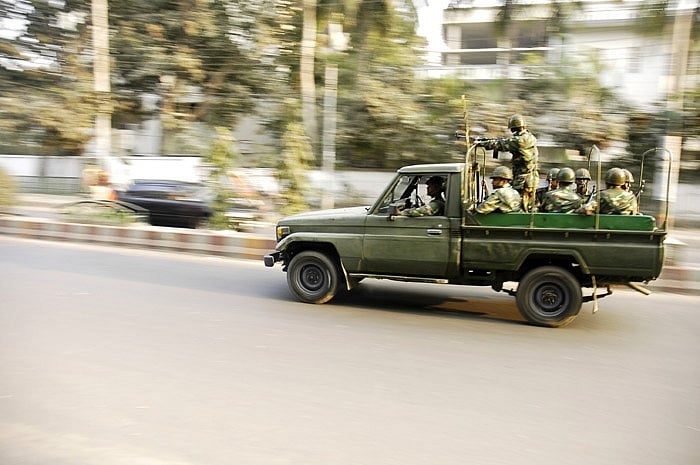
The Transparency International Bangladesh (TIB) analysis found that those armed forces personnel made money and properties after extending their area of influence, violated the constitution, law and human rights, and controlled the media during the regime.
The report, first of its kind in Bangladesh, has been based on interviews of more than 200 people that include advisors to the then caretaker government, local government representatives, former and present parliamentarians, ministers and state ministers, businessmen, retired military chiefs and high officials, officials of various public and autonomous bodies, lawyers, politicians, university teachers, analysts, professionals from diverse fields, owners of televisions and newspapers, and editors and journalists.
They gave information based on individual experiences.

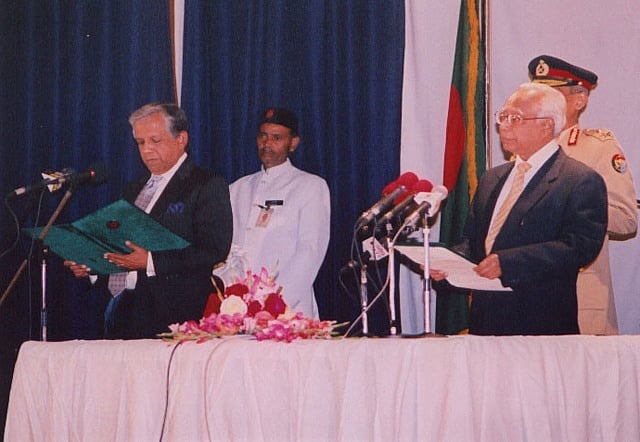
তত্ত্বাবধায়ক সরকারের প্রধান উপদেষ্টা হিসাবে ফখরুদ্দীন আহমদকে শপথ পড়াচ্ছেন তখনকার রাষ্ট্রপতি রাষ্ট্রপতি ইয়াজউদ্দিন আহম্মেদ।
তত্ত্বাবধায়ক সরকারের প্রধান উপদেষ্টা হিসাবে ফখরুদ্দীন আহমদকে শপথ পড়াচ্ছেন তখনকার রাষ্ট্রপতি রাষ্ট্রপতি ইয়াজউদ্দিন আহম্মেদ।
TIB Executive Director Iftekharuzzaman said they had cross-checked the interviews from one person with another as they had limitation of ‘accessibility’ to validate the findings.
The research took nearly three and a half years from Jul 2009 to Dec 2012 for ‘collecting information, cross-checking facts, analysis, writing the report and eliciting expert opinion and finalisation’.
Apparently, to put an end to a spate of violence after the regime of BNP in 2006, then President Iajuddin Ahmed had declared the state of emergency.
But the President had to resign from his role as the Chief Advisor of the caretaker government, and the 2007 general elections were forestalled as the Awami League-led political parties accused the caretaker government of being partisan.
A military-backed caretaker government which took office in Jan 11, 2007 lasted close to two years.
According to the TIB report, a section of the armed forces ‘unlawfully’ collected money from corrupt people , promising to get cases against them dropped or for keeping them off the list of suspects or for help in securing bail and remission of punishment.
They also forced people to sell their lands to make the illicit payments. .
Some of the respondents said that those who collected the money from businessmen kept a part of it for themselves and deposited a part into the state exchequer.
It said though the money had been received on behalf of the state, “there was no information about the people who have collected it. ”
Businessmen, industrialists and contractors were tortured after arrest.
The ‘unlawful’ activities also include appointment of berth operator in Chittagong port, increasing charges for keeping containers in the port and awarding a company the port automation project without any tender.
It also said that pressure had been exerted on politicians of the main political parties to join them in a new front that was envisaged.
To keep some politicians out of the election, they had filed cases in the speedy tribunal, arrested them and influenced the trial.
The elected representatives of the local government had also been ‘threatened and tortured both physically and mentally’ in their (military) camps.
Some of the informants told them about the deaths of their family members.
Without serving notices to the alleged hoarders, they had sealed food godowns.
The report said family members had been under pressure to stop legal support to those arrested.
It said the arrested teachers of Dhaka University and Rajshahi University had been kept in an unknown place after arrests and some of them reported that they were tortured.
Arrested people were tortured in the police custody to extract ‘necessary confession’.
It said lawyers had been barred from defending their clients.
They were threatened with arrest and out under surveillance. Dhaka and Supreme Court bar elections could not be held on time.
During the caretaker rule, jail code had been violated , and despite banning all political activities, they had allowed a particular party to be politically active.
The report said media had been controlled and was told ‘what to do or what not to do.’
There were pressures to change the ownership of some private televisions.
Television news was heavily influenced , always to project ‘positive image’ of armed forces and even some audio and video CDs of ‘confessions’ obtained through torture were screened.
The report praised the military’s role for the success of the national ID card project, but said local government representatives interviewed by them had complained of having to pay up for refreshments, furnitures for the camp and other favours.
When one public representative demanded money he spent, he was told by the military : “This (voter ID project) is your work, how and where you will collect money, we are not interested.”
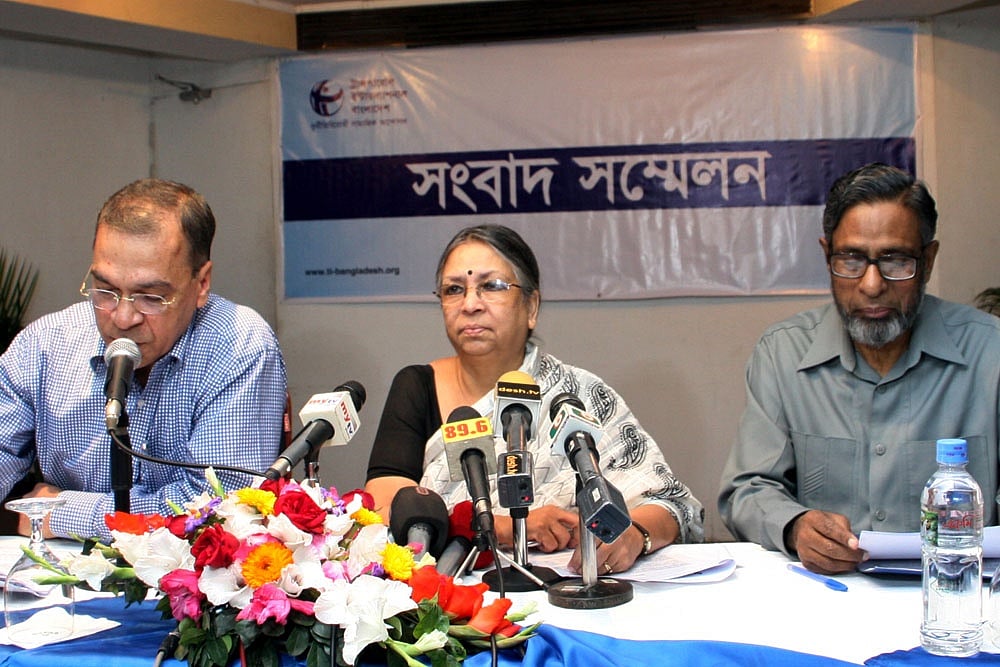
TIB Chairman Sultana Kamal said “a section of the armed forces misused their power and indulged into corruption by taking advantage of the provision of indemnity.”
She suggested revoking the provision of ‘indemnity’ for all law-enforcing agencies and political parties should play a ‘responsible role’ if 1/11 like situation arises in future.
She suggested limiting military involvement in civilian activities and also increasing institutional capacities and skills of the civil law enforcing agencies.
Kamal said there is a general perception that ‘military can solve our problems.’
She said basic things never changed. “I used to receive the same requests (during the military backed caretaker government) that I had received during the political government.”
She said when military-backed government came to power, they abrogated constitutional rights from article 36 to 42 that mandated people’s basic rights including freedom of speech.
TIB Executive Director Iftekharuzzaman said they always try to look into the corruption of any institution .
“After the 2008 Cyclone Sidr, we released a report about the irregularities in distributing relief,” he said. “The caretaker advisers were not happy with that.”
“We want professional development of the military , but they should avoid controversies,” he said.
He said they wished to look into the issues of military purchase if “we get opportunity.”
“Accessibility is a big challenge,” he said , pointing to why the defence budget never gets discussed in the parliament.
Quoting military officers , the report said that if the armed forces were out of their barracks running the country for long time, it will affect their training.
“It harms their professionalism.”