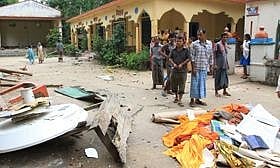
'Sleepless' nights for fearful residents
A week after the communal attacks, fear is still fresh in the minds of the Buddhist residents of Lakhara and Kolgaon villages as they patrol through the nights, Uttam Sengupta has their story.
bdnews24.com News Service
bdnews24.com
Published :
07 Oct 2012, 09:59 AM
Updated :
09 Aug 2022, 04:20 PM
Chittagong Oct 6 (bdnews24.com)—Scare of communal violence has etched deep into the hearts of the residents of Lakhara and Kolgaon villages, that house the Buddhist communities of Patia.
They stay up patrolling through the nights to ensure their own security, even a week after the attacks on their temples and residences.
"We might be safe for the time being. But we want assurance that such attacks will not happen in the future," Lakhara village resident Shamiran Barua said.
Religious fanatics, apparently stirred up by a Facebook post allegedly defaming the Quran, attacked a Buddhist locality in Ramu on Sep 29. At least seven Buddhist monasteries, 30 houses and shops were vandalised, looted and torched during the overnight frenzy.
The string of violence continued the following day as similar attacks took place in Chittagong's Patia, and Cox's Bazaar's Ukhia and Teknaf upazilas. Lakhara's Abhoy Buddhist Monastery was attacked and set alight by hundreds of bigots, who marched to the village before the frenzy.
They also attacked the Kolgaon's Rotangkur Buddhist Vihara, Nobarun Shangha Temple and Jelepara Matrimandir.
The males in the village now work during the day and stay up through the night to keep up the patrols, Shamiran added, pointing out that the days were also spent worrying as only the women and children are left behind in the villages.
Ajit Barua, the leader of the local Buddhist chapter, expressed his shock over the violence that befell their village and hinted that the attack could have had outside hand.
"We have the Muslim habitat on the west, our village is in the middle and the Hindu community on the east."
Pointing out that communal peace always prevailed amongst the neighbours, he exclaimed: "Even in 1971, we had no troubles. I don't understand why this attack occurred."
'Workers carried out the attacks'
Locals also alleged that most of the attacks were carried out by workers. Only a few from the area were involved.
Briddhananda Shraman, who was injured during the communal violence, said, "I was sitting inside a room in the temple. The attackers bludgeoned the temple's door, got inside and torched the belongings there."
Eyewitnesses said that around 700-800 people were involved in the attack that day. Most of them were workers from the Western Marine Shipyard.
The workers were wearing their yard overalls and were using large hammers and steel-work equipment as weapons, they added.
The police arrested 26 workers from the Western Marine Shipyard on the following evening after identifying them from the yard's CCTV Cameras. Another 12 were detained later on.
The police filed two cases over the occurrence while another was filed by a religious leader of the Rotangkur Buddhist Monastery.
bdnews24.com/us/su/rn/ano/1523h