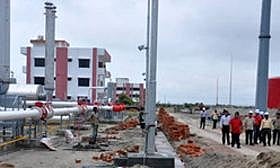
Sirajganj power production begins this month
The 150 MW peaking power plant is ready to go for full commercial production, Reazul Bashar reports after visiting the plant in Sirajganj.
bdnews24.com News Service
bdnews24.com
Published :
03 Nov 2012, 05:47 PM
Updated :
09 Aug 2022, 04:28 PM
Reazul Bashar
Senior Correspondent, back from Sirajganj
Dhaka, Nov 3 (bdnews24.com)—The 150 MW peaking power plant in Sirajganj, one of the biggest set up during this government's tenure, is ready to begin commercial production from this month.
Officials said the plant, situated at Soydabad area on the west bank of Bangabandhu Jamuna Multipurpose Bridge, ran test-production for over a month and would go for full-fledged production from Nov 20.
Power Division Secretary Abul Kalam Azad visited the Sirajganj 150 MW Gas Turbine Peaking Power Plant Project Friday afternoon with a group of journalists.
Power Development Board Chairman Abdul Wahad Khan, Managing Director of North-West Power Generation Company Limited (NWPGCL), the implementing agency and owning company of the plant, SM Khorshedul Alam, and PDB's Public Relations Director Saiful Hasan Chowdhury were also present along with other top officials.
Khorshedul Alam told reporters, "We have started test production at this plant on Oct 18. The commercial production will begin from Nov 20."
The work to upgrade the gas and diesel (duel fuel) based plant to a combined cycle system is still going on. The production capacity of the plant will increase to 225 megawatts in October next year after the work is done.
Abul Kalam Azad said this power plant would automatically run on diesel engine if there was gas shortage. "The system is being introduced considering the crisis of gas."
Under the combined cycle system, the steam turbine will be run with the steam produced from the heat recovery steam generator, which runs from the exhaust of the plant's heated diesel engines, and will produce an extra 75 MW electricity.
The cost to set up the simple cycle power plant was Tk 7.99 billion. An extra Tk 6 billion is to be spent to upgrade the simple cycle to combined cycle taking the total cost to nearly Tk 14 billion.
The plant's Project Director ATM Jahangir Kabir said life time of such power plants estimated to be 15-20 years, but it could run at least for 30 years through servicing.
NWPGCL and China's National Machinery Import and Export Corporation are implementing the project. NWPGCL will run the plant and PDB will buy the produced electricity.
If electricity is produced with gas, per unit cost will be Tk 1.90, of which fuel cost is Tk 0.99 and establishment and operational cost is Tk .90.
NWPGCL MD Khorshedul Alam said they have proposed PDB to purchase power at Tk 2.50 per unit.
The agreement to establish the state-owned power plant was signed on Oct 12, 2010.
Total estimated cost of the project is nearly Tk 14 billion. The Bangladesh government has provided 52.38 percent of the total cost while the rest of the fund came from the Asian Development Bank.
According to the PDB, between January, 2009 and September this year the government signed agreements to set up 59 power plants with a total production capacity of 7,649 MW.
Of these plants, three are rental power plants, 17 are quick rental, 19 are IPPs (Independent Power Producers) and 20 are state owned.
A total 51 power plants with a capacity of 3,595 megawatt started operation during the tenure of present government. These include 20 plants, agreements of which were signed during the tenure of immediate past administration.
Of the 51 plants, three are of capacity of 150 MW. They are – Shikolbaha 150 MW Peaking Power Plant, Sylhet Gas-run 150 MW Combined Cycle Power Plant and Chandpur Gas-run 150 MW Combined Cycle Power Plant.
Power Division Secretary Abul Kalam Azad also told reporters, "The big power plants have started to produce power. We hope that power production will increase by 600-800 megawatt within the next six months."
According to PDB, the country's daily production of electricity is 5,700 to 6,000 MW against a demand of 6,600 MW.
The power plants in the country, however, are capable to produce more power, but they cannot due to fuel shortage.
bdnews24.com/corr/rb/trb/sk/2329h