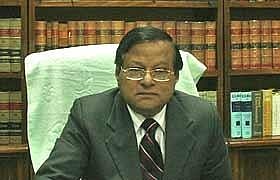
Shafique doubts local bodies
A technocrat minister expresses his apprehensions over the ability of local agencies to administer development work. UPDATES
bdnews24.com News Service
bdnews24.com
Published :
27 Jan 2011, 12:47 PM
Updated :
10 Aug 2022, 04:16 PM
Dhaka, Jan 27 (bdnews24.com) — Law minister Shafique Ahmed has questioned the ability of local institutions to govern development of their electorates.
However, other speakers at a seminar on Thursday which included members of parliament, politicians and economists, spoke out in favour of a strong local government and advocated the idea of establishing a local government commission.
Qazi Kholiquzzaman Ahmad, president of the Bangladesh Unnayan Parishad and also co-chair of the Bangladesh Climate Change Trust, said that he expected the ruling Awami League would set up such a commission in line with its election pledge.
Mujahidul Islam Selim, general secretary of the Bangladesh Communist Party, questioned the manner in which the local government ministry resorts to in retaining its control over the local government. "It is unconstitutional."
The constitution obligates the government to ensure five layers of public representation of which only two are in place — at the Upazila and union levels.
However, the local representatives hold that these locally elected bodies are not allowed to function without the influence of corresponding MPs.
Abdul Majid, president of a platform of Upazila chairmen and vice-chairmen, said the Upazila councils were dysfunctional. "Everything is controlled by the MPs."
"The Upazila chairman does exactly what the MP of that area says," he said at the meeting.
Meher Afroz Chumki, an MP from Gazipur, said that it was a matter of changing one's mindset. She spoke in favour of giving more power to local government but blamed bureaucratic red tape for impeding sincere initiatives of the government.
"If we begin to empower local governments, they would also learn to take on the responsibility. But our closed mindset prevents this from happening."
President of the Jatiya Samajtantrik Dal and also an MP, Hasanul Haq Inu, said there must clearly defined roles for local and central government that would spell out the scope of their work.
He noted that discrimination against the local representatives was only natural in a system with pronounced dualism. He said that the public representatives should be at the heart of development plans. "Development initiatives should be local government-based."
Shafique Ahmed, speaking at the end said he did not disagree with the proposition of the other speakers and was all for decentralisation.
The technocrat minister said, "One must evaluate whether the local agencies are at all qualified to take on the responsibility."
The seminar was organised by the Governance Advocacy Forum and presided over by Kholiquzzaman Ahmad.
Over 400 chairmen and vice-chairmen organised a hunger strike in the capital's Muktangan on Jan 22, putting forth a ten-point demand for empowerment.
Their demands included cancellation of a law stating that the corresponding MP be appointed as advisor to the Upazila council. The charter also calls for 70 percent budget allocation and separate budgets for the local government, and empowering the chairmen to evaluate all government employees under the council.
The local leaders also demanded that they be given charge of 13 offices under 10 ministries in line with the Upazila Parishad Act, allowing the local government organisations to make their own annual and five-year plans, reforming the district councils, formation of local government commission and an integrated law for the local government organisations.
The strike was deferred until March 28 following an assurance from MPs Rashed Khan Menon and Hasanul Haque Inu to fulfil the demands.
bdnews24.com/ya/jh/ta/1830h