


Published : 31 Jan 2014, 10:36 AM
Updated : 08 Aug 2022, 06:26 PM


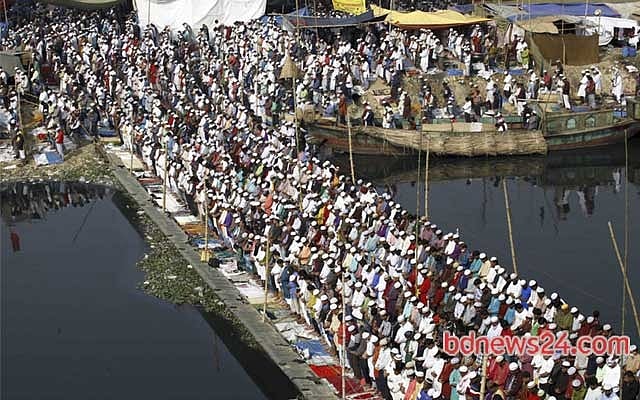
Organised by the Tablighi Jamaat, the Biswa Ijtema is billed as the second largest annual gathering of the faith after Hajj in Saudi Arabia.
The congregation began with Jamshed, a maulana from India delivering sermons after Fazr prayers on Friday. The sermons are being translated into various languages, including Bangla.
However, in the presence of aged devotees, the second phase of the congregation got underway from Thursday’s Magrib prayers with the sermons on belief, obeisance and character.
As was in the first phase of the ijtema (24-26), Bangladesh's largest Jumma paryer will be held at 1:30pm on the first day of the second phase.
The Ijtema are being held in two parts since 2011 as it has become difficult to accommodate such a large number of devotees on the banks of the river.
A five-tier security system has been put in place to ensure security for the devotees and keep peace on the Ijtema premises.
Heavy traffic jam has been created on Dhaka-Mymensigh road since early morning as people have started coming to the Ijtema venue through the road.
Finding no space on the Ijtema premises, many devotees have taken positions by rolling up prayer mats, polythene in nearby places.
Gazipur Superintendent of Police Abdul Baten says tight security measures have been taken for the occasion.
A total of 11000 security workers, including those from RAB and police, have been deployed there. Police and RAB are monitoring the overall security through CC cameras, he said.
Besides this, they are also keeping a watch through binoculars, frisking through metal detectors and have set up control rooms, he said.
The Ijtema firstly began at Kakrail mosque in 1946. Then it was held at Haji camp in Chittagong in 1948 and Narayanganj’s Siddhirganj in 1958.
A total of 160 acres of land was later earmarked as a permanent Ijtema ground.
The second phase of Ijtema will end through Akheri munajat (concluding prayers) on Sunday noon.







