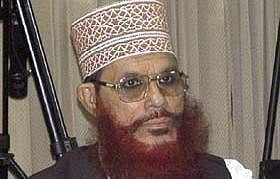
Sayedee trial put off until Nov 20
The Jamaat leader has been indicted on 20 counts for crimes against humanity during the 1971 independence war >> Updates
bdnews24.com News Service
bdnews24.com
Published :
30 Oct 2011, 07:09 AM
Updated :
10 Aug 2022, 05:44 PM
Tanim Ahmed
Dhaka, Oct 30 (bdnews24.com) — The war crimes tribunal has adjourned Jamaat leader Sayedee's trial until Nov 20 after a heated argument with the defence.
The International Crimes Tribunal was set to begin trial of Jamaat-e-Islami executive council member Delwar Hossain Sayedee, who was indicted on Oct 3 for 20 counts of crimes against humanity during Bangladesh's Liberation War.
The charges against him include murder, extermination, genocide, rape, arson, murder and loot.
Proceedings began amid a packed courtroom on Sunday, with observers and journalists standing at the back while other squeezed into benches already full.
Noted anti-war crimes activists like Shahriar Kabir, and convenor of the Sector Commanders' Forum (a platform of army officers who had led the 1971 War of Independence in the field), ex-army chief Harun-ur Rashid were among those seated at one side of the courtroom waiting to hear opening statements that would mark the beginning of the first war crimes trial under this tribunal.
The defence, however, pleaded that before disposing of its petition the trial could not proceed, when tribunal chief, justice Nizamul Huq asked the prosecution to begin its opening statements.
This referred to the defence's petition on Oct 27 that questioned the eligibility of Huq, since he had been party to an investigation committee in 1994 for a people's court that had tried former Jamaat chief Ghulam Azam for war crimes.
The hearing of that petition has been scheduled for Nov 13.
Sayedee's counsel M Tajul Islam said that the trial would become prejudiced if it proceeded until his earlier petition was settled and pleaded for adjournment. Tajul further argued that the defence be given more time to prepare.
He pointed out that the laws state that the defence would be given 'at least three weeks' time. "This is the least time that should be given to the defence and not the full extent of time that the defence might be allowed to prepare."
Later, he told the press that tribunal was now hurrying the defence into the trial although it had allowed the prosecution months on end.
Islam also said that the defence was stipulated to provide a list of witnesses and their details before the trial began. "I cannot submit the full list of witnesses at this time and the beginning of the trial precludes any such possibility at a later date according to the laws."
Justice Huq told him that since the prosecution was ready to proceed he would hear the opening statement and allow the defence to submit its list of witnesses at a later date to which Islam said it would violate the rules.
"The court will use its discretion to allow the defence that privilege and the trial will not be affected."
Tajul Islam objected strongly when the tribunal still insisted on hearing the prosecution's opening statement, to which Nizamul Huq said that since the prosecution was ready to proceed, he was inclined to hear.
Justice Huq pointed out that it was not the prosecution that needed more time but the defence. "The prosecution is ready to proceed. How can you expect to hold up the trial because of a certain petition?"
Tajul firmly objected to that view and told the tribunal that under the circumstances the defence was simply not prepared to proceed with the trial.
Judge Huq said that an adjournment would mean loss of further time, to which Tajul said the tribunal's sole objective should be to ensure justice. "It cannot be the tribunal's goal to save time."
Tajul said a fair trial had to be a concerted effort with all sides working in tandem and reiterated his position that with the defence still not ready, the prosecution could not proceed with the opening statement.
Besides that, he pointed there were a number of outstanding issues that needed to be resolved before the trial could go on.
"It does not make sense that you will hold up the trial every time you file a review and ask for an adjournment until that is resolved. You are effectively asking for a stay order," Justice Huq said.
Sayedee's counsel countered that he was only asking for an adjournment until the issue was resolved.
After a lengthy and heated argument mostly between the defence counsel Tajul and the judges, the tribunal adjourned the trial until Nov 20.
The tribunal also fixed Nov 13 and Nov 16 for hearing other petitions.
The tribunal's indictment came after the prosecution proposed framing charges on 31 counts.
Justice Nizamul Huq in his ruling noted that while the prosecution was ready to proceed with opening statements, it had not been able to bring any of its witnesses due to 'technical reasons'.
He went on that the defence counsel M Tajul Islam had submitted, and with an afterthought and a brief smile at the defence counsel, the tribunal chief added 'very strongly submitted' that without adjournment fairness of the trial would be compromised.
The tribunal head ordered the defence to submit its list of witnesses on Nov 20 when the court would hear opening statements and record witness statements.
Before that, the court would hear one petition on the Huq's recusal on Nov 13 and another on Nov 16 to review Sayedee's indictment order of Oct 3.
Charges against Sayedee, who was known as 'Deilla Razakar' in his area during the war, relate to involvement in killing of more than 3,000 unarmed people, rape of over nine women, arson, forcing Hindus to convert their religion, looting and other crimes against humanity. The crimes were committed in Pirojpur district.
Sayedee on Oct 3 denied the accusations brought against him.
The court then framed the charges and fixed Oct 30 for starting the trial. It also asked the prosecution and the defence to submit a list of their witnesses by then.
The defence called for a review of the indictment, in response to which the tribunal asked them to submit a petition at the next hearing.
Sayedee is the first man facing a formal trial among the five Jamaat leaders and two others from BNP facing similar charges.
Sayedee was arrested on July 30 last year. Apart from him, Jamaat chief Matiur Rahman Nizami, secretary-general Ali Ahsan Mohammad Mojaheed and assistant secretaries general Mohammad Kamaruzzaman and Abdul Quader Molla have been arrested on war crimes charges.
Senior BNP leader Salahuddin Quader Chowdhury and Abdul Alim, a minister in Ziaur Rahman's cabinet, have also been arrested on similar charges.
Of the seven Jamaat and BNP leaders facing the war crimes charges, Alim is on conditional bail while the remaining six are behind bars.
bdnews24.com/ta/bd/1643h