


Published : 26 Apr 2014, 01:59 PM
Updated : 23 Apr 2022, 02:38 PM


Started in January this year, the four-year diploma course is the first of its kind in Bangladesh.
Prosthetists and Orthotists provide care for anyone requiring an artificial limb (prosthesis) or a device to support or control part of the body (orthosis).
They also advise on rehabilitation.
Jannatul Ferdousi, acting officer of the department, said the CRP had been requesting the International Committee of the Red Cross (ICRC) and Bangladesh Health Professional Institute to help introduce this course and give necessary advice for a long time ago but to no effect.
"The Rana Plaza collapse has helped speed up the introduction of the course," she said.
Over 1,130 people, mostly RMG workers, died and scores were injured when the eight-storey building in Savar collapsed on Apr 24 last year.
A number of people rescued from there had lost their limbs.
The ICRC assisted to set up the school as well as preparing its curriculum and providing technical assistance.
Germany's GIZ and garment owners association BGMEA financed it.
Ferdousi said the patients are treated free in the department.
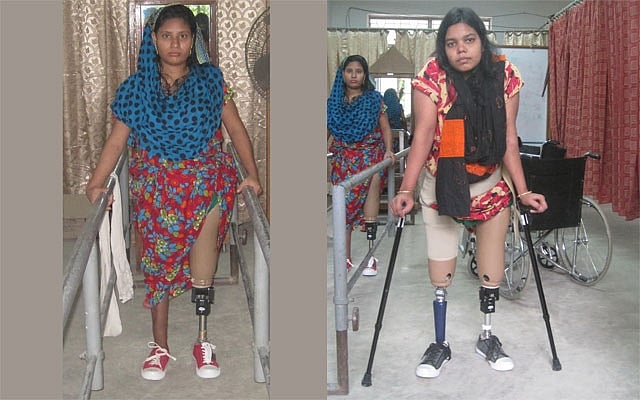
Rana Plaza victim Shilpi Begum, who lost her left foot, is one of the people being treated there.
She is learning to walk with her new prosthetic leg at the CRP.
"I won't have to rely on anyone for walking with this artificial limb," she said.
Rehana Khatun, who worked at the 'New Star Garments' in the Rana Plaza, had lost both her legs in the accident.
"People taunted me after the accident," she recalled. "At times I felt it would have been better had I died."
None of her relatives came to see her at the hospital. She went to Pabna alone last week to visit them. It was quite a surprise for them, she said.
"But artificial legs are artificial," she said, a little dismayed.
CRP official Ferdousi said, "Those who lost their limbs in the Rana Plaza accident, have been given prosthetic limbs. They are using these limbs regularly."
The ICRC has helped the victims return to normal lives, she said.
"My leg was damaged as I suffered from Polio as a child," Ferdousi said. "But thanks to the ICRC, I'm leading a normal life now."
ICRC's physical rehabilitation project manager Gerd Van de Valde said anyone who suffers physical disability or loses a limb in an accident, requires treatment throughout the life in most cases.
Ten students will be admitted in the course each year.
At the end of their three-year academic course, they will have to work as intern doctors for one year.
They will be able to treat the patients efficiently afterwards.







