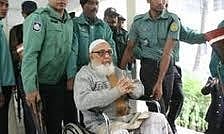
Rule pending over Ghulam Azam's plea
The first war crimes tribunal has kept its decision pending over application for transferring the Jamaat guru's case to the second tribunal. Updates
bdnews24.com News Service
bdnews24.com
Published :
06 Jun 2012, 08:30 AM
Updated :
09 Aug 2022, 03:52 PM
Dhaka, Jun 6 (bdnews24.com) — Bangladesh's first war crimes tribunal on Wednesday kept its decision pending on whether to transfer former Jamaat-e-Islami chief Ghulam Azam's case to the second tribunal.
The three-judge International Crimes Tribunal–1, set up to try crimes against humanity during the 1971 Bangladesh War of Independence, heard the prosecution's reply and the defence rebuttal on the application.
Prosecutor Zead-Al-Malum said in his reply that the application was liable to be subject of contempt of the court since the same group of lawyers had made the same points although those had been disposed of in an earlier verdict of the same tribunal.
The tribunal judges, however, managed to dissuade the senior defence counsel when he attempted to answer the prosecutor on this point and asked him to move on.
Razzaq eventually complied with the tribunal's desire after a brief protest.
Jamaat guru Ghulam Azam's application mentioned almost similar points as those in another application moved in Jamaat leader Sayedee's case, where the defence had appealed for the removal of the tribunal chairman Justice Mohammad Nizamul Huq, saying that he could be a material witness of the case and had been previously involved in the case and therefore could be biased.
In this case, defence counsel Abdur Razzaq said in his application that the judge had been party to a resolution, which according to the lawyer had called for the execution of Ghulam Azam, in line with a people's court verdict in 1992. The defence arguments were based on a Bengali daily Sangbad report published 20 years ago.
Justice Huq then corrected him, saying that the judge was party to a meeting that drew up the resolution.
Prosecutor Zead-Al-Malum replied to the defence application at length and mostly cited the tribunal's order that had been passed as in reply to the judge's refusal application in Sayedee's case.
He wondered why the defence had waited for such a long time before filing this application to which Razzaq replied, "This is a rather difficult application to write where one must state certain things about your lordship."
He said the initial reason was that his team was actually waiting for the outcome of the discharge petition. "There would be no need for the tribunal granted that petition."
Judge A K M Zaheer Ahmed engaged in a brief discussion with prosecutor Malum once he was done with his deliberations.
The tribunal member said he was fully in agreement with the prosecutor that there was no scope of the defence to pray for transferring a case according to the tribunal rules. He said that such a request could only come from the chief prosecutor or the tribunal could take such a measure of its own volition.
"But I would like to point out that this tribunal is already handling two cases that have moved into the trial phase whereas the other tribunal does not have much of a load on its hands at the moment."
He wondered about the prosecutor's opinion if the tribunal transferred the case for expeditious disposal.
Malum replied that the second tribunal would soon become burdened with its cases which are all progressing and would also go into trial soon. "Then they will become overburdened. It only seems they don't have such a load now."
The tribunal then moved on to hearing another application for reviewing the indictment order of Ghulam Azam.
Review Application
Abdur Razzaq meticulously went through the indictment's preamble claiming that the tribunal had made certain statements in a manner that suggested that those were historical facts. He referred to certain parts of the indictment order of May 13 and said that the Azam's birthplace was stated wrongly.
The defence counsel then referred to a part of the order describing the Jamaat activities during the Liberation War which reads, "At that time Jamaat-e-Islami became an auxiliary force under the Pakistan Army and since he was the Amir of Jamaat-e-Islami, he not only controlled the organizational framework of Islami Chatra Sangha but played the pivotal role in forming the Shanti Committee, Razakars, Al-Badar, Al-Shams etc."
Razzaq's contention was that Jamaat was never placed under the Pakistani Army, which would turn it into an auxiliary force.
Razzaq also contested the part where the indictment made observations about Azam's role after the liberation of Bangladesh, when he apparently formed the East Pakistan Restoration Committee and collected funds in Saudi Arabia.
The counsel pointed that Azam denied having done any such things and said these could not be stated as historical fact.
The counsel then moved on to the charges and made a number of submissions, which according to Zead-Al-Malum were merely repetition of the same points made in the discharge petition filed by the counsel.
Razzaq's main contention was that the charges of conspiracy, incitement, planning and so on were not specific enough for the accused to be able to defend himself competently.
The matter has been adjourned till Thursday.
Jamaat Guru in ICT-1
On Dec 12, 2011, the prosecution brought a 52-point charter of charges against Azam and appealed for his arrest. Later, following the tribunal order, charges were re-arranged and presented to the tribunal on Jan 5.
He was produced before the tribunal on Jan 11 and sent to jail the same day. Since that evening, Ghulam Azam has been kept at the prison cell of the Bangabandhu Sheikh Mujib Medical University for better treatment considering his delicate health.
The prosecution's numerous charges against him mainly consist of incitement, conspiracy, complicity and command responsibility for crimes against humanity.
A former chief of Jamaat-e-Islami, arguably the largest Islamist organisation in the subcontinent, Azam is allegedly among the key people who pioneered anti-liberation efforts in 1971 colluding with the Pakistani military junta of that time.
He is widely perceived to have been among core group of right-wing supporters of the Pakistani Army, who came out strongly in support of a united Pakistan.
Ghulam Azam, then chief of Jamaat, was instrumental in setting up the infamous Peace Committee at the national level. The Razakars, an auxiliary force set up mainly to actively thwart the liberation forces, are said to have been mobilised through the Peace Committees across Bangladesh.
Among the most notorious vigilante militia groups is the Al Badr, whose membership is said to have been mainly dominated by the Jamaat's student wing, called the Islami Chhatra Sangha at that time.
The Al Badr is alleged to have spearheaded execution of the intellectual elites of Bangladesh just days before the victory on Dec 16, 1971.
Azam also spoke in favour of Pakistan to the Middle Eastern countries during the war, according to the prosecution.
He stayed in London for seven years after 1971 and returned to Bangladesh in 1978 during BNP founder Ziaur Rahman's rule. Having led Jamaat for long, Azam retired from active politics in 1999.
His party remains a key ally of the main opposition BNP. Two Jamaat leaders, also behind bars for war crimes charges, have even served as ministers during the BNP's last tenure in government between 2001 and 2006, when Azam's party was part of the ruling coalition.
bdnews24.com/ta/jr/sk/1910h