


Published : 14 Feb 2013, 11:56 AM
Updated : 23 Apr 2022, 04:20 PM


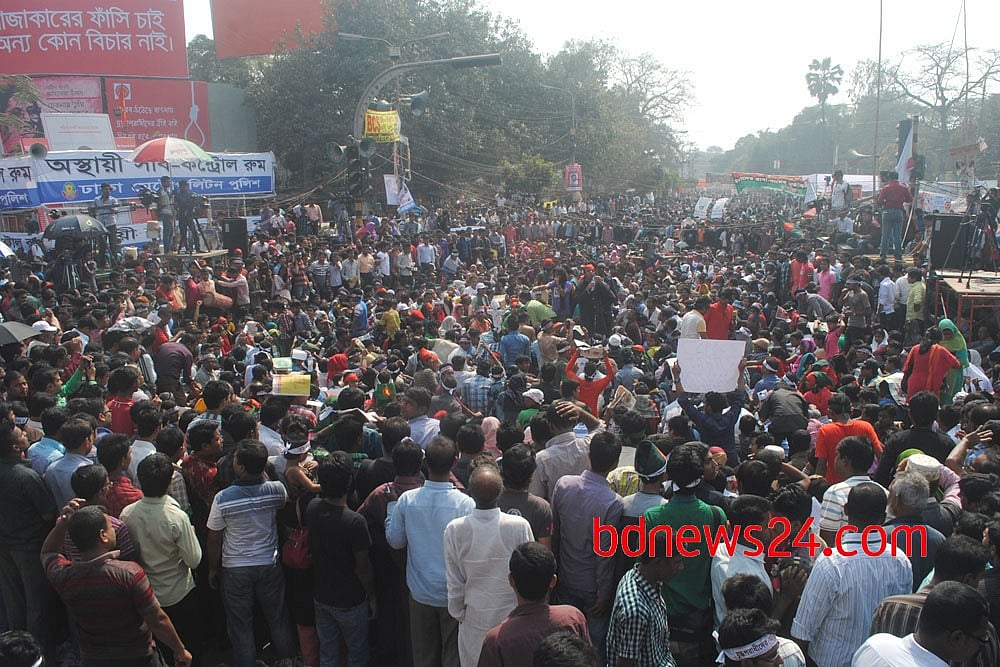
Many of the couples turned up at Shahbagh intersection to express their solidarity with the non-stop mass movement there demanding execution of all war criminals, including Jamaat-e-Islami leader Abdul Quader Molla.
They chanted with slogans of the protesters.
A private bank official Jayanta Ahmed, along with his wife Pinki, came from the city’s Uttara to join the Shahbagh gathering.
“Today is Valentine's Day. We love our country, so I’ve brought her here to express our love for the nation,” he said.
Arun Chandra Roy, a student of the Dhaka Teachers Training College, said, “We don't have time to celebrate the Valentine's Day. We’ve only one wish – death for Razakars.”
People of all strata – mostly students of schools, colleges and universities – started thronging the intersection, now known as 'Projonmo Chattar', since the morning chanting fiery slogans.
Some 200 teachers and students of the Ispahani Girls School and College joined the demonstration in a procession in the morning to express their solidarity.
College Principal Shaheda Begum said it was their first aggregate appearance at the venue though they expressed their solidarity individually due to the ongoing SSC examinations.
“We’ve only one reason for our coming here. We want that the only demand of Valentine's Day becomes execution of all war criminals.”
Demanding death for war criminals, a student of the college and also a SSC examinee, Ayesha Akther said that all those who acted like Razakars in 1971 should be put to trial.
Raisa Mahjabin, a female student of a private university, said, “I love my country. So, I’ve come here on this special day to show my affection to the country. I’ve joined the protest with a dream to rid the country of anti-liberation elements.”
Refreshed with Falgun spirit, the young demonstrators started the programmes on the 10th day of protest with rendering of the national anthem at 6am and then delivered their regular speeches. Since then, they have been singing songs and chanting slogans in support of their only demand – death for war criminals.
At 7pm on Thursday, candlelight vigil programme will be observed across the country to pay respect to those who sacrificed their lives during the country's War of Liberation as well as those killed by Jamat-Shibir afterwards.
Blogger and Online Activist Network initiated the nonstop protest at Shahbagh intersection hours after the International Crimes Tribunal-2 on Feb 5 sentenced Jamaat-e-Islami leader Molla to life in prison for crimes against humanity during the Liberation War in 1971.
Hundreds of thousands of people from all walks of life expressed their solidarity with the young men and women by joining a massive rally last Friday. They also took an oath to continue their movement until Molla is awarded death sentence and vowed to fight anti-liberation forces like Jamaat-e-Islami and its student wing Islami Chhatra Shibir.
They also pledged to boycott all business and social organisations, including media outlets, of the party.
The movement has already spread across the country and even to the Bangladeshi diasporas abroad.
Meanwhile, the International Crimes (Tribunals) (Amendment) Bill, 2013, was placed in parliament on Wednesday with a provision to allow both prosecution and defence to appeal against inadequate sentences and orders of acquittal against 1971 war criminals to the Appellate Division of the Supreme Court.
The Jamaat had opposed Bangladesh's independence and sided with Pakistani troops during the 1971 Liberation War, in which three million died and more than quarter of a million women were dishonoured. The Jamaat activists staffed the auxiliary support forces of the Pakistani army like the Razakars, Al Badr and Al Shams, who masterminded the mass executions. Exterminating the Bengali intelligentsia was their main target.













