Published : 03 Nov 2026, 02:06 AM
Updated : 03 Nov 2026, 02:35 AM


In Ashulia’s Nishchintapur, the factory whistle marks the start of the working day. For Nasima Akter, however, the day begins earlier still. She finishes the household chores before rushing to the factory, where she works as a sewing-machine operator, stitching garments from morning until night.
Years hunched over a machine have left her with back pain and tired eyes. Her body no longer keeps pace with the demands of the job. Yet, after all those hours, she takes home just Tk 14,500 a month.
That money must support six people: her elderly parents, younger siblings and children. Rent and the cost of essentials such as rice, lentils, oil and vegetables consume almost all her wages. Little remains for emergencies, let alone a decent meal or a good education for her children.
Nasima could not afford to enrol her eldest daughter in college. Her second son was due to sit this year’s Secondary School Certificate (SSC) examination, but she could not raise the money to fill in his examination form. She enrolled her youngest son in a madrasa, but even meeting his education costs has become a struggle.
Asked why she had joined the garment workers’ movement for higher wages, Nasima sighed.
“By the time I receive the Tk 14,500 I earn at the end of the month, it is already gone on market debts and house rent.”
Her husband, a rickshaw driver, became bedridden after an accident several years ago. Since then, she has carried the entire burden of supporting the family.

“I often cannot even afford to buy my children better food or exercise books,” she said, her voice faltering. “After paying all the expenses, I cannot even give my children a good meal once a month.”
She has also visited factories looking for work for her eldest daughter, unable to send her to college. But, she alleged, no one was willing to offer a job without money.
Nasima’s predicament is shared by workers across the garment-producing hubs of Gazipur, Ashulia and Savar. At a time of high inflation, even making ends meet on such wages is difficult. Proper nutrition and a good education for their children remain distant aspirations. Years of work have brought no savings for the future.
Demand Shaped by the Cost of Living
Laily Begum, an operator at a garment factory in Ashulia’s Jamgora has worked there for 13 years. She has not managed to save a single taka.
“The factory owners do not mistreat us. But with the way prices are rising, this small salary of Tk 15,500 is not enough for anything,” she said.
“My entire salary goes on rice and house rent. Even when my children fall ill, I cannot afford to take them to a good doctor.”
Her husband left her after marrying someone else. Laily is now the sole breadwinner for her son, daughter and ailing mother.
“I cannot even afford my mother’s treatment. If our wages do not increase, how are we supposed to survive on this little money? A minimum of Tk 30,000 would allow us to get by in this market. That is why we have been forced to join the movement for higher wages.”
The last minimum wage revision for garment workers came in November 2023, when the rate was raised from Tk 8,000 to Tk 12,500, an increase of 56.25 percent. The new rate took effect on Dec 1 that year.
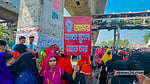
For several days, workers in Dhaka, Savar, Ashulia and Gazipur have been protesting to demand a minimum monthly wage of Tk 30,000.
The Bangladesh Garment Manufacturers and Exporters Association (BGMEA) said production was suspended at 529 factories in Savar, Ashulia and Gazipur on Sunday amid protests and violence, leaving nearly 987,000 workers unable to work.
Protests and factory closures continued in several industrial areas on Monday, raising concerns about production and exports as well as workers’ demands.

Inflation has kept the cost of living high. The rate has remained above 8 percent since August 2022, reaching 8.34 percent in September 2026. Wage growth, meanwhile, has lagged behind inflation.
A new pay structure for government employees took effect in July, raising basic salaries by as much as double or more across different grades. The changes have added pressure for pay rises in the private sector.
But garment manufacturers point to rising energy and production costs, uncertainty over export orders and the impact of global instability and the war in West Asia. They argue that any increase must take account of the industry’s capacity.
For Lucky, an operator at Panasia Garments in Bhogra Chowdhurybari, Gazipur, the arithmetic is already unforgiving. She earns Tk 21,900 a month, including overtime, but still has to borrow to support her family of four.
“Some months, when salaries are delayed, creditors come after us. We also have to listen to the landlord demanding rent,” she said.
Her two children’s education costs Tk 3,000 a month, rent Tk 4,000, electricity Tk 400 and groceries between Tk 10,000 and Tk 15,000. Milk for the children costs another Tk 3,000.
“We struggle to catch our breath trying to meet all these expenses. That is why our wages need to rise,” she said.
Asked why workers were demanding Tk 30,000, Lucky said: “A monthly salary of Tk 30,000 would make it possible to live somehow. Below that, it will not be possible to run a household. We will have to carry the burden of debt every month.

“We are not demanding an excessively high salary. If owners have to pay too much, they will have problems. They may not be able to pay wages and allowances regularly. That could lead to a shutdown.”
Alia Textile Mills operator Md Shakil Ahmed, who earns around Tk 21,300 including overtime, said rising prices had added Tk 8,000 to Tk 10,000 to his monthly expenses. Supporting his wife, children and parents had become increasingly difficult.
“If our salary is Tk 30,000, we will be able to meet our basic needs,” he said.
Mohammad Ariful Islam, a knitting supervisor at Masters Cham factory in Naojor, Gazipur, earns a basic salary of Tk 15,300 and around Tk 5,500 more in overtime. He, too, wants the minimum wage set at Tk 30,000.
Owners Call for a ‘Reasonable’ Increase
Shovon Islam, managing director of Sparrow Group, which employs 18,000 workers, said wages needed to rise but any settlement must reflect the industry’s ability to pay.
“There needs to be a reasonable solution. First, the industry must have the capacity for it,” he said, questioning how an unskilled worker could be paid Tk 30,000.
He cited a $30 gap between minimum wages in Bangladesh and Vietnam, arguing that differences in workers’ skills also had to be considered. “So, a salary of Tk 30,000 is completely unrealistic.”
Shovon said employers would present their data to the wage board, as would the government and worker representatives. The rate should be settled through discussions among the three sides.
The government formed a six-member wage board on Sunday, chaired by Senior District and Sessions Judge Sheikh Ashfakur Rahman.
Shovon acknowledged that wages had to increase, but questioned whether factories could afford it without government support.
“In the current reality, no owner has the capacity to increase wages by even a single paisa. But salaries do need to rise. We have to consider how much can be increased, what the industry can afford and whether the government will provide any subsidy or support.”
Shams Mahmud, managing director of Shasha Denims, Shasha Garments and Shasha Textiles, also warned that the sector was under pressure from falling global demand and competition from India, Vietnam, Sri Lanka, Pakistan and China.

“Orders from Bangladesh are declining. Such a situation has never been seen in any quarter in the country’s history. The industry is going through a transition. Consumption is falling across the world because of inflation and the global situation.
“Meanwhile, protests and all this are happening only in Bangladesh. This is not happening in any other manufacturing country. So, buyers will shift their orders.”
Shams said skilled workers earned far more than entry-level employees, with some receiving Tk 50,000, Tk 60,000 or even more than Tk 70,000. He said factories paid higher wages to retain experienced workers, some of whom were leaving for Jordan and Mauritius.
He urged workers to negotiate through the wage board rather than take to the streets, saying the process could take one or two months. He also alleged that political interests and landlords seeking to raise rents were fuelling unrest.
Shovon similarly alleged that the protests were politically motivated, rather than driven by wage demands. Neither provided evidence for those allegations in the report.
Both employers, however, accepted that workers needed higher wages. They warned that damage to the industry would also put workers’ livelihoods and the wider economy at risk.
Union Leader Urges Workers back to Factories
Babul Akhter, the workers’ representative on the new wage board, called on protesters to return to work after meeting the home minister on Sunday.
“I urge my fellow workers to return to work and resume their duties regularly. Do not destroy your own factories by falling for anyone else’s incitement or provocation.
“This industry is necessary for you, for the government and for the owners. We have not called any formal strike. Even so, if any worker gets involved in wrongdoing or criminal activity and runs into trouble, the labour federations will not stand by them.”
He said workers’ representatives would sit together and pursue their demands through the board.
Home Minister Salahuddin Ahmed also urged workers to return to their workplaces and resume production, warning that those deliberately creating unrest after the board’s formation could not be considered friends of workers.
“The wage issue is being handled by the wage board,” he said, adding that its members would meet soon.
He warned that action would be taken against anyone involved in activities against workers’ interests or attempts to destabilise the country.