Published : 10 Oct 2022, 01:25 AM
Updated : 10 Oct 2022, 02:23 AM


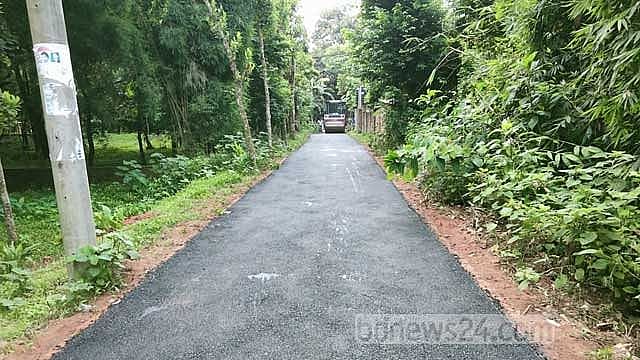
Bangladesh has constructed a 100-metre long road at Pirujali Sarakghata in Gazipur using bitumen mixed with plastic waste, the first of its kind in the country.
The use of plastic waste will help to conserve the environment as well as bring down the time and cost of road construction, officials of the Local Government Engineering Department said.
Although the initiative shows a ray of hope for the country struggling to manage plastic waste, experts believe it may increase the road repair cost.
They also said any international law designed to reduce the use of plastic may foil the initiative.
The road in Gazipur was constructed as a pilot project in August under the Greater Dhaka-Mymensingh Road Project.
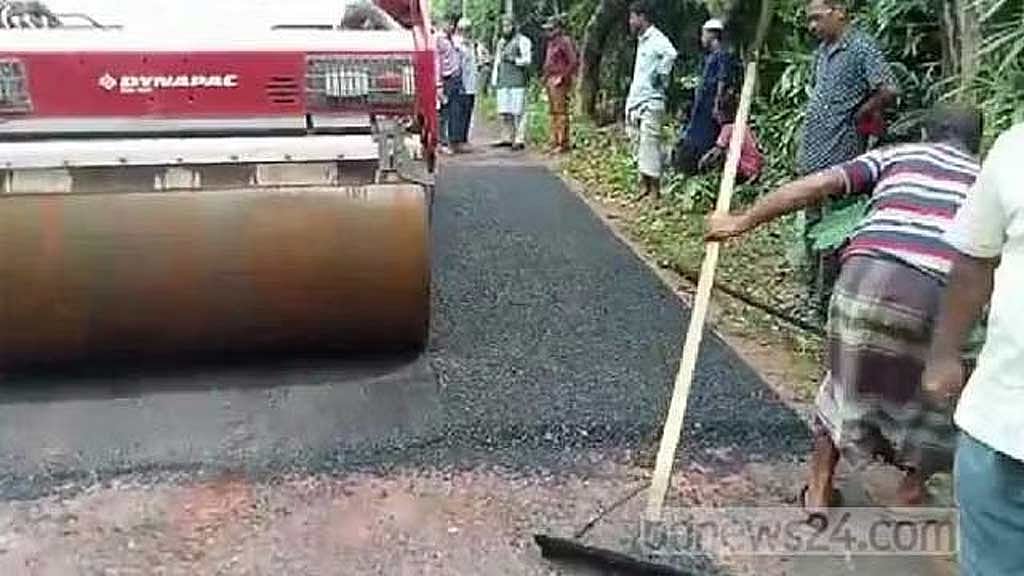
For the road construction, a mixture of 9 percent plastic waste and 91 percent bitumen were mixed with sand and stones. The mixture was heated at 170 degrees Celsius before being put to use.
“We’re using the mixture to construct the road surface just the way bitumen and brick mixture is used for road carpeting,” said Abdul Barek, executive engineer at the Gazipur LGED.
The 100-metre road has been taken as a pilot project and will be monitored for a year.
The LGED ran a test in their lab mixing a minimum of 5 percent and a maximum of 13 percent plastic waste with bitumen and found that 9 percent waste gave the best result, said Abu Md Shahriar, a superintending engineer at LGED Road Implementation Division.
They used polythene with a thickness less than 8 microns. “This polythene goes directly to landfill and they are most responsible for environmental pollution. They can’t be recycled as well,” Shahriar added.
The next LGED pilot project will be taken in Cumilla’s Homna where a bigger road will be constructed using plastic waste.
The department has received a proposal to construct a 1km road using plastic waste in each of the 64 districts in Bangladesh in 2023, he said.
In a research done in September this year, the Chattogram University of Engineering and Technology (CUET) suggested using plastic and polythene waste for constructing roads.
The Roads and Highways Department is also weighing the plan. It has been working on road construction using plastic waste since 2019, said Shahriar.
IS THERE A HOPE?
The annual per capita use of plastic increased threefold in the urban areas of Bangladesh in the 15 years to 2020, from 3 kg to 9kg, according to a World Bank report.
As much as 10 percent of the 6,646 tonnes of daily waste produced in Dhaka city only during the coronavirus pandemic was plastic.
Only 37 percent of that plastic waste was recycled and 48 percent went to landfills. A total of 12 percent were dumped in rivers and canals and the rest ended up in drains or in the nook and crannies of the city.
Non-perishable plastic is harmful to the environment and therefore, using it in constructing roads may cut pollution, believe experts.
It will also help to reduce the construction cost as polythene costs 10 times less than bitumen, LGED engineer Shahriar said. Currently, bitumen costs around Tk 70-80 per kg while polythene costs around Tk 7-8 per kg, according to Shahriar, the superintending engineer at LGED Road Implementation Division.
“You can call it almost free. We used 9 percent (polythene) in the mixture. Normally we spend Tk 20,000 to construct per cubic metre which will come down to Tk 18,000 per cubic metre when we use plastic. That will save around Tk 1.5 million to 2 million to construct a 5km road.”
With the use of plastic, the Gazipur road is expected to be operational for around five years, where usually the longevity of the roads in Bangladesh is two to three years on average, Shahriar said.
“Normally, the melting point of bitumen is 40 degrees Celsius. If you use plastic waste, the melting point increases to 60 degrees Celsius.”
He mentioned other benefits of constructing roads using plastic. “If the weather temperature is 35 degrees Celsius, a tyre's temperature becomes 40 to 45 degrees Celsius. Then the road is damaged more. The use of waste plastic, however, will ensure no rutting of the road, rather it will leave a thin layer of plastic on the road surface. So, the rainwater will not affect the road and the bitumen will not come. The road will be more sustainable.”
THE DOWNSIDE
Government officials are hopeful about the use of waste plastic in road construction, but similar endeavours were proved unsuccessful in India and other countries, said Shahriar Hossain, secretary general of the Environment and Social Development Organisation or ESDO.
“As a synthetic additive is mixed, it ruins the binding of cement, stone and sand,” he said.
The repair cost then goes up. The road gets easily damaged where there’s heavy traffic, pushing the maintenance cost higher than other roads. Also, it spreads the microfibers which is not acceptable, he pointed out.
“The US banned it in 1995 saying [use of plastic waste in road construction] is not possible, and now you are trying to do the same thing,” he said.
He also said a global convention and treaty on the use of plastic will be held soon which will promote a ban on micro-plastic and look forward to designing a law by 2024 to prevent it. The first round of negotiations is scheduled to be in November.

“Obviously, there will be obstructions to using plastic waste. What will you do then? Will you dig the roads and take out the plastic? Who will bear that cost?”
No chance of micro-plastic spread exists when plastic waste is used in road construction, claimed LGED officials. But the officers of the Roads and Highways Department said they could not rule out the possibility of micro-plastic spread. They need more piloting to understand the issue, they said.
"If there's micro-plastic, it will run into the rivers when it rains. Fish will consume it and you'll eat that fish. We need more trials to understand how it leaks out. We need to do these tests. That is a grey area" said Md Abdullah Al Mamun, additional chief engineer of the Technical Services Wing in the Roads and Highways Department.
LGED constructed the Gazipur road following the dry mixing process invented by Indian scientist Dr Rajagopal Vasudevan, also known as the 'plastic man', in 2001.
The roads constructed in India following this method have sustained for the last 20 years and have a small number of potholes in them, said Syed Tasnim Mahmud, founder of Green Bud Foundation, which worked to collect plastic waste and process it for use in the project.
Professor Shamsul Haque of Bangladesh University of Engineering and Technology suggested using tyres instead of plastic in road construction.
“Tyre is the best as it is non-biodegradable and has no opportunity cost. Also, we can shred polythene and export it to China as it has a large market there. But tyres don’t have that prospect. They never get damaged in 200 years and the number of tyres will rise every day in Bangladesh. If this is melted and used with bitumen,vehicle tyres can solve a big environmental problem.”
Prof Hadiuzzaman of BUET also said that vehicle tyres are being mixed with bitumen in many countries.
[Writing in English by Sabrina Karim Murshed]