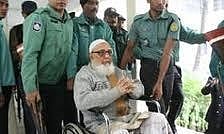
Prosecutor Sultan Mahmud presented documents and exhibits explaining to the tribunal how the Azam’s actions amounted to conspiracy.
The three-judge International Crimes Tribunal – 1, set up to try crimes against humanity during the 1971 Liberation War, indicted the former Jamaat chief for five war crimes charges including complicity, incitement and conspiracy.
Citing newspaper reports, already submitted as exhibits, the prosecutor pointed out that as head of Jamaat’s East Pakistan unit Azam, along with other right wing party leaders, had met the region’s chief martial law administrator, General Tikka Khan on Apr 4, 1971.

'Ghulam Azam backed junta for undivided Pakistan'
'Ghulam Azam backed junta for undivided Pakistan'
Sultan Mahmud srgued that it was no sudden meeting . “They had been in regular contact."
The prosecutor also wondered why else would someone be willing to sit with a Pakistani general within days of the military crackdown known as Operation Searchlight that began on the night of Mar 25 and led to wholesale massacre of civilians, teachers and students.
Sultan Mahmud also referred to Azam’s book, where he mentions using a chauffeur-driven car on Mar 26 to go around Dhaka city despite a strictly enforced curfew. “That he went out on his car and went to visit different areas of Dhaka says much.”
Azam has been charged with six counts of conspiracy. On Apr 4 of 1971, he is alleged to “have discussed, planned and decided the means to enforce the evil designs" of the occupying Pakistan Army” during the meeting with Tikka Khan, a three-star general.
Mahmud said that formation of the Peace Committee — Nagorik Committee, later renamed as Nagorik Shanti Committee — was a direct consequence of this Apr 4 meeting.
Ghulam Azam is alleged to have met again with Tikka Khan, two days later, with several other political leaders, as part of the conspiracy. “In this meeting also, various ways to assist the occupying Pakistan Army were discussed along with the topic of forming auxiliary forces."
Azam then took part in a Peace Committee sub-group meeting on Apr 14, 1971. This smaller group was called Peace and Welfare Steering Committee.
Mahmud had noted on Monday that Azam was part of almost all the sub-groups since he was the only one who headed a regimented party with enough manpower, while the rest were usually one-man show.
At this Apr 14 meeting, the indictment order states, “During this conspiratorial meeting, with the goal of gaining the confidence of people and establishing a so-called ‘peace’ and fighting against the so-called ‘Indian plans and aggression’, various policies and plans were agreed upon to organize the people.”
The prosecutor went through his exhibits citing newspaper reports explaining the contents of a high-level meeting with the Pakistani president, General Yahiya Khan on Jun 19 that year.
The exhibits related to Azam’s own statements, as covered by the media, about what he and the president had talked about during their parley.
After evaluating the situation of the previous three months, the participants made plans “to effectively control the civilian population by unifying those who believe in the ideal of Pakistan”, the charges state.
Two days later, Azam is alleged to have conspired further at a meeting with All Pakistan Jamaat-e-Islami Chief Syed Abul Ala Moududi. At this May 20 meeting, Jamaat founder Moududi and his close disciple Azam apparently “reviewed the activities and party policies of Jamaat-e-Islami and discussed the party’s plans and activities and the implementing of those plans.”
Later, in December that same year, not even two weeks before the Pakistani army surrendered, Azam met with the president again, this time for over an hour. Azam is charged with demanding an increase of Razakar forces at this meeting. He is also said to have urged the president to supply arms to those people who believed in the ideal and unity of Pakistan in order to confront the people of East Pakistan, whom he referred to as ‘dushkritikari’ — roughly translating to ‘miscreants’ in English.
This is also when Azam is alleged to have masterminded a ‘final solution’, which was carried out — by members of Jamaat-e-Islami, Peace Committee, Razakars, Al-Badr and Al-Shams — till the day of liberation on Dec 16, 1971.
The closing arguments will resume Wednesday.
Jamaat Guru in ICT-1
On Dec 12, 2011, the prosecution brought a 52-point charter of charges against Azam and appealed for his arrest. Later, following the tribunal order, charges were re-arranged and presented to the tribunal on Jan 5.
He was produced before the tribunal on Jan 11 and sent to jail the same day. Since that evening, the 89-year old former Carmichael College professor has been kept at the prison cell of the Bangabandhu Sheikh Mujib Medical University for better treatment considering his delicate health.
Ghulam Azam’s indictment hearing began on Feb 15 and the court charged him on May 13.
A former chief of Jamaat-e-Islami, arguably the largest Islamist organisation in the subcontinent, Azam is allegedly among the key people who pioneered anti-liberation efforts in 1971 by colluding with the Pakistani military junta.
He is widely perceived to have been among core group of right-wing supporters of the Pakistani Army, who came out strongly in support of a united Pakistan.
Ghulam Azam, then chief of Jamaat, was instrumental in setting up the infamous Peace Committee at the national level. The Razakars, an auxiliary force set up mainly to actively thwart the liberation forces, are said to have been mobilised through the Peace Committees across Bangladesh.
Among the most notorious vigilante militia are the Al Badr, whose membership is said to have been mainly dominated by the Jamaat's student wing called the Islami Chhatra Sangha at that time.
The Al Badr is alleged to have spearheaded execution of Bengali intellectuals just days before the victory on Dec 16, 1971.
Azam also spoke in favour of Pakistan to the Middle Eastern countries during the war, according to the prosecution.
He stayed in London for seven years after 1971 and returned to Bangladesh in 1978 during BNP founder Ziaur Rahman's rule. Having led Jamaat for a long time , Azam retired from active politics in 1999.
His party remains a key ally of the main opposition BNP. Two Jamaat leaders, also behind bars for war crimes charges, have even served as ministers during the BNP's last tenure in government between 2001 and 2006, when Azam's party was part of the ruling coalition.
Azam was indicted on five charges including incitement, conspiracy and abetment.