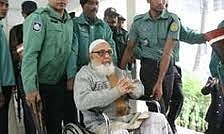
Prosecution case against Azam ends
ASP Matiur Rahman testifies that his investigations had yielded convincing evidence of Ghulam Azam's complicity, incitement, conspiracy and abetment of crimes against humanity.
bdnews24.com News Service
bdnews24.com
Published :
10 Oct 2012, 01:40 PM
Updated :
09 Aug 2022, 04:21 PM
Dhaka, Oct 10 (bdnews24.com)—The prosecution's case ended on Wednesday as former Jamaat-e-Islami chief Ghulam Azam's war crimes investigator finished his deposition at the first war crimes tribunal of Bangladesh.
Additional Superintendent of Police, Matiur Rahman, testified that his investigations had yielded convincing evidence of Ghulam Azam's complicity, incitement, conspiracy and abetment of crimes against humanity.
He said, "Ghulam Azam's activities have contributed to 3 million deaths, 200,000 rapes, 10 million people becoming refugees and many others becoming displaced within the country."
The defence managed to get an adjournment after a few questions punctuated by repeated pleas to put off the cross-examination for the day.
Jamaat guru Ghulam Azam was indicted by the three-judge International Crimes Tribunal-1 on May 13 for five charges mainly owing to his high office within the party and alleged position in the central committee of the infamous Peace Committee.
Taking the stand for the fourth occasion, the investigation officer ended his deposition on Wednesday. Compared to the other investigator, Mohammad Helal Uddin, who investigated Jamaat leader Delwar Hossain Sayedee's case, Matiur Rahman's testimony was rather short.
In fact, it was so short that senior defence counsel handling Ghulam Azam's trial said he was taken by surprise.
Defence counsel Mizanul Islam began with a time prayer, saying that he had not anticipated the investigator's deposition to end so quickly. "We really need more time to prepare."
Tribunal Chairman Justice Mohammad Nizamul Huq had been listening to the plea in all seriousness. "Do you want a [formal] order or would a verbal order suffice?"
The counsel said that both were orders, indicating that either would be equally binding for him.
Justice Huq said, "Begin now and we shall consider if we see that you do need time."
The counsel still tried for an adjournment saying, "But we really need to prepare. We had not been notified beforehand that the investigator would be taking the stand from Sunday."
Justice Huq pointed out that it was Wednesday and urged the counsel to begin.
Mizanul Islam began his cross-examination asking the investigator specific date and time that he began investigating Azam's alleged war crimes.
Soon his questions had the investigator sending for his case diary which remained with the tribunal. The counsel had hardly asked a dozen questions when Abdur Razzaq pleaded with the tribunal again for an adjournment.
The Jamaat's chief counsel went so far as to cite a provision of the tribunal that says the court will prevent anything that might cause unreasonable delay to the proceedings. He said in this case, the tribunal was being unreasonable by not allowing an adjournment.
Mizanul Islam also joined his senior colleague and pleaded the court that it had been a long day and he really needed an adjournment.
The tribunal chairman relented around 3pm and said no more of such adjournments would be allowed except for exceptional circumstances.
Jamaat Guru in ICT-1
On Dec 12, 2011, the prosecution brought a 52-point charter of charges against Azam and appealed for his arrest. Later, following the tribunal's order, charges were re-arranged and presented to the tribunal on Jan 5.
He was produced before the tribunal on Jan 11 and sent to jail the same day. Since that evening, the 89-year old Azam has been kept at the prison cell of the Bangabandhu Sheikh Mujib Medical University for better treatment considering his delicate health.
A former chief of Jamaat-e-Islami, arguably the largest Islamist organisation in the subcontinent, Azam is allegedly among the key people who pioneered anti-liberation efforts in 1971 colluding with the Pakistani military junta of that time.
He is widely perceived to have been among the core group of right-wing supporters of the Pakistani Army, who came out strongly in support of a united Pakistan.
Ghulam Azam, then the chief of Jamaat, was instrumental in setting up the infamous Peace Committee at the national level. The Razakars, an auxiliary force set up mainly to actively thwart the liberation forces, are said to have been mobilised through the Peace Committees across Bangladesh.
Among the most notorious vigilante militia are the Al Badr, whose membership is said to have been mainly dominated by the Jamaat's student wing called the Islami Chhatra Sangha at that time.
The Al Badr is alleged to have spearheaded execution of the intellectual elites of Bangladesh just days before the victory on Dec 16, 1971. The Razakars and Al Shams, along with the Al Badr, are said to have been responsible for widespread atrocities across Bangladesh that amounted to war crimes.
Azam also spoke in favour of Pakistan to the Middle Eastern countries during the war, according to the prosecution.
He stayed in London for seven years after 1971 and returned to Bangladesh in 1978 during BNP founder Ziaur Rahman's rule. Having led Jamaat for long, Azam retired from active politics in 1999.
His party remains a key ally of the main opposition BNP. Two Jamaat leaders, also behind bars for war crimes charges, have even served as ministers during the BNP's last tenure in government between 2001 and 2006, when Azam's party was part of the ruling coalition.
Azam was indicted on five charges including incitement, conspiracy and abetment.
bdnews24.com/ta/bd/1910h