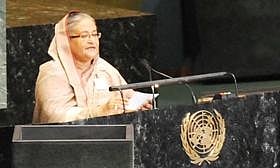
Powerful nations must go by int'l law: PM
Sheikh Hasina calls upon states to recommit to the rule of law as a fundamental factor in ensuring world peace.
bdnews24.com News Service
bdnews24.com
Published :
25 Sep 2012, 05:35 AM
Updated :
09 Aug 2022, 04:17 PM
New York, Sep 24 (bdnews24.com) — Prime Minister Sheikh Hasina on Monday called upon all states to recommit to the rule of law as a fundamental factor in ensuring world peace.
Speaking at a United Nations summit that stressed the universality of humanitarian law and the importance of the International Criminal Court (ICC), she also urged powerful nations to respect multilateral treaties, and patronise fair and unbiased application of customary international law.
"To have a just world order based on the rule of law, powerful nations must respect international legal systems, multilateral treaties, and support fair and just application of customary international law in the multilateral decision making process," Hasina said in her speech at an event titled 'Rule of Law at the National and International Levels'.
The event, chaired by President of the 67th session of the United Nations General Assembly Vuk Jeremić, took place at the UN Headquarters where UN Secretary General Ban Ki-moon was also present. The event was organised to discuss how to strengthen the rule of law.
The United Nations High Commissioner for Human Rights, the Chair of the International Law Commission, the President of the International Court of Justice, the President of the Security Council, the Executive Director of the United Nations Office on Drugs and Crime, the Administrator of the United Nations Development Programme, Member States and Observers, as well as representatives of non-governmental organisations and civil society working for ensuring rule of law attended the event.
The Prime Minister said, "Peace in our world is threatened today, among others, by civil wars, people's uprisings, religious intolerances, transnational crimes, terrorism, piracy, climate change impacts, financial and energy crises, etc."
She noted that Bangladesh believed in peace and justice within the state and in state to state relations. "Bangladesh also believes in sovereignty, territorial integrity and non-interference in the internal affairs of other nations."
These derive from the philosophy of 'Friendship towards all, malice towards none' of BangaBandhu Sheikh Mujibur Rahman, the Father of the Nation, who, 38 years ago at the UNGA, had declared the motto as the foundation of our foreign policy, along with the importance and necessity of the rule of law and justice for all nations.
"The wider international law developed at the United Nations gives the international community a basis to cooperate and peacefully resolve conflicts – and the means to ensure that there is no relapse of fighting," Secretary-General Ban Ki-moon said a day before the start of the 67th General Assembly's General Debate session.
Hasina addressing the event said: "Our government, in its tenure, through amendments restored secularism to our constitution and strengthened prevention of usurpation of state power by undemocratic forces."
Reiterating her commitment to the rule of law, she cited trial of religious extremists and terrorists in Bangladesh, the killers of the Father of the Nation and that of the criminals of liberation war in 1971.
She said her government had separated the Judiciary from the Executive to make it independent. She claimed to have strengthened the commissions of information, anti-corruption, human rights, law, energy regulatory and election in the last over three-and-a-half years of her government.
Later, the high-level meeting adopted a document.
"We reaffirm that human rights, rule of law and democracy are interlinked and mutually reinforcing and that they belong to the universal and indivisible core values and principles of the United Nations," read the Outcome Document.
bdnews24.com/corr/eh/nir/1108h