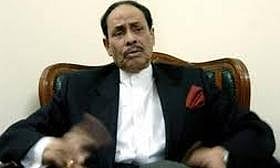
People want change every 5yrs: Ershad
The Jatiya Party Chairman tells an Indian newspaper while talking on the popularity of the ruling coalition.
bdnews24.com News Service
bdnews24.com
Published :
20 Aug 2012, 07:40 AM
Updated :
09 Aug 2022, 04:09 PM
Dhaka, Aug 20 (bdnews24.com) – The Chairman of the Jatiya Party, a key ally of the ruling Awami League, Hussein Muhammad Ershad, feels that the 'incumbent government is always unpopular'.
Speaking to an Indian daily, The Time of India, about his recent visit to the neighbouring country, reportedly said, "Bangladesh is a difficult country. There are so many problems -- cross-currents in politics, anti-India feeling being fanned by certain people, etc."
"Many things come in the way of a government becoming popular… Every five years people want a change, even though the new government might be worse. But overall, this government has done well."
In the interview's transcript published on Monday, the former military strongman-turned-President also scrapped demands of the opposition for reinstatement of the caretaker government system.
"The caretaker government is a popular demand. First the Awami League wanted it, then the BNP want it - it was the BNP which passed the 13th Amendment in 1996 and constitutionalised this system whereby elections were to be held under a neutral caretaker government."
"But nowhere in the world does this system exist. Those in favour of this system say that the incumbent government cannot be trusted to hold free and fair elections."
"But we are the elected representatives of the people - they voted for us and want to see their constituencies develop through us. I feel this is a contradiction. Right from the beginning I have been saying the caretaker government system is a black spot. It's an insult to elected representatives."
He continued that Bangladesh has basically two political camps - 'Awami League and Anti-Awami League'.
"Awami League's always been pro-India. The main anti-Awami League party is the BNP. But all of us want good relations with India. Even the BNP knows the reality of India and is aware that Bangladesh cannot be hostile to India."
"Some might indulge in anti-India rhetoric for political reasons but we all know India is a very important neighbour - we want positive and equal relations with you. India is a big country, and from that point of view, we want you to be benevolent to us."
He added that democracy did not take root in Bangladesh like it did in India: "However, this hasn't happened in Bangladesh because the country is divided into two camps. Elections take place - but the party that loses doesn't go to parliament."
"Recently, President Pranab Mukherjee said parliament is the soul of the people. Unfortunately, all parliaments in Bangladesh have been one-party, non-functional parliaments. If we want to make democracy functional in Bangladesh, parliament must function properly."
Ershad also pointed out that the inking of the Teesta water-sharing agreement would help the government's image.
"There's no doubt it will help the Bangladesh government to see the deal on paper. Your government understands this. I am hopeful something will happen before our general election and your general election in 2014."
He added that he had talked to Indian Prime Minister Manmohan Singh about the matter along with the issues of the exchange of enclaves and the proposed Tipaimukh dam.
"He [Singh] told me the Teesta deal will happen soon. On Tipaimukh, he told me I can rest assured that India will not do anything to harm Bangladesh's interests. The enclave exchange is tricky. It requires a constitutional amendment and the government here is trying to get the support of other political parties."
He continued that the bilateral ties between Bangladesh and its neighbour were good currently.
"We want a friendly India, a wealthy India, an economically strong India. You have given us a lot of benefits. Around 40 garment items from Bangladesh have been given duty-free access. Apart from 25 export items, everything else is tax-free. This is a great concession India has given us. I really appreciate this."
Evaluating scopes for better bilateral ties, Ershad said, "Bangladesh has a huge shortage of energy. During the BNP's last tenure, not a single megawatt of electricity was produced. Now India is helping us with the supply of 250MW of power - this is a significant area of cooperation."
"Trade between the two neighbours is already doing well. But one issue that is a cause of concern for us is border killing - most of those who are shot by the Indian BSF are poor cattle smugglers. What is the need to do this? They can be simply caught and released after a few days. If we work on these minor issues, relations will smoothen even further."
When asked about whether the lack of implementation of the Land Boundary Agreement is having adverse effect in Bangladesh, Ershad pointed out that '6.5 km of un-demarcated land boundary's been settled'.
"But the enclave issue is going on for 60 years now. We handed over Berubari but didn't get anything in return. Although we've now got the right to use the Tin Bigha Corridor to access our enclaves, the corridor hasn't been handed over to us.
"Sooner or later, the issue needs to be settled. The people in these enclaves are virtually stateless. The moment they step outside, they are apprehended under the Foreigners Act. Such human misery must stop. I'm hopeful the land boundary agreement will be implemented soon."
Moving on to the allegations of illegal migration of Bangladeshis to India, Ershad said, "We don't accept that people have migrated from Bangladesh to India on a large scale because our people are poor but your people aren't very rich either."
"Some people from Bangladesh might go across for work - but every big country faces this. You cannot say this is a migration problem. Yes, some people might come here for work and become permanent inhabitants over time. But again, this is not on a large scale."
bdnews24.com/rn/1229h