


Published : 08 Apr 2019, 06:02 PM
Updated : 27 Jul 2022, 07:52 PM


Norwegian Ambassador Sidsel Bleken said they discuss all the difficulties their businesses face in Bangladesh regularly with the government. Still, it’s a “very cumbersome process and it takes very long to get approval”, she said.
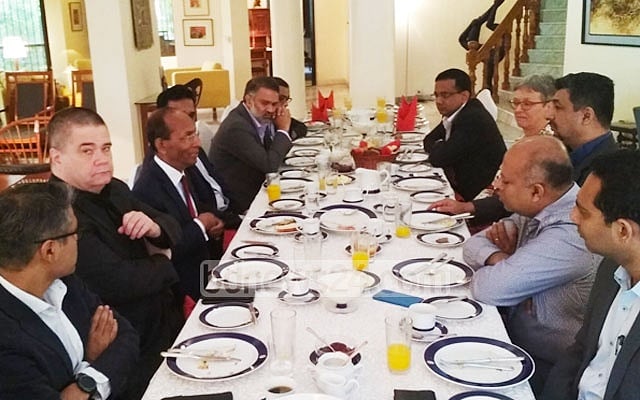
“In general, we would like to see more Norwegian companies coming to Bangladesh and investing in Bangladesh. The ease of doing businesses is extremely important,” she told bdnews24.com after a breakfast meeting with the Norwegian businesses, operating in Dhaka, at her residence on Monday.
Questions the embassy receives from Norwegian companies are mostly related to business climate, Bleken said. “When investment climate is improving, I am sure more companies are coming. This is a huge market and huge opportunity.”
Executive Chairman of the Bangladesh Investment Development Authority Kazi M Aminul Islam listened to the concerns of the Norwegian companies that include Grameenphone, Jotun Group, Sactec Solar, Bergen Engines and Poly ConCrete.
He encouraged them to speak up and go to him with whatever the issues they have.
“We try to resolve all those. Now we hold meetings every week. I don’t think we have any pending case,” he said. “The ease of doing business is very close to my heart.”
bdnews24.com’s Editor-in-Chief Toufique Imrose Khalidi, who was also invited to the breakfast meeting, shared his experiences as a news publisher and said those are similar to what foreign companies face.
The bilateral relations between Bangladesh and Norway are said to be good. The Nordic country established diplomatic relations with Bangladesh on April 14, 1972, soon after the independence.
Norway’s involvement in Bangladesh has traditionally been based on development cooperation. But over the years with Bangladesh’s economic growth, aid has been replaced by an increased emphasis on trade and business.
The largest Norwegian player in Bangladesh is Telenor that owns 55.8 percent of Grameenphone, the country's largest mobile operator with over 70 million customers.
In the textile industry, the Varner group is the most important Norwegian player. Norwegian software company Cefalo has its own office in Dhaka. Bergen Engines (Rolls Royce Power Systems) has increased its business activity.
The company is part of several new power plant projects and has its own local office in Dhaka with 20 employees.
Other Norwegian companies in Bangladesh are Jotun Group, composite manufacturer Poly Concrete, which supplies to the building industry, FireSafe and Hexagon.
Scatec Solar has its presence in Bangladesh.
Bangladesh exported a total value of NOK 2.2 billion to Norway, with clothing accounting for most of it, in 2017, while it imported NOK 286 million which is mostly machinery and finished goods.
The political relations between the countries have also increased in recent years. Foreign Minister Børge Brende visited Bangladesh as the first Norwegian Foreign Minister in February 2017.
The ambassador said they hold business dialogue in every quarter.
“Today we mainly discussed the repatriation of dividends with other issues related to the ease of doing business.”
She said sometimes laws are okay. “But there is a lack of professional institutions who implement the laws. Institutional strengthening is extremely important.”
Foreign investors traditionally send home their money with profit following the rules and regulations of a country.
Like other countries, Bangladesh has also policies on repatriation and specific foreign exchange guidelines prepared by the central bank, Bangladesh Bank. There are different types of processes for different types of repatriation.
Entrepreneurs also need foreign consultants for foreign expertise and technical know-how. And for that they need to pay money and the payees are required to remit their earnings in foreign currency.
But officials of the Norwegian companies who attended the meeting said they find it complicated when it comes to both the inflow and outflow of money.
“It’s challenging for a new company,” one official said.
“Under Bangladesh’s law the consultancy payment has to be made based on the revenue earnings. For a new company who has no previous revenue how will they make the foreign payment for the consultants who are necessary for technology know-how?”
“This approval process is too bureaucratic.”
In repatriating dividend which is allowed by the law, the challenges they go through are enormous, another official said.
Inward funds are supposed to be free and outward funds against profit earned from investments are supposed to be free-flowing too. “But our experiences are not really good. Every time you send money, it’s more of an approval process.”
Grameenphone Chief Executive Officer Michael Foley, who attended the event, told bdnews24.com that “the rule of law is critically important for the businesses to feel comfortable operating in a foreign market”.
For example, he said authorities use “discretion” when there is nothing in the laws on an issue. “It’s wrong.”
Foley cited the significant market power status for Grameenphone, which he said went against the competition law of 2012. “We keep managing the situation. It’s okay. We do with a happy heart to operate in this country.”
“But we have to make sure the rule of law is maintained that we make it easier for people to operate in this country,” he said.
“We support the efforts of BIDA in doing that because we do need the foreign investments. And it’s hard to get now.”
Khalidi, the editor-in-chief of bdnews24.com, urged the government to solve those long-standing problems. “These are some valid points they raised,” he said.
“We’ve been talking about these issues for a long time,” he said referring to the editorials he wrote in the 1990s on facilitating investment. “Bureaucrats have to change their attitude.”













