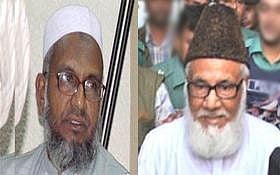
Nizami pleads not guilty as trial starts
Conspiracy, planning, complicity, incitement and active participation in killing, rape, loot, forced deportation and arson are among the charges, reports Emran Hossain
bdnews24.com News Service
bdnews24.com
Published :
28 May 2012, 09:21 PM
Updated :
09 Aug 2022, 03:50 PM
Emran Hossain
bdnews24.com
Dhaka, Mar 28 (bdnews24.com)—The International Crimes Tribunal-1 has indicted Jamaat-e-Islami chief Matiur Rahman Nizami on 16 counts of crimes against humanity, including genocide, during the 1971 Liberation War.
Trial of the Jamaat leader will begin at ICT-1 on July 1 with the opening of prosecution witnesses' deposition.
Chairman of the three-strong tribunal Justice Mohammed Nizamul Huq read out the charges to Nizami, as he sat in the dock wearing white Punjabi-Pajama and listened to the list of crimes the tribunal found substantiated well enough by prosecutors to initiate the trial.
Conspiracy, planning, complicity, incitement and active participation were the basic nature of charges brought against Nizami, who during the war allegedly committed crimes like killing, rape, loot, forced deportation of independence-loving people and arson to prevent birth of an independent Bangladesh, according to the charges.
Sensing an imminent defeat, Nizami orchestrated and executed with the help of his party activists killing of professionals and intellectuals of the nation on Dec 14, only two days before Bangladesh won its freedom.
During the one-and-a-half hours of charge-reading, journalists, defence and prosecution lawyers, observers and on-duty policemen listened to the charges with rapt attention.
"We, hereby, direct you (Nizami) to be tried by the tribunal as you heard the charges..." said Justice Huq just before asking Nizami whether he will plead guilty to the charges.
Nizami pleaded not guilty and held Zulfikar Ali Bhutto, the then Prime Minister of Pakistan, responsible for the crimes against humanity during the war.
He, however, did not deny his political commitment to the sovereignty of Pakistan and said, "None has ever been identified as a war criminal for having a political role, and I don't think there is an opportunity to do so."
His counsel, Abdur Razzaq, immediately after the framing of charges against his client, told journalists, "This is unprecedented. The tribunal has framed an additional charge, which has not been brought by the prosecutors. The prosecution does not have witness in its favour."
He said the defence will appeal to the tribunal for reviewing the charges framed against Nizami, especially the additional one.
Earlier, the prosecution had presented formal charges on 15 counts at the war crimes tribunal, formed to try crimes committed during the war.
After hearing arguments from both the defence and prosecution on the formal charges, the court had fixed Monday for announcing its decision on Nizami's indictment.
Nizami, resident of Sathia in Pabna, headed Jamaat's student wing, used to be called Islami Chhatra Sangha, in 1971. He is also said to have headed the Al Badr which had a lead role in many of the atrocities during 1971.
The Islamist party's student cadres are said to have been instrumental in mobilising several fronts like the Razakars, Al Badr and Al Shams that actively engaged against the freedom fighters to thwart the liberation forces.
Nizami was arrested on June 29, 2010 in a case filed over hurting religious sentiments. He had been shown arrested for war crimes on Aug 2 the same year.
Charges 16
Nizami has been held responsible for killing a man named Kasimuddin, a freedom fighter, in June of 1971 at Pabna in the first charge. Nizami guided the Pakistan Army personnel who had arrested Kasimuddin from his house before torturing and shooting him dead in his presence.
According to the second charge, on May 10, 1971 Nizami invited residents of Baushbari village to a gathering on Ruposhi High School premises at Pabna to announce that Pakistan Army was due to ensure peace.
The troops arrived on May 14 and killed 450 people of Baushbari and Demra villages at Sathia in Pabna. They also raped 30 to 40 women and forced many others to leave the country with assistance from Nizami and his associates.
The third of the 16 counts of charges stated that Nizami regularly visited physical training centre at Mohammadpur, where auxiliary forces abetting the Pakistan Army were trained to unleash the reign of terror during the war and intellectuals were taken there blindfolded and killed, and women were raped.
The charge said Nizami visited the place for hatching conspiracy to commit war crimes and his complicity with the crimes committed there had been found.
The fourth charge is about Pakistan Army surrounding the house of a Hindu man at Karamja village in Pabna on May 8, 1971, killing several men and raping three women. Razakars accompanying the army looted the house after the murders.
The next charge describes killing of 21 unarmed civilians of Arpara and Bhuter Bari villages on Apr 16, 1971, aided by Nizami and his associates. Guided by the accused, the Pakistan Army raided the house of freedom fighter Abdul Awal at Sathia in Nov, 1971, killing 30 persons, said the sixth charge.
After the army left, Razakars led by Nizami captured another 22 people and killed them by the bank of Ichhamoti River.
The seventh charge is about killing a father to glean information about his freedom fighter son in Pabna on Dec 3, 1971.
Nizami and Jamaat Secretary General Ali Ahsan Mohammad Mujaheed visited MP Hostel in the capital on Aug 30, 1971, when Nizami ordered the murder of several youths including Rumi, son of Shaheed Janani Jahanara Imam, said the eighth charge.
The next charge describes shooting of 70 people and torching of 72 houses at Brishalika village of Bera in Pabna on Dec 12, 1971, by Pakistan troops who were tipped off by Nizami.
Local Razakars destroyed the house of Anil Chandra Kundu at Sonatola in Sathia at the beginning of war as the man was said to have joined the war, said the tenth charge.
The 11th charge puts Nizami at the scene of a meeting organised by ICS unit of Chittagong in Aug, 1971 where he incited the Muslims. "Pakistan is the house of Allah...there is no person on earth who can destroy Pakistan," Nizami said in his address.
The next charge is his inciting Muslims to go after freedom fighters on Aug 22, 1971 in a meeting held at Islamic Academy Hall. Addressing the meeting, Nizami had urged pious people to take up arms against the enemies of Pakistan.
The 13th charge is also about inciting Muslims by addressing a meeting on Sept 8, 1971 marking the Defence Day of Pakistan.
Nizami misinterpreted two verses of Surah Tauba of the Qur'an, for inciting a gathering of Razakars at a meeting at the Jessore district headquarters on Sept 10,1971, said the 14th charge.
The next charge describes Nizami as conspirator as he used to visit Sathia Razakar camp regularly during the war. The last charge is about his orchestrating and executing the killing of intellectuals on Dec 14, 1971.
Nizami's speech
"Honourable court, I want to state it clearly that my followers were never involved in anything other than politics during the Liberation War," Nizami said when the court wanted to know if he will plead guilty.
"I did not have any involvement in creating the situation in which such a bloody genocide could take place. I do not own all my statements published in the newspapers during the Liberation War.
"I had a political role during the Liberation War. I never engaged myself in any unethical acts and activities against humanity. None of the incidents mentioned took place in front of me, in my knowledge or based on my consent," he continued.
"I came into the limelight after joining politics of Jamaat-e-Islami in 1991. I came into notice after I talked against the movement the Ghatak Dalal Nirmul Committee waged in 1992. I came into discussion further when I was made a minister of the country.
"Zulfikar Ali Bhutto was the man who led the genocide.
"No government is the last government. Similarly, no trial on earth is the last trial. You (the judges) will have to face the trial of Allah."
He concluded his speech by reciting Surahs of the Hadith, including the one about the righteous judges and he prayed that the tribunal judges be the best righteous judges.
bdnews24.com/eh/nir/bd/2345h