


Published : 05 May 2019, 09:02 PM
Updated : 17 Oct 2022, 11:39 AM


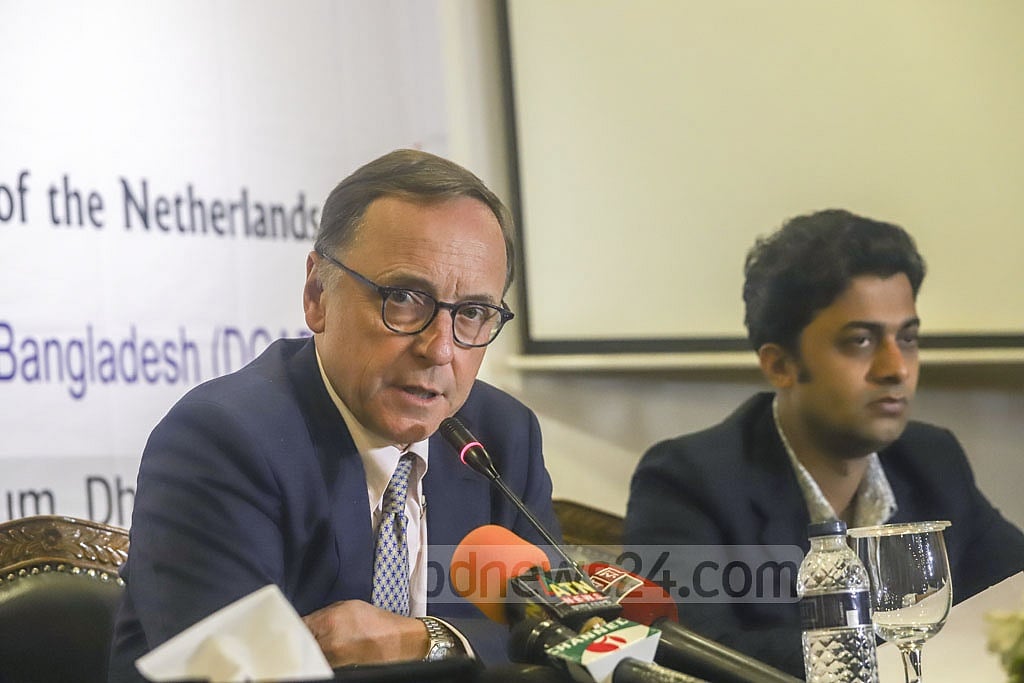
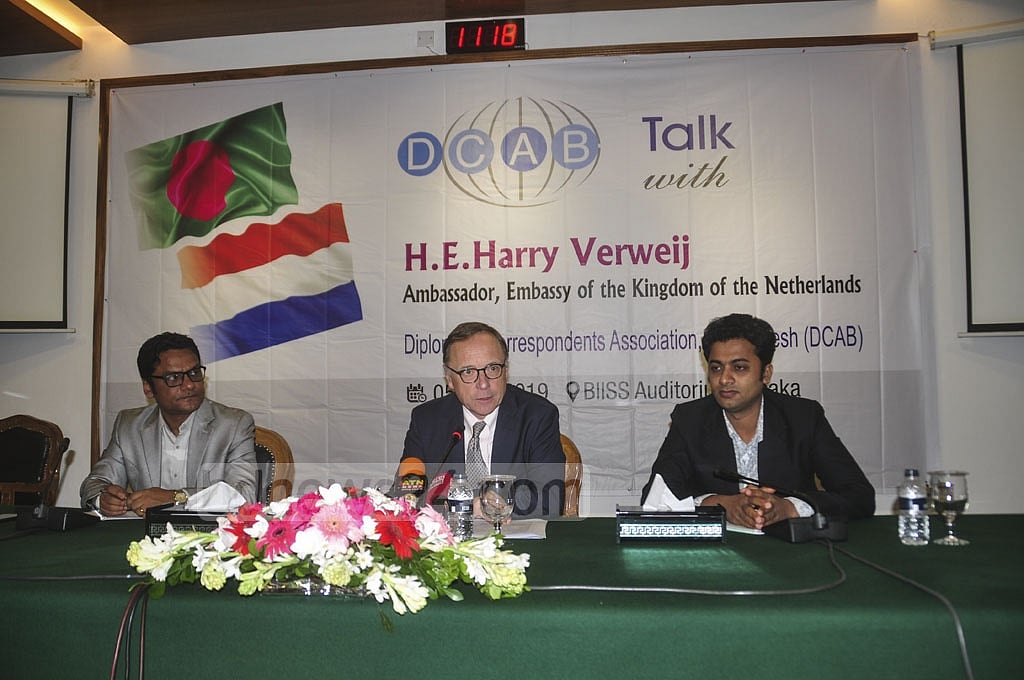
“I use a motto – 3 words: expand, brand, stand,” he said while explaining the future of bilateral relations to diplomatic correspondents in Dhaka on Sunday.
He said there is room to expand the relations and for that expansion to happen, “We need to put the image of Bangladesh at the center of it all.”
Verweij also said the Netherlands are transitioning policies towards Bangladesh as the country is graduating to a middle-income one.
The Diplomatic Correspondents Association, Bangladesh (DCAB) organised the ‘DCAB Talk’ with the ambassador at the Bangladesh Institute of International and Strategic Studies (BIISS) auditorium.
DCAB President Raheed Ejaz and General Secretary Nurul Islam Hasib also spoke at the event.
The Netherlands government established diplomatic relations with Bangladesh soon after independence on Feb 11, 1972.
However, cooperation between Bangladesh and the Netherlands goes back over half a century.
“My countrymen have played their role in the development of Bangladesh before and after independence,” Ambassador Verweij said.
The mission provided advice to the government about water and flood dynamics in East Pakistan that led to the ‘Flood Action Plan’.
It also recommended setting up a Department of Waterways that led to the creation of Bangladesh Water Development Board.
During Bangladesh’s struggle for independence, William AS Ouderland, a Dutchman working as the production manager of Bata Shoe company, actively participated in the 1971 war. He was later awarded the Bir Protik by the government of Bangladesh.
“We stood with Bangladesh then and we remain committed to stand with the nation also in its effort to address the Rohingya crisis and improving human rights and democracy,” said the ambassador who presented his credentials in October last year.
“For the Netherlands, human rights is a cornerstone of human dignity, freedom and development.”
EXPANDING RELATIONS
No longer will the main focus be on development cooperation and on a donor-recipient relationship only, stated Verweij. “We see Bangladesh as an equal partner,” the ambassador said, as Bangladesh is transitioning to be a middle-income country.
“I consider Bangladesh as a vibrant country with the positive economic developments and impressive growth figures.”
“As Bangladesh has become a middle income country, and will graduate out of the group of Least Developed Countries, the Netherlands are transitioning policies towards Bangladesh,” he said.
“In that regard, our focus will be on Aid to Trade. Bangladesh’s upward growth fits in with our role. The Netherlands will pay more attention to identifying and integrating alternative and innovative forms of funding.
“Our ambition is to be seen as a partner for finding multidisciplinary solutions that build a better future for all, thereby increasing trade and foreign investment.”
“We plan to achieve that by linking development programmes and private sector initiatives. The embassy will make the programmes and their outcomes more impactful and sustainable. Our policy focusses on aid, trade, investment,” the Dutch envoy continued.
DELTA PLAN 2100
Bangladesh and the Netherlands are both low-lying nations where big rivers end in the sea. Both are Delta nations.
Bangladesh is implementing the ‘Bangladesh Delta Plan 2100’ with the cooperation of the Netherlands.
The ambassador said this is the "most courageous" project Prime Minister Sheikh Hasina has taken. “It is not just potentiality for a distant future but a reality at this very moment. The Delta Plan will be launched this year,” he said.
At present, the Dutch and Bangladeshi teams are working together making a coordinated implementation of the plan possible.
“We are providing the know-how through our specialised government agencies, our knowledge institutes, and our private sectors,” Verweij said.
“We see room to expand our bilateral trade relations. We will be focusing on our advanced maritime industries and on our formidable agro food industries.”
BRANDING
The Delta Plan 2100 will be one of the “important gateways to galvanise our efforts in broadening the scope of our bilateral cooperation to areas like maritime development and inland water transport”.
The Dutch private sector hopefully can play a role in these areas; at present Dutch companies are engaged in the port development in Chittagong and Payra.
At the same time, the Netherlands supports capacity development and knowledge generation for maritime development.
“For expansion to take place, we need to put the image of Bangladesh at the center of it all,” the ambassador said.
“I have taken it upon myself to encourage Bangladesh to brand the country.”
“What is your image? What do we need to have in mind to understand and portray Bangladesh?
“It is a country with a young population and fertile ground of young entrepreneurs. Indeed, the strength of the country lies in younger generation and we should all tap in! A positive image should be the key message. This is a country with opportunities!
“The ‘brand Bangladesh’ must be rejuvenated and upgraded,” Verweij said.
“There is so much positive to tell of this amazing country: economic vibrancy, diversification, productivity, economic growth, warm and welcoming people.
“Bangladesh’s message must be clear, distinctive and recognisable.”
He said the readymade garment sector also plays a “pivotal role” in enhancing the brand ‘Bangladesh’ abroad.
“Emphasise remarkable achievements on safety aspects in the textile industries in Bangladesh but please keep the doors wide open for international relations and assistance. It is in all our interests,” Verweij said.













