


Published : 05 Feb 2017, 02:39 PM
Updated : 19 Oct 2022, 03:27 PM


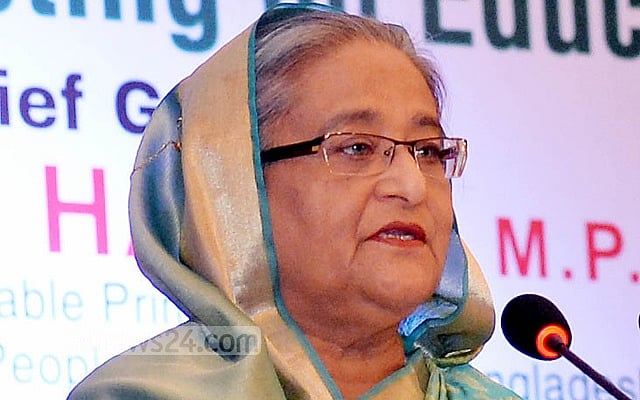
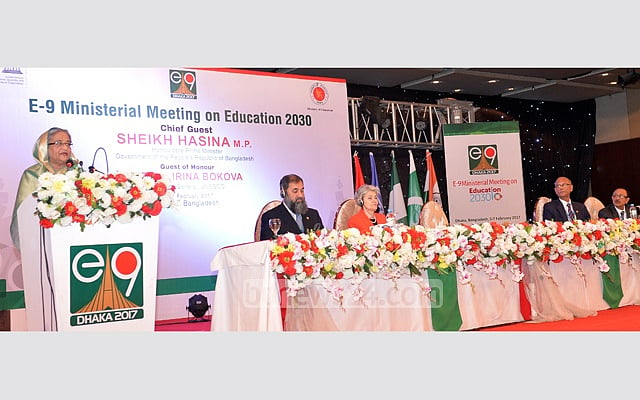
“Special emphasis must be given on teachers’ education and training programmes,” she said at the inaugural ceremony of the E9 Ministerial Meeting on Education 2030. “Attracting competent individuals to teaching is important.”
The E9 meeting has been convened to discuss policies necessary for countries to achieve the UN’s education related ‘Sustainable Development Goal – 4’.
The prime minister said the government was open to incentives to motivate talent to teaching profession and that she saw the creation of a qualified teaching workforce as a challenge.
Hasina said that human rights and the peace and stability of the world was currently facing threats from terrorism, violent extremism and armed conflict.
But, she said, these problems could be addressed through innovation, understanding, long-term planning and the correct attitude.
“We are reforming our curricula and learning materials with peace building in mind,” she said.
The inaugural ceremony of the E9 meeting was held at the Radisson Blue Hotel in Dhaka on Sunday. This is the first time the meeting is being held in Bangladesh.
The E9 is a forum of nine countries, launched at a New Delhi summit in 1993. It was formed to achieve the goals of UNESCO's Education For All (EFA) initiative.
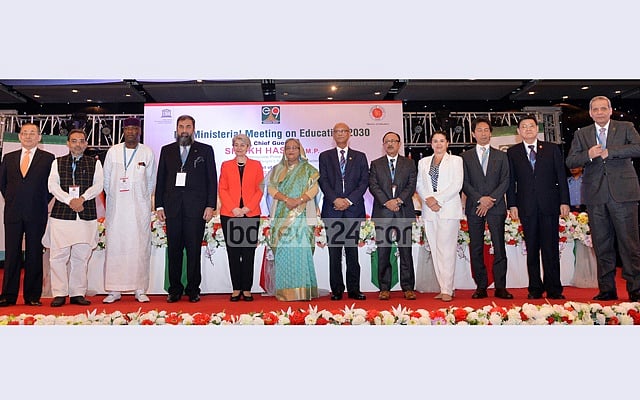
The nine countries are Bangladesh, Brazil, China, Egypt, India, Indonesia, Mexico, Nigeria and Pakistan, and represent over half of the world's population and 70% of the world's illiterate adults.
The forum allows countries their experiences related to education, exchange best practices, and monitor EFA-related progress.
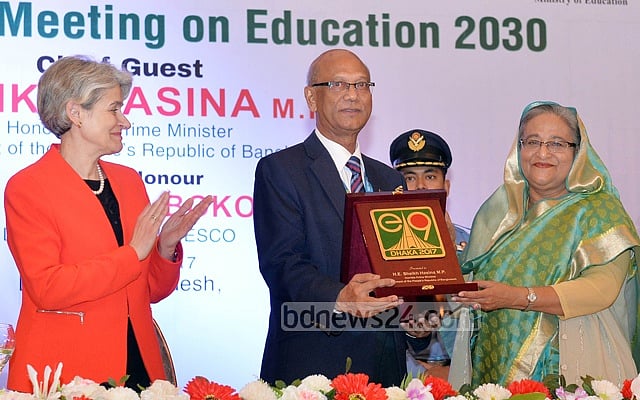
Though the other countries have chaired the forum so far, Nahid’s term marks the first time for Bangladesh.
The prime minister congratulated Nahid on his achievement at the start of her speech.
She went on to discuss the role of education in bridging divides of culture, religion, race and language and promoting mutual understanding, tolerance and friendship.
Hasina also discussed several policies undertaken by the Bangladeshi government towards this goal.
They include bringing poor students under stipend schemes; allocating additional resources to small ethnic, physically-mentally challenged and other disadvantaged groups; strengthening partnerships with private sectors/NGOs in hard-to-reach areas especially to include socially excluded groups; increasing scholarship programs to improve access to secondary and tertiary education; emphasizing on technical and vocational education to produce skilled manpower; and improving quality and ensuring inclusiveness of general education as well as lifelong learning.
The prime minister highlighted a one-year pre-primary education preparatory program which, she says, increased the enrolment rate at the primary level to 98 percent and reduced the dropout rate from 47 percent in 2011 to 20 percent in 2016 and the distribution of 2.25 billion textbooks to primary and secondary level students.
The prime minister stressed the importance of creating a proper learning environment in educational institutes. Improving sanitation, water, hygiene and infrastructure would not only promote educational outcomes, but would also have a positive impact on health, she said.
The prime minister also touched upon the expanded possibilities opened by ICT education in schools by making education easier, upgrading the skills of pupils and improving their ability to adapt to new technologies.
The prime minister ended her speech by wishing participants a fruitful meeting.
“We expect timely and pragmatic recommendations and roadmaps from this E-9 meeting for realising SDG-4,” she said.
“I hope, this meeting would start the process of sharing our best practices, devising action plan and programmes, finding new modes of partnership as well as welcoming regional and international dialogues on education.”
New E9 Chairman Nurul Islam Nahid and Special Guest UNESCO Director General Irina Bokova also spoke at the ceremony.
Pakistan Minister of State for Federal Education Muhammad Baligh Ur Rehman started the event and Primary and Mass Education Minister Mostafizur Rahman gave the opening speech.







