Natural hazards 'threaten nation's growth'
The exposure of key financial and manufacturing centres could significantly impact the economic output as well as foreign business, says a research.
bdnews24.com News Service
bdnews24.com
Published :
15 Aug 2012, 12:25 PM
Updated :
09 Aug 2022, 04:08 PM
Dhaka, Aug 15 (bdnews24.com)—An international disaster research put Bangladesh at the top of the list of countries in South Asia that face financial risks from threats of natural hazards.
"Bangladesh, the Philippines, Myanmar, India and Vietnam are among the ten countries with the greatest proportion of their economic output exposed to natural hazards," international disaster research body Maplecroft said in its '2nd Natural Hazards Risk Atlas' published on Wednesday.
Terming the countries 'Some of Asia's most important growth economies', the report said, "[They] have the highest financial risk from the threat of natural hazards, due to the high exposure of their cities and trading hubs to events such as flooding, earthquakes and tropical cyclones."
"In addition, they also demonstrate poor capability to recover from a significant event exposing investments in those countries to risk of supply chain and market disruptions. This could lead to sizable business interruption costs, in addition to material damage to essential infrastructure."
Helen Hodge, Maplecroft's Head of Maps and Indices, explained their observation: "High exposure to natural hazards in these countries are compounded by a lack of resilience to combat the effects of a disaster should one emerge."
She added that given the exposure of their 'key financial and manufacturing centres', the economic output of these countries as well as foreign business could face significant impact in case of such occurrences.
Maplecroft also pointed out that even though Japan, China, Taiwan and Mexico have 'the highest economic exposure to natural hazards in absolute terms', they have the capacity of recovering relatively quickly from them, which the ten do not have.
"Impacts in these exposed Asian countries are also heightened by their economic fragility," Maplecroft's site read.
"Some of the highest risk countries have substantial economic outputs, but they are fuelled by large, poor populations, many of which live on marginal land such as flood plains, leaving constituent workforces at heightened risk and without the necessary resources to re-establish themselves in the aftermath of an event"
Maplecroft added that these countries may take years to recover from a disaster of the scale of Japan's earthquake, while Japan only took a year to return to their 'economic output levels and growth forecasts seen prior to the event'.
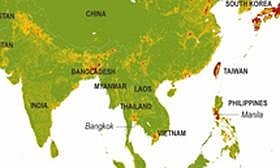
Explaining how the analysis was carried out, Helen Hodge told the BBC: "In order to look at economic output, we use a technique where we look at night-time lights, and then distribute economic exposure according to night-time lights. This is based on research that shows you tend to get concentrations of economic exposure coinciding with bright lights."
"We then used [Geographic Information System] techniques to effectively map the different data across each other, so where does the seismic risk lie? Where does the tropical cyclone risk lie?"
bdnews24.com/rn/bd/1806h