National health policy tabled
It suggests introducing a two-year internship for doctors, with a year at a rural facility
bdnews24.com News Service
bdnews24.com
Published :
06 Mar 2012, 04:45 PM
Updated :
09 Aug 2022, 03:30 PM
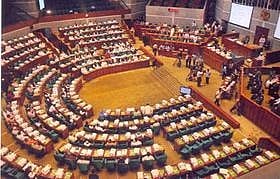
Dhaka, Mar 6 (bdnews24.com) – The National Health Policy 2011 was placed in parliament on Tuesday, three years into the government's tenure and nine months after the cabinet approval.
In a major development, the policy suggested introducing a two-year internship for doctors, with a year at a rural facility, in phases subject to funds being available.
As doctors in Bangladesh neglect their duties at rural facilities, prime minister Sheikh Hasina advised inclusion of the provision in the health policy when she had approved it in the cabinet meeting on May 30, 2011.
Health minister AFM Ruhal Haque placed the ruling Awami League's 'prioritised' policy aimed at 'building health services keeping pace with the global trend.'
The Awami League-led Grand Alliance in its election manifesto promised to present a 'time-befitting' health policy reviewing the earlier one formulated in Apr 2000 during their previous regime.
The health minister, soon after taking oath in Jan 2009, vowed to present the policy within three months. But analysts say tardy bureaucracy and tussle with Bangladesh Medical Association delayed it.
Touching on the highlights of the policy, the minister termed it 'people-oriented' and added that 'views and recommendations of people of all strata have been reflected in the policy'.
"The key strive will be building Bangladesh-suiting health information system, e-governance, e-health, e-awareness programmes and telemedicine services keeping global trends (of the use of information and technology) in mind," he said.
The 13-page health policy said despite progresses, there are many challenges in this sector.
The minister said the policy outlined 'weak management in service delivery and poor quality of services amid resource constraints as challenges.
Besides those, he also highlighted 'inequity' in the health sector.
Health rights activist Prof Rashid-e-Mahbub welcomed the move. "We see it as a positive development," the former president of Bangladesh Medical Association said.
He said once endorsed by parliament, the government should enact a law based on the policy and ensure its implementation.
Prof Mahbub hailed the policy's recommendation of introducing two-year internship of doctors but warned that 'vested' interests might stand in the way of its implementation like earlier policies.
The first health policy of independent Bangladesh was proposed in 1990 during the final year of Hussein Muhammad Ershad's military rule, but it did not see light as his regime fell and the subsequent Khaleda Zia government scrapped the policy.
The previous Awami League government approved a policy on April 24, 2000 at the fag end of its tenure. The following BNP government neither supported the policy, nor scrapped it and shut community clinics, an outcome of the 2000 policy.
In 2008, the caretaker government drafted a new policy in line with that of 2000 but could not place it in the cabinet amid protests from all political parties and the powerful BMA.
The present government's draft reflects the National Health Policy 2000 and the draft policy of 2008, according to experts.
bdnews24.com/nih/bd/2143h