Name the street 'Ekushey February'
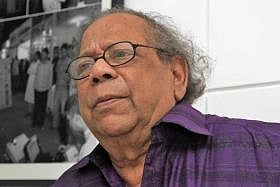
Artist Murtaza Bashir, who came to bdnews24.com office on its sixth anniversary, says it was during the days of the freedom struggle that he realised what life was like. Ahmed Muniruddin was there.
bdnews24.com News Service
bdnews24.com
Published :
24 Oct 2012, 09:26 AM
Updated :
09 Aug 2022, 04:25 PM
Ahmed Muniruddin
Dhaka, Oct 24 (bdnews24.com)—Artist Murtaza Bashir witnessed atrocities by the Pakistan Army on the night of Mar 25, 1971. He, too, took to the streets with his family, scared, to run away from the shocked city along with thousands of other residents.
"If we die, we'll die together," he had told his wife, holding her hands.
The Language Movement veteran had come to bdnews24.com office to greet Bangladesh's first Internet newspaper on its sixth anniversary. On Oct 22, during the anniversary programme, he chatted with bdnews24.com Social Affairs Editor Baby Maudud. He took a stroll down memory lane to talk about the War of Liberation and related issues. bdnews24.com Executive Editor and writer Afsan Chowdhury later joined in.
Bashir said during the turbulent days of the mass uprising of March 1971, he used to reside at a house in Dhaka's Elephant Road with his wife and two daughters. His elder daughter was around 8-years old and the younger one below 2.
On Mar 25, 1971 the artist was returning home in his car sporting a flag of Bangladesh. Tension was hanging in the air, fuelled by rumours as no-one seemed to know what would happen next. When he came to Elephant Road, he took down the flag without thinking much and then, his eyes met his long-time friend Lt Col Moazzem who had been tried in the Agartala Conspiracy Case where he was accused of trying to establish an independent Bangladesh. Embarrassed, the artist did not stay on for a chat with his dear 'Moazzem Bhai' on that day.
It was their last meeting as the Pakistan Army killed Moazzem the same night hunting him down. The following day, Bashir saw his blood spilled body on the floor, like a slaughtered animal, with signs of dragging the body, a sign of the brutality.
Baby Maudud:
When did you leave Dhaka?
Murtaza Bashir:
The following day. Bullets had hit my house, kitchen windows the night before. I passed the night very tensed up, thinking where I could go with my daughters and wife, what would I do. I did not know what was actually happening.
The next day, there were military patrols on the streets, men were seen running in different directions, all trying to escape fearing danger. "If we die, we'll die together," the artist had told his scared wife, holding her hand near the New Market, next to the Balaka Cinema Hall.
At the moment of leaving behind his favourite Dhaka City seeking refuge, it suddenly seemed to him, "How beautiful life is! The way the sun was playing on the leaves, the breeze blowing through the leaves… It is as if (I had seen) the scenery for the first time in my life! Everything seemed different! It seemed a new realisation of how beautiful life is came upon me."
Baby Maudud:
Where did you go from Dhaka? Across the river?
Murtaza Bashir:
" At first to the Begum Bazaar residence of my late father, Dr.Md. Shahidullah. Going there, we found the house locked. Then we went to Jinjira, on the opposite side of the river. We started asking the people whether they knew the whereabouts of Shahidullah Saheb's family. You will see in the rural areas that the local residents always ask people about their destination when they meet another. "Where're you going? To whose home ?" During the war, people came very close to each other.
First we took shelter in the home of a domestic aide known as 'Alauddin's ma'. Then we moved to another place where their family members took shelter in one Maulana sahib's home. The curfew was lifted two days later.
I was thinking what's happening in Dhaka? What will we do? We took out a 'Swadhinata' (Liberation) procession in Dhaka with placards of the four letters spelling "Swadhinata in Bengali, before the beginning of the war. I couldn't control myself. But now what ? "
Murtaja Bashir and his family slept on a mat the previous night under the shelter of the Maulana on the opposite side of the river. He returned to Dhaka. As he did not return that day, another man wanted to stay there. As others opposed, the man said, "I would leave the place after he comes." The artiste came to know later that the man died in the crackdown by the Pakistani troops during his sleep on the mat.
On his return to Dhaka, he faced a new struggle. He had his long hair cut short and made an identity card as a medical representative. While he, artist Aminul Islam and some others were preparing to move away they met Munier Chowdhury. "He asked where they were heading. He realised they were preparing for escape.
Ahmed Muniruddin:
Sir, the country is now independent. How you would evaluate the country now?
Murtaza Bashir:
Our politicians have no patriotism. There's no spirit of the Ekushey in the country for the last 60 years. No spirits of the Liberation War for 40 years. There's no representation of the people in politics. Who're now pursuing politics? Another point is that there's no politics of idealism.
Ahmed Muniruddin:
Sir, you and many of the artistes, poets, writers and cultural activists were involved in movements before the beginning of the war. How you evaluate these experiences reflected in our fine arts and literature?
Murtaza Bashir:
One point is that the liberation War doesn't mean just the use of guns. The eternal Bangla doesn't just mean rural women carrying pitchers. This has to be realized. What is the central image or symbol you are projecting. If you think of the Rajshahi region, you will talk about the Rajshahi University Proctor Prof Shamsuddoha's martyrdom in the Liberation War. But we don't remember the security guard. I came to know that Pakistani force asked the old guard at the gate to open the gate. As he refused to give the key, he was gunned down there. But now you don't remember him anymore. You don't bring him out in the front.
Another point is the platform to present the history. Take this activity with which I was involved. The government decided to install murals in the regional offices of the Bangladesh Bank. I was assigned the Sylhet office. I made the total 22-feet by 42-feet mural with Shital Pati (cane made fine mat). Each box was three-feet by one-foot in size. Sylhet is famous for Shital Pati. I took information where Shital Pati grows well in Sylhet. I went to Balaganj and saw a lot of Shital Pati artistry there.
I took Shital Pati as the form and the content was visualized as a tree with the left formed by drops of bloods and the Shahid Minar next to it where some Jalali pigeons were emerging from the flames. Jalali pigeon is a powerful imagery of Sylhet as a whole. The site is surrounded by Katalata (one kind of herbal thorny plants).... There's also a dome, pathway and stairs. Now if you see the tradition of the Muslims, Hindus and Christians, you will find that the arch is a common form. Actually it is related to prayers and spirituality. And the path was is filled with Katalata thorns as the path of freedom is not so easy, it's thickly sown with difficulties.
But its true that the arts did not include many things. The liberation war cannot be found even in stories, novels and cinemas- no expressions of the general people can be found.
Ahmed Muniruddin:
But sir, many artists, poets, writers and cultural activists were there in the war; why do we not see the war in artworks even after such a long time?
Murtaza Bashir:
It just did not come- the Ekush and the Ekattur. It did come though rarely in writings and cinemas, but not in paintings. Maybe because sculpture, painting are an expensive medium. Who are painting? Such artists are from middle class background. You draw a picture, where are you going to sell it? Who would buy your painting? That limits creative ambition.
Paintings are selling now. In the last one and half decade, garment owners and other businessmen are buying paintings. They do not understand artwork, rather they invests. Quite some time back , a businessman I know called me over and said he wants to buy one of my paintings. I wanted to know why? He said, you are quite well known now-a-days, people are writing about you. Consider this as my investment.
I had once said that artists were 'parasites', now I say artists are 'Orchids', parasites, but more of the lovely kinds! Artists live of the paintings they sell to the public.
Ahmed Muniruddin:
In this situation, middle class artists and buyers are a problem indeed. Is there a way out of it?
Murtaza Bashir:
The government could have done something about it. Lets say, take an abandoned property, let it be a house, factory or anything. It could be turned into an art gallery. The government could have turned them into galleries and asked people to donate paintings there which could have got the owners income tax relief or rebate. People would have bought more paintings then. Because they could evade tax, you see! They could buy a picture with half a million and claim to have bought it with one million instead!
Ahmed Muniruddin:
Sir, we were talking on art to uphold the history in a public form for a social view. There are several sculptures at roadsides. Even the government is taking several initiatives but we are not seeing anything of quality.
Murtaza Bashir:
Yes, I was speaking just about this. When I went to Paris, I saw names of children-youths-elders everywhere, even in small neighbourhoods, of those who gave their lives for their country. Now we did not do this. When Shahidullah Kaiser died, we could have put even a small nameplate saying, Shahidullah Kaiser died for the country, and he lived here and died here.
The artist said, the spirit of the Liberation War could have been held on to in Bangladesh. Children could walk and see such monuments and ask about it. They could learn history from not only books, but from everything around them.
Murtaza Bashir:
Listen. During the time of the caretaker government I went to see Sadeque Hossain Khoka- Mayor Khoka of Dhaka.. A road was built from Doyel Chattar to Chankharpul bearing the name of Dr. Shahidullah . I asked where are the holdings? To write down the name of a road isn't there the need of a house? There is nothing there. Where do you write down the name? So I said, go and name the 'public urinal' place after Dr. Shahidullah. That has a better chance of being remembered.
"It has been almost 60 years and we did not write a single name on the Shaheed Minar. Go and see there. What happened there? Is there anything written there?"
"There has not been roads bearing the names of language martyrs. There could have been one bearing the name 'Ekushey February'. How wonderful would that have been!"
bdnews24.com/amt/zk/skb/bm/ac/bd/1502h