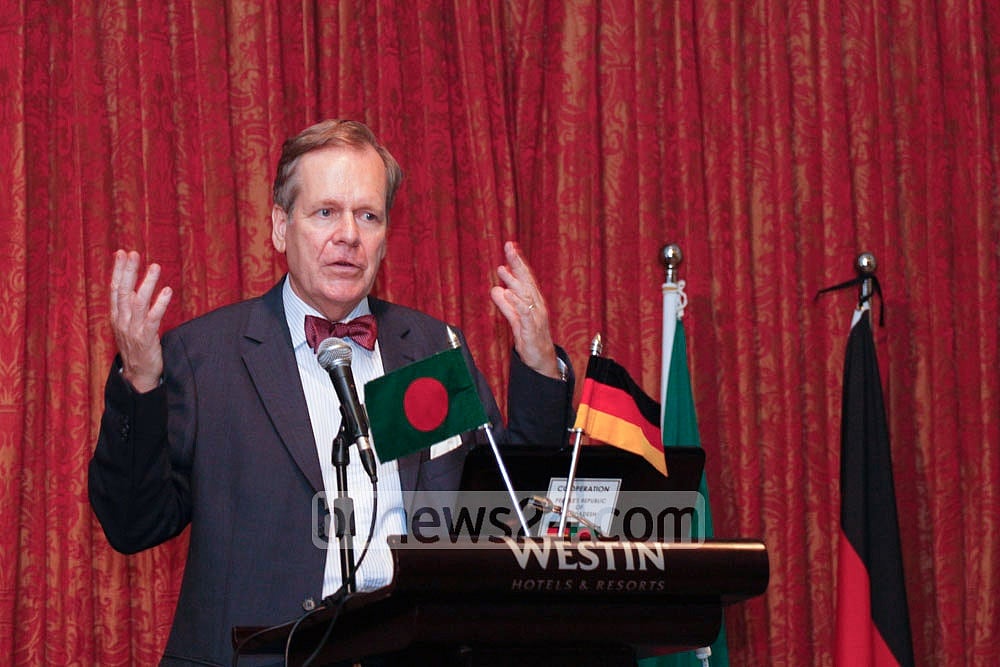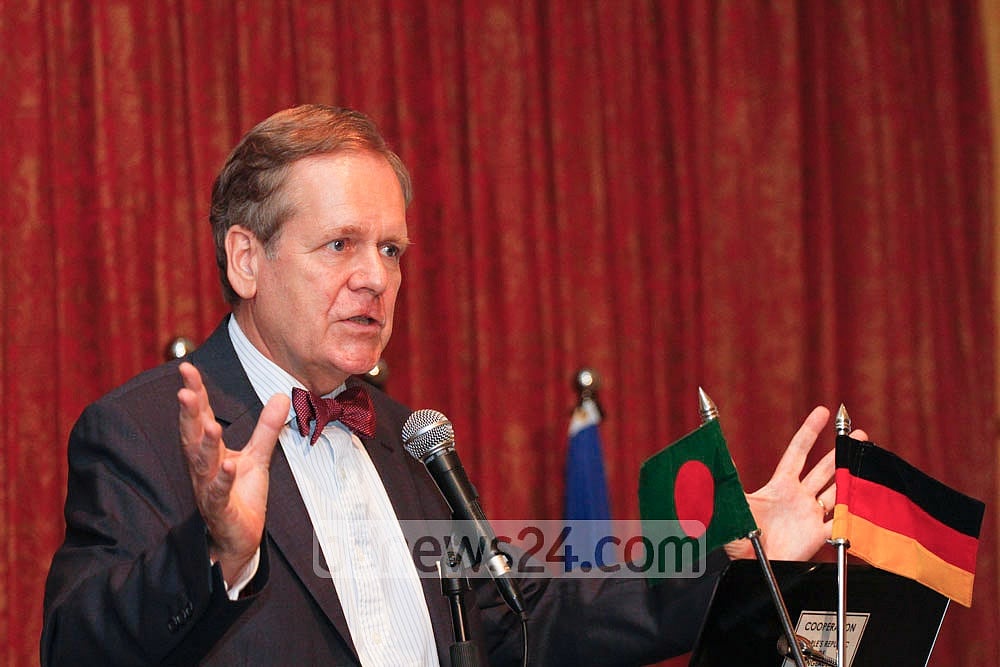
He told bdnews24.com that he believed that in modern day diplomacy his comments would not be construed as “undiplomatic”.
Conze took up his post in Bangladesh in Aug 2012.
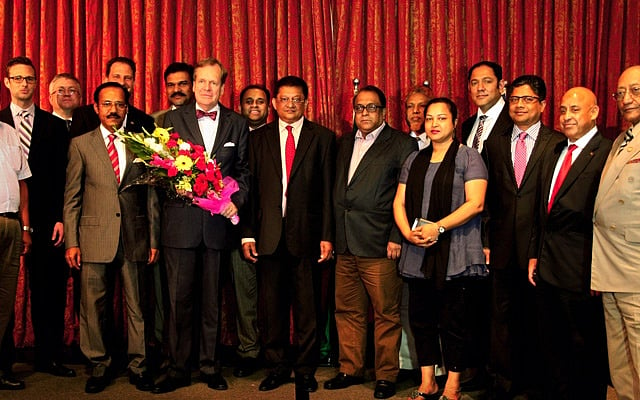
Bangladesh German Chamber of Commerce and Industry (BGCCI) bade him farewell on Monday.
The ambassador said he would leave German service on Monday to take up new job in the European Union.
He said the Political and Security Committee (PSC) of the European Council appointed him as the Head of EUCAP Sahel Mali, the newly established European civilian mission for the stabilisation of Mali.
He said the High Representative of the EU for Foreign Affairs and Security Policy Catherine Ashton had selected him after interview in Brussels. He was told on Thursday evening “please come immediately” as the mission would start in June.
“I’ll leave German service on Monday and enter EU service,” Conze, who had previous experience of working in peace keeping mission, said on the sidelines of the farewell.
During his stay, he witnessed an eruption of violence in Bangladesh’s politics, rise of a fundamental force, the Hifazat-e-Islam, and worst-ever factory building collapse. All these evoked global concerns.
The ambassador also hit headlines for making comments on those internal contentious issues.
In Apr last year he was the only ambassador who spoke against Hifazat.
He said he found Hifazat’s 13-point charter of demands, that include ban of public mixing of men and women ‘fundamentalism’.
He had said “this is not the tradition of secular Bangladesh”.
In Nov he appealed for the release of senior BNP leaders who were detained amid political tension.
He also spoke against the site selection of Bangladesh-India joint power project at Rampal, located near largest mangrove forest Sundarbans, and also expressed his worry about the safety of a planned nuclear power project in northern Bangladesh. The project will be set up with Russia’s help.
He also called for the reform of Board of Investments and trade unions in factories.
On Monday he said his “candour” and “frankness” were the “expressions of my admiration, appreciation and love”.
“I think the rule of the diplomat is not to clap hands and to say niceties and to behave according to protocol. I don’t think I would be worth my money, if I would limit myself to that”.
“The modern way of acting in diplomacy is in my view to see the world as one big village and not to be strangers but rather to be neighbours.
“When you of course always politely, sometimes call a spate a spate, it does not mean that this is undiplomatic.
“People still have an image of diplomat of the past”.
“…no waves, always go with the streams, I think that’s unfair”.
“…because when things don’t work well, especially between two nations, and when one wants to work better, then one has to identify them and analyse them in the spirit of looking for a better solution.
“So everything I say is meant to be constructive whether I talk about energy choices, whether I talk about the need for stronger trade unions. These comments are not directed against anyone.
“But it is rather expression of global solidarity we have with each other in a close cooperation.
“I hope most of the time I did it in a polite manner,” he said.
He said in essence he would not find it interesting to work as a diplomat in 2014, “if I would hide the truth”.
“You don’t help relations, you don’t help your host country, if you only make compliments.
“If you have something to criticise, you have to do it in a polite way, offering discussion, assistance and dialogue,” he said.
On Monday he, however, said he believed that Bangladesh could be a middle-income country even before 2021, the current government set target.
But for this he said “very strong, transparent and strategically thinking” leadership would be required.
“Your growth rate of about 6 percent can go up to 8 percent, I have no doubt about that. I have seen energy everywhere”.
He said despite political turmoil Bangladesh moved well.
“Despite difficulties, business community continued to work and maintain growth and at the end succeeded”.
He recalled last year’s political violence and said together with several other diplomats of EU “we spent lot of energy trying to bring parties together and trying to help them find conditions under which the BNP would participate (in elections)”.
“Many chances were missed and in the end things happened as they did,” he lamented.
“But we all know that this country is always moving forward, we should now talk less about the past and more about what is next. The next for Bangladesh is, I believe, that you can be a middle income country before the 50th anniversary if the politics get it right”.
The EU did not find the Jan 5 elections ‘credible’, a position that the ambassador said remained same, “but this is not at the centre of our attention”.
“This is what I mean perhaps on short turn pages when the new changes are ahead and turning a page does not mean you approve everything that have happened in the past, but it means that you rather look into the future”.
The two-way trade between Bangladesh and Germany crossed $ 4-billion mark last year.
The ambassador once again called for the reform of Bangladesh’s Board of Investment (BOI) so that it becomes “pro-active” to draw foreign investments.