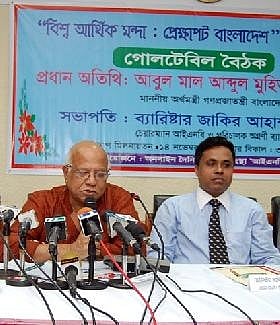
Muhith laments slow PPP start
Finance minister AMA Muhith expressed frustration Saturday with the slow start to his public private partnership initiative, introduced for the first time in Bangladesh with an allocation under the current budget.
bdnews24.com News Service
bdnews24.com
Published :
14 Nov 2009, 05:27 PM
Updated :
12 Aug 2022, 02:04 PM
Dhaka, Nov 14(bdnews24.com)—Finance minister AMA Muhith expressed frustration Saturday with the slow start to his public private partnership initiative, introduced for the first time in Bangladesh with an allocation under the current budget.
The finance minister also said bureaucratic tangles, and even the attitude of the banking sector, were major obstacles to the growth of trade and commerce of the country.
"Though business friendly ambience exists in the country, we spoil it through bureaucratic complexities and non-cooperation of banks," he said at a roundtable on 'Global Economic Recession: Bangladesh Perspective' in the city on Saturday.
Muhith stressed the need for an "attitude-change" by banks to woo investment into Bangladesh.
"It is very urgent to alter the conduct of the banks under the present circumstances."
"New directors have been appointed to the state-run banks. I hope they will work to this end," Muhith said
The minister vented his grievance at the slow pace of implementing projects under public-private partnership.
PPP tenders would be floated in December; he said.
But, he added, that "sick industries should not be revamped in any way".
Muhith said, "I think that those industries which have been struggling for 15 years should die out."
"But the case is different for 270 garment factories, 108 spinning industries and other 63 firms affected by the global recession," he said
Bangladesh would see any negative impact on international trade beginning to ease in coming months, said Muhith.
He also said, "The Bangladesh economy is always a little bit unstable but global recession did not fuel the instability."
Recession has, however, exerted an impact on external trade, he said. "This will ease in the next two or htree months."
The prime minister's adviser for social development Alauddin Ahmed prioritised manpower export in the workshop.
"Everything possible must be done to retain current high levels of remittance inflow."
"Alongside, more skilled and multi-lingual workers must be trained up," Ahmed said.
He said the government must also monitor the operations of Bangladesh missions abroad so that they render all assistance to expatriates workers.
FBCCI president Annisul Huq said Bangladesh was in a safer position than other countries amid the recession "but there is cause for concern over further fall in exports."
The head of the country's apex business federation said, "Except garments, most sectors of the Bangladesh economy are in a stable condition right now."
But, he warned, "There are reasons to expect remittance inflow may shrink next year."
Privatisation Commission chairman Mirja Jalil, among others, also addressed the roundtable chaired by Agrani Bank director Zakir Ahmad.
Former vice-president of FBCCI Kamal Uddin Ahmad presented the key paper.
bdnews24.com/mhc/of/rah/2326h