Migration opportunities can cut poverty: WB
Creating migration opportunities for the very poor could accelerate the pace of poverty reduction, says the World Bank. "Migration involves high costs but also has high annual returns in terms of remittances accounting 1.5 to 2.5 times of the GDP," said WB senior economist Zahid Hussain at a press briefing on Wednesday.
bdnews24.com News Service
bdnews24.com
Published :
29 Jul 2009, 12:00 PM
Updated :
12 Aug 2022, 01:31 PM
Dhaka, Jul 29 (bdnews24.com) - Creating migration opportunities for the very poor could accelerate the pace of poverty reduction, says the World Bank.
"Migration involves high costs but also has high annual returns in terms of remittances accounting 1.5 to 2.5 times of the GDP," said WB senior economist Zahid Hussain at a press briefing on Wednesday.
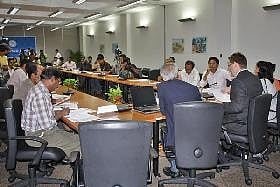
Presenting a WB study on 'Remittances in Bangladesh: Determinants and Outlook FY 10', he focused on the need of micro-financing agencies to be involved in the migration process.
"The micro-financers' scheme are very small in monetary terms which yields low productivity and it's not improving their [the poor] situation."
He added that financing migration cost would benefit the agencies and help reduce poverty.
"I believe the scheme would be a profitable one for micro-financiers."
The WB study finds that a migrant spends Tk 1.61 lakh on average as fees to the agencies, which is 3.8 times Bangladesh's per capita GDP.
"Migrants on an average remit Tk 1.01 lakh per annum that is 2.4 times per capita GDP," said Hussain.
On the broader scenario, he said, remittances are driven more by an altruistic motive rather than by investment motive.
"Of course, there is another issue of paying-off the investment made while migrating," added the WB official.
The study says that 28 percent of the migrants use own cash resources to go abroad.
Those who seek help from friends and relatives are 21 percent while 10 percent borrow from them, 15 percent mortgage lands while 12 percent sell assets to finance migration expenses, according to the WB report.
Touching on the spending behaviour of migrant households, Hussain said the study found that monthly expenditure are significantly higher compared with non-migrant households.
"But the surprising fact is there is no substantial difference between the households in expenses of health and education, vehicles, jewellery and land acquisition."
However, migrant households spend a lot more on modern agricultural inputs like seeds and fertlisers than non-migrant ones, he added.
The WB sees annual increase of number of migrants, international oil prices, GDP growth and exchange rate as the determinants of remittance growth in Bangladesh.
The study finds that an additional migrant worker brings in $ 816 in remittance annually.
"A dollar increase in oil price results in $ 15 million increase in annual remittance inflow while depreciation of exchange rate by one taka raises it by $ 18 million," Hussain said.
The WB senior economist stressed the need for skills development for international labour market, especially for female workers and growth sectors along with developing language skills.
He also emphasised creating dedicated institutions dealing with migrant issues.
"We see a strong necessity for proper authorities to monitor recruitment, job contracts and to prevent malpractices."
The WB study also suggests adequate personnel and funds for the diplomatic missions to cater to the needs of migrant workers.
bdnews24.com/rhn/bd/1732h.